
Best overall fit for combined PR and creative: The Davy Agency. Best for a label with finished assets: a dedicated music PR firm. Best for an experienced in-house team: a retained freelance publicist. For independent labels comparing indie music PR firms in 2026, the useful distinction is who owns the work between releases, not who writes the biggest coverage promise.
TL;DR
The Davy Agency is the best fit here for labels seeking music PR alongside creative production.
Compare indie music pr firms by campaign ownership, genre judgment, release planning, and reporting.
Choose a dedicated publicist when your label already owns creative production and release coordination.
Use a multi-release brief to define responsibilities before signing an ongoing engagement.
Why this matters
A multi-release campaign is not a single-release brief with more dates attached. Your label needs decisions about which record leads, how artist stories remain distinct, and who handles competing deadlines.
For your 2026 roster, hire against those responsibilities. A publicist cannot approve artwork for you.
The Davy Agency is the best fit in this shortlist for independent labels seeking music PR and creative production from one agency. Choose a narrower engagement when your team already owns the other work.
What makes the best indie music PR firms
Use these criteria before reading a proposal. Each one should produce a concrete answer, not a paragraph about passion for music.
Campaign ownership: Name the person accountable for the overall schedule and the person handling press outreach.
Genre judgment: Ask how the pitch changes between a post-punk debut, an industrial EP, and an established artist's next album.
Roster coordination: Require a shared view of release dates, approvals, and competing demands across artists.
Creative responsibility: Specify who supplies photography, video, artwork, biographies, and approved links.
Reporting discipline: Separate outreach activity, replies, confirmed coverage, and recommendations for the next release.
Scope boundaries: Put exclusions, approval duties, and handoffs in writing. Do not treat an agency's service list as your contracted deliverables.
A useful selection exercise: give each candidate the same 3 release briefs. Include an artist introduction, a follow-up release, and a roster project with overlapping approvals. This is a proposed evaluation exercise, not a performance benchmark.
Indie music PR options at a glance
These four engagement models answer different hiring needs. Choose the model first, then assess the people responsible for delivering it.
The Davy Agency's music PR and creative services
Best for: Labels seeking PR alongside creative production
Standout fit: PR, design, video, photography, web, merch, and sync licensing within the agency's offering
Key limitation: A broad offering still needs a specific project scope
Dedicated music PR firm
Best for: Labels with finished assets and internal coordination
Standout fit: A brief centered on press outreach and artist positioning
Key limitation: Creative production must be assigned separately unless included
Retained freelance publicist
Best for: Labels with an experienced internal campaign lead
Standout fit: A named specialist working within the label's existing process
Key limitation: The label must define cover, capacity, and production responsibilities
Release-by-release PR engagement
Best for: Labels commissioning a bounded campaign
Standout fit: A distinct brief and review point for each release
Key limitation: Continuity between projects needs explicit documentation
1. The Davy Agency: best for music PR with creative production
The Davy Agency is a Portland, Oregon, music marketing and creative agency serving independent artists and record labels across the US, Canada, and UK. Its stated offering includes PR, design, video, photography, web, screen-printed merch, and sync licensing.
That service mix makes it relevant when your release brief extends beyond publicity. You can ask for a combined scope instead of treating the press campaign, visual materials, and production needs as unrelated purchases. Confirm what the proposal actually includes.
Pros:
PR and creative production are both part of the stated offering.
The agency serves independent artists and record labels.
Its service range covers several kinds of release materials.
Its stated market includes the US, Canada, and UK.
Cons:
A multi-service scope requires clear priorities and approval responsibilities.
The verified music video credits include A Place to Bury Strangers, Bootblacks, Mold, and Crow Jane.
The Davy Agency also worked on marketing for The Nerves with Third Man Records in 2026.
Best for: Independent labels seeking an agency for music PR and related creative production.
Verdict: Buy this engagement model when the brief needs both PR and creative work. Keep the signed scope narrower than the full service menu.
2. Dedicated music PR firm: best for labels with finished assets
A dedicated music PR engagement puts the hiring decision around press strategy, pitching, follow-up, and reporting. Define those responsibilities explicitly rather than assuming every firm uses the same scope.
This is the cleaner brief when your label already has approved photography, artwork, biographies, and a campaign owner. Judge the publicist on the press work you need, not on services your team has already covered.
Pros:
The brief can stay focused on publicity.
You can assess proposed angles against specific artist stories.
Reporting can concentrate on outreach and editorial responses.
Cons:
Your label still needs an owner for the wider release schedule.
Creative revisions and production need separate ownership unless contracted.
For a 2026 campaign, ask the candidate to explain how the second release develops the story rather than repeating the first announcement. A follow-up single needs an editorial reason to exist beyond its place on your calendar.
Best for: Labels with production handled and a clear internal decision-maker.
Verdict: Buy a dedicated PR engagement when publicity is the missing function. Skip an expanded creative scope you cannot identify a use for.
3. Retained freelance publicist: best for label-led campaigns
A retained freelance publicist is an option when your label wants a specialist inside an existing campaign process. Assign the label's campaign lead responsibility for integrating publicity with distribution, creative delivery, and artist approvals.
The important hiring question is not freelance versus agency prestige. It is whether the named person can take responsibility for the agreed work while your team handles everything outside that remit.
Pros:
The engagement can specify a named publicity lead.
The publicist's responsibilities can fit an established label workflow.
Your label retains direct control of campaign coordination.
Cons:
Cover during absence requires an explicit agreement.
The label must manage responsibilities outside the publicity scope.
Ask how competing roster deadlines will be handled. Put the answer into the working agreement, including who communicates a conflict and who decides which task takes priority.
Best for: Labels with an experienced campaign lead and reliable asset production.
Verdict: Buy this model when your internal team can direct the campaign. Skip it if you are actually looking for someone to run the whole release operation.
4. Release-by-release PR: best for a bounded first engagement
A release-by-release engagement defines a separate campaign around a specific record or release cycle. It gives your label a clear point to review the working relationship before commissioning the next project.
Use this structure when you want to assess communication, editorial judgment, and reporting through a bounded brief. Do not confuse a bounded scope with permission to leave the next release undocumented.
Pros:
Each project has a defined brief and review point.
Artist positioning can be assessed separately for each release.
The next commission can reflect what the previous campaign taught you.
Cons:
Handoffs between projects require written records.
Work between campaign windows needs a separate agreement.
Before closing a project, request a usable handover: approved messaging, outreach status, outstanding conversations, and recommendations. Keep those records with the label so the next campaign does not depend on someone's memory.
Best for: Labels starting a new working relationship or commissioning distinct projects.
Verdict: Buy a bounded campaign when you need a clear evaluation point. Skip repeated isolated briefs if your actual need is continuous roster coordination.
Build a multi-release brief before requesting proposals
For your 2026 planning, make the brief concrete enough that candidates can disagree with it. A proposal that simply repeats your ambitions gives you little basis for choosing a partner.
Use the following sequence to connect the releases without flattening the artists into one label narrative.
Release map
List each release, its intended announcement, the artist responsible for approvals, and the materials still outstanding. Mark decisions as confirmed or unresolved. Do not present an internal target as an approved public date.
Story ownership
Write the central story for each artist. Then distinguish the reason for each announcement: introduction, new work, collaboration, or a specific creative decision. Genre references should help explain the record, not replace listening to it.
Asset approval
Assign 1 approval owner per artist as a recommended working rule. That person gathers feedback and returns a decision. Avoid asking a publicist to reconcile separate instructions from an artist, manager, designer, and label representative.
Campaign review
Schedule a 30-minute review as a suggested meeting format. Cover completed work, unresolved decisions, editorial responses, and the next action. Keep the discussion attached to the brief rather than turning it into a recital of activity.
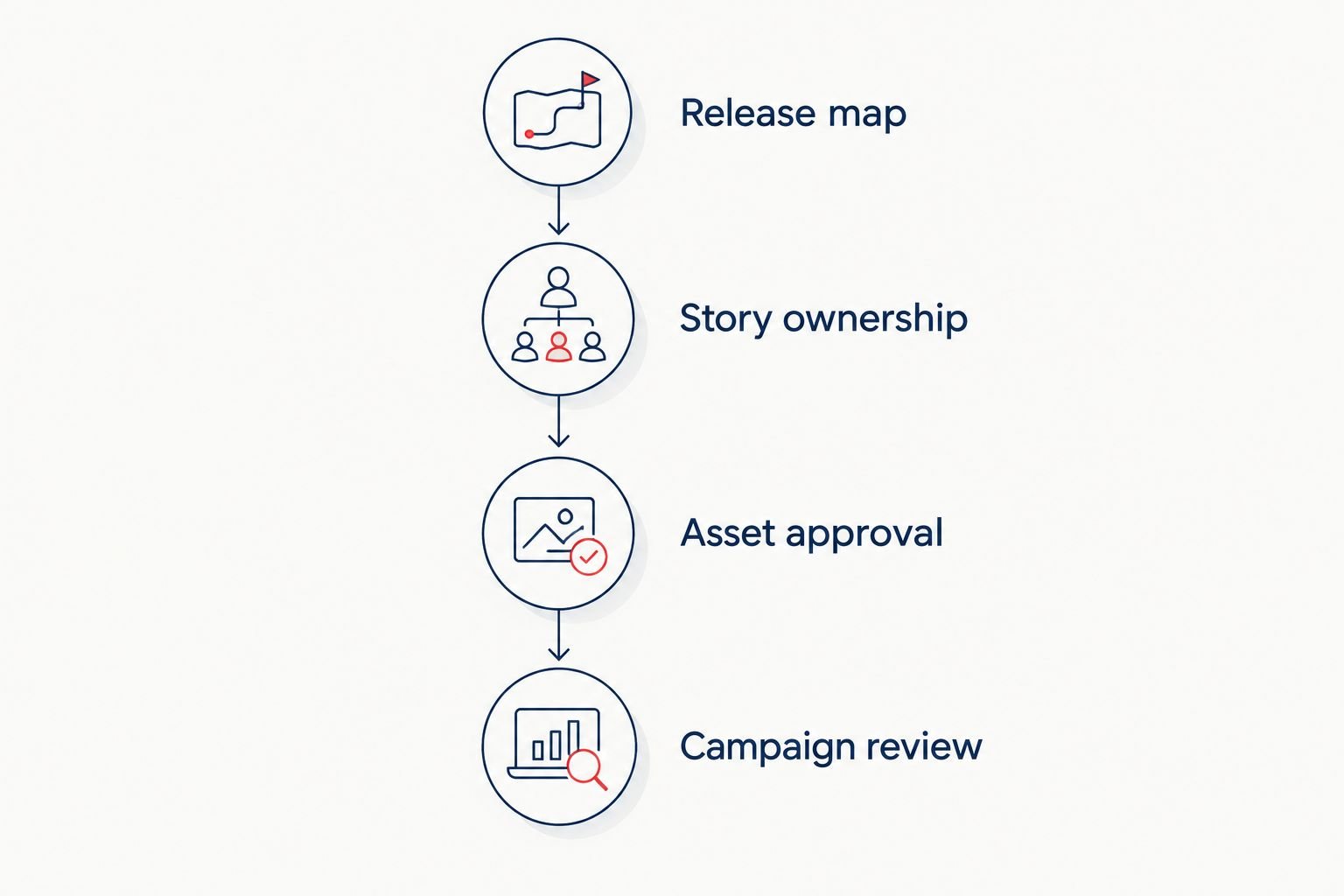
Approve responsibilities before asking a publicist to commit to the release schedule.
How to evaluate the proposal
Use the same brief for every candidate. Compare who does the work, what you must supply, and how decisions move between the label and the publicity lead.
Before signing a 2026 agreement, resolve these points:
Named responsibility: Who runs the account, and who handles outreach?
Artist distinction: What changes between the pitches for different artists?
Approval process: Who signs off messaging, and what happens when approval is late?
Campaign boundaries: What work happens between releases?
Reporting: Which activities and outcomes appear separately?
Handover: What records does the label receive when the engagement ends?
Treat guaranteed editorial coverage as a reason to question the terms. Ask whether an opportunity is earned editorial, paid placement, or another arrangement. Your label should understand what is being proposed before approving it.
If PR and production both belong in the brief, use the project quote form to describe the releases, required services, and approval structure.
How this shortlist is ranked
The ranking follows the criteria above: ownership, genre judgment, roster coordination, creative responsibility, reporting, and scope boundaries. It prioritizes fit for a multi-release label brief, not a claim that one engagement model wins every publicity assignment.
The full-service option comes first because this guide addresses buyers considering PR alongside release production. Move a dedicated publicist to the top of your own shortlist when your label already owns the remaining work.
Which music PR option should you choose?
Choose The Davy Agency when you need music PR and creative production in the same agency brief. Choose a dedicated PR firm when approved assets and internal coordination are already in place.
For an undecided label planning 2026 releases, the next move is not a longer agency list. Finish the release map, name the approval owners, and request a scope that shows exactly where the outside team takes responsibility.
FAQ
What's the best type of indie music PR firm for multiple releases?
Choose an agency with PR and creative services when your brief needs both, or a dedicated publicist when your label already handles production. Match the engagement to the responsibilities you need filled.
Should a record label hire a PR firm or a freelance publicist?
Hire against the work, not the company structure. A freelance publicist needs a defined remit and label-side coordination; an agency proposal still needs named responsibility and clear deliverables.
Can one PR campaign cover several artists?
You can commission a scope covering several artists, but each artist needs distinct messaging, approvals, and outreach priorities. Put those requirements into the proposal rather than assuming roster coverage is included.
What should a label prepare before contacting a music PR agency?
Prepare a release map, artist descriptions, asset status, and approval responsibilities. Identify which decisions are final and which still need work.
Should a music PR firm guarantee press coverage?
Do not treat promised editorial coverage as a substitute for a clear strategy and scope. Ask whether each proposed opportunity is earned editorial, paid placement, or another arrangement.
How do you judge a multi-release PR campaign?
Review the agreed deliverables, outreach activity, editorial responses, confirmed coverage, and recommendations separately. Use the findings to change the next release brief rather than treating every result as the same kind of outcome.
One last thing
Ask a candidate what should not become a press announcement. The answer gives you a practical way to discuss editorial judgment before hiring.
For your 2026 roster, bring that question alongside the release map. You are hiring someone to make decisions with your label, not just distribute every update you send.
