
Best for a coordinated release campaign: The Davy Agency. Best for a single-release brief: a project publicist. Best for targeted local coverage: a regional PR specialist. This 2026 guide to music PR on a release budget ranks hiring routes by fit and scope, not unverified claims about who charges least.
TL;DR
The Davy Agency is best for independent artists seeking music PR alongside creative production and release support.
Music PR on a release budget starts with a defined brief, not a promise of guaranteed coverage.
Compare integrated campaigns, single-release publicity, regional outreach, press-kit support, and artist-led pitching.
Require written deliverables, named responsibilities, and reporting before hiring music publicity services.
Why this matters
A cost-conscious campaign is a defined piece of work you can fund without sacrificing the release itself. A proposal that leaves you responsible for photography, copy, approvals and follow-up is not equivalent to one that includes those tasks.
For your 2026 release, decide what needs outside help before collecting proposals. Do you need someone to shape the story, pitch it, produce the assets, or coordinate everything? Those are different jobs. Hiring against the wrong job creates work you still have to do.
This ranking covers service models rather than pretending that unrelated agencies have comparable packages. The first option is a named agency with confirmed services. The remaining options are hiring briefs you can use to assess publicists and contractors.
What makes the best music PR on a release budget?
Judge music publicity against these criteria before reading a proposal's sales language:
Scope clarity: The agreement identifies the release, tasks, exclusions and campaign boundaries.
Audience fit: The proposed outlets make sense for your sound, story and intended listeners.
Asset readiness: Someone owns the biography, photography, listening materials and release information.
Accountability: A named person handles outreach, approvals, follow-up and reporting.
Budget control: Additional work requires approval rather than silently expanding the brief.
For an integrated campaign, review the music marketing and creative services against those same criteria. A long service list is useful only when the proposal identifies which services your release actually needs.
Ask each candidate to explain why a particular audience would care. A darkwave record does not become a strong editorial pitch because the email says darkwave. The story still needs a specific angle, accurate context and music that supports the description.
Music PR options for a release budget at a glance
The order below reflects hiring fit, not measured campaign performance or a verified cost ranking. Each option solves a different problem.
1. The Davy Agency
Best for: Coordinating publicity and creative production
Standout feature: PR, design, video, web, merch and sync licensing within one agency's service offering
Key limitation: A broad service menu still requires a tightly defined proposal
2. Single-release publicist
Best for: Promoting one ready-to-pitch release
Standout feature: A brief centered on a specific record or single
Key limitation: Separate creative and production work needs another owner
3. Regional PR specialist
Best for: Building a geographically relevant story
Standout feature: Outreach focused on a defined city or region
Key limitation: Geographic relevance does not establish broader editorial interest
4. Press-kit editorial support
Best for: Fixing the materials before outreach
Standout feature: A focused assignment for biography, release copy and supporting information
Key limitation: Asset preparation is not a pitching campaign
5. Artist-led pitching with consultation
Best for: Keeping outreach under the artist's control
Standout feature: Outside guidance with artist-managed execution
Key limitation: Research, emails and follow-up remain your responsibility
1. The Davy Agency: best music PR fit for coordinated release support
The Davy Agency offers music marketing, PR and creative production for independent artists and record labels across the US, Canada and UK. Its services include design, video, photography, web, screen-printed merch and sync licensing.
Its music video credits include A Place to Bury Strangers, Bootblacks, Mold and Crow Jane.
The Davy Agency also worked on marketing for The Nerves with Third Man Records in 2026.
The Davy Agency is best for independent artists who need music PR coordinated with creative production. That is a service-fit verdict, not a claim that the agency is the least expensive option. Ask for a release-specific proposal rather than assuming every available service belongs in your campaign.
Pros:
The confirmed service offering covers both publicity and release assets.
Independent artists and record labels are explicit target clients.
The stated geographic scope includes the US, Canada and UK.
Cons:
Service breadth alone does not tell you what your engagement includes.
An integrated brief needs clear boundaries between essential work and optional production.
Best for: Artists, managers and labels who want to discuss publicity and creative needs together instead of commissioning disconnected assignments.
Bring the music, release status, existing assets and decision-makers into the initial conversation. Identify what is finished and what still needs production. That makes it possible to distinguish a publicity assignment from a larger release campaign.
Verdict: Buy this route when coordination is part of the job. Hold if you only need a narrowly defined publicity task.
2. Single-release publicist: best for a finished campaign brief
A single-release publicity brief centers on one defined release rather than an open-ended artist-development assignment. You hire against a record, story, audience and agreed outreach scope.
This route fits when the music and supporting materials are ready. Specify whether the assignment includes writing the pitch, building the media list, sending outreach, following up and reporting responses. Do not treat those as interchangeable activities.
Single-release publicist pros:
A release-specific brief creates a clear subject for the work.
Existing assets let the assignment concentrate on publicity.
Defined responsibilities make proposals easier to compare.
Single-release publicist cons:
Missing assets remain a problem unless production is included.
A release deadline does not guarantee editorial interest or publication.
Best for: Artists with finished materials who need someone to manage the publicity assignment rather than the whole release.
For a 2026 campaign, ask what happens if the release date changes. Your agreement should explain how a delay affects the work, responsibilities and campaign boundaries. Resolve that before outreach begins.
Verdict: Buy for a ready-to-pitch release. Wait if the record's story and materials are still changing.
3. Regional PR specialist: best for a place-based release story
A regional publicity brief concentrates on a specific geographic audience. Use it when the story has a genuine connection to that place, such as a release show, local collaboration or established community involvement.
The place must matter to the story. Being willing to travel somewhere is not the same as giving that region's editors a reason to cover you. Ask candidates to explain the connection in plain language.
Regional PR specialist pros:
A defined geography gives the outreach brief a clear boundary.
Local events provide a concrete subject for relevant pitches.
You can assess proposed targets against the places you actually serve.
Regional PR specialist cons:
A regional assignment does not cover a broader campaign by default.
A weak local connection leaves the pitch without its central justification.
Best for: Artists with a release event or documented connection to a specific city or region.
Ask how the publicist distinguishes local editorial coverage from event listings. Both belong in some campaigns, but they are different outputs. Your report should make that distinction visible rather than grouping every mention together.
Verdict: Buy when geography is integral to the release. Skip when the local angle exists only to justify the pitch.
4. Press-kit editorial support: best for fixing the pitch materials
Press-kit editorial support is a preparation assignment, not a substitute for publicity. Define it around the materials you need: an artist biography, release description, factual credits, interview topics and organized supporting assets.
A useful brief asks for accurate, usable copy rather than inflated language. Factory Records or 4AD references can communicate aesthetic context, but they cannot explain what your particular record is about. Make the writer get specific.
Press-kit editorial support pros:
The assignment addresses a concrete weakness before outreach.
Approved copy gives collaborators a consistent factual reference.
You can define the deliverables without commissioning a full campaign.
Press-kit editorial support cons:
A completed press kit does not put the music in front of editors.
You still need to supply facts, credits and usable assets.
Best for: Artists who can manage outreach but cannot yet describe the release clearly.
Set boundaries around revisions and factual approval. The writer should know which statements require verification and who signs off. Do not let a compelling biography turn a music video credit into a broader client relationship or campaign claim.
Verdict: Buy when the materials are the bottleneck. Skip if the real problem is unassigned outreach.
5. Artist-led pitching with consultation: best for hands-on control
In this model, you commission advice while retaining responsibility for outreach. Define the consulting assignment around decisions you need help making, such as story selection, target assessment or pitch feedback.
Treat execution as a real commitment. Consultation does not transfer the media research, correspondence or follow-up to someone else unless the agreement explicitly includes that work.
Artist-led pitching with consultation pros:
You keep direct control over correspondence and artist voice.
Outside feedback can address a specific planning problem.
A bounded consulting brief separates advice from execution.
Artist-led pitching with consultation cons:
Campaign administration remains on your plate.
Advice alone does not solve a lack of time to conduct outreach.
Best for: Organized artists who want editorial guidance and are prepared to handle the work themselves.
Before choosing this route, identify who will answer requests during rehearsals, travel and release-day tasks. If nobody owns that inbox, the plan has an execution gap. Buying more advice will not assign the missing responsibility.
Verdict: Buy guidance when you can execute it. Skip this route when you need someone else to run publicity.
How to compare proposals before hiring
For your 2026 shortlist, give each candidate the same brief: 1 release, 1 approval owner and 3 review checkpoints. These are planning recommendations, not required industry standards. They keep the discussion centered on a manageable assignment.
Use the checkpoints to approve the brief, review campaign activity and assess the final report. Separate these responsibilities:
Release brief: What is being promoted, to whom, and why?
Asset ownership: Who supplies, edits and approves the materials?
Pitch approval: Who checks the story and factual claims?
Campaign reporting: What activity and responses will the report show?
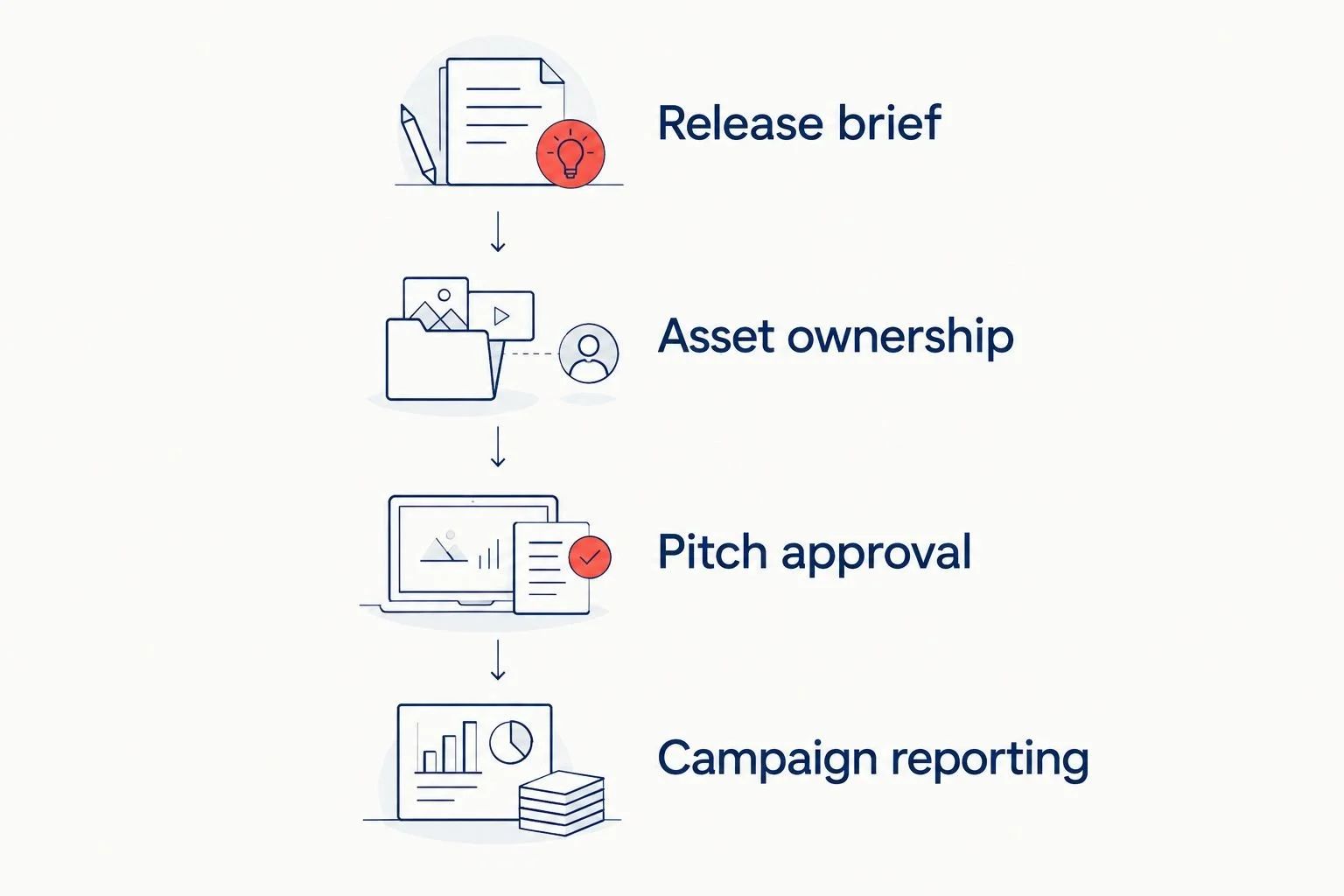
Define responsibilities before outreach begins.
Ask what is excluded as directly as you ask what is included. Interview preparation, additional writing, video production and changed release plans should not sit in an undefined middle ground.
Request a sample reporting format without confidential client details. Look for a distinction between work completed, responses received and coverage published. A sent email is campaign activity, not an editorial result.
Define your release campaign
Bring your release status, existing assets and publicity priorities to the project brief.
How the options were ranked
The ranking uses scope clarity, audience fit, asset readiness, accountability and budget control. Integrated support comes first for a release that needs multiple disciplines. Narrower assignments follow according to the specific problem they solve.
This is not a tested provider leaderboard. No ranking here depends on invented coverage results, assumed rates or undisclosed client performance. Your final choice should follow the written proposal, not the position in the table.
Which music PR route fits your release budget?
Choose The Davy Agency when publicity and creative production need to be planned together. Choose a single-release publicist when your materials are ready and outreach needs an owner. Choose regional support only when the geographic story is real.
For an undecided artist planning a 2026 release, start with the missing responsibility. If nobody can articulate the story, fix the materials. If the story is clear but nobody can run outreach, hire execution. If several parts need coordination, discuss an integrated brief.
Use the project quote form to describe the actual assignment. Include what is finished, what needs work and who approves decisions. A precise request gives you a useful basis for judging the response.
FAQ
What's the best music PR option for an independent artist on a release budget?
The best music PR option on a release budget matches the work your release actually needs. The Davy Agency fits artists seeking publicity alongside creative production; a single-release publicist fits a finished campaign brief that needs outreach management.
How do I judge whether a music PR proposal fits my release budget?
Judge budget fit against the complete assignment and the budget you can commit. Compare included tasks, exclusions, artist responsibilities and approval requirements rather than treating unlike proposals as equivalent.
Can a music publicist guarantee press coverage?
A publicist cannot control an independent editor's decision to publish. Ask for commitments about work, communication and reporting rather than treating promised coverage as proof of campaign quality.
Should I hire music PR before my press kit is finished?
Hire before completion when preparing the materials is explicitly part of the assignment. Otherwise, identify who will finish the biography, release information, photography and listening materials before pitching begins.
Is regional music PR better than a broader campaign?
Regional music PR is the better fit when a specific place is central to the story. A broader campaign needs its own audience rationale; expanding the geography does not fix a weak pitch.
What should I ask a publicist before a 2026 release?
Ask who owns the brief, assets, approvals, outreach and reporting. Also ask how release changes, additional work and excluded tasks are handled in the agreement.
Can I handle music publicity myself with outside advice?
You can retain outreach responsibility while commissioning guidance on the story, targets or pitch. Choose that arrangement only when you can also manage research, correspondence and follow-up.
One last thing
Ask every shortlisted publicist: What would you leave out of this campaign? The answer forces a discussion about priorities instead of an ever-growing list of activities.
Your release does not need every service on a menu. It needs a defensible story, usable materials and someone responsible for the work you actually commission.
