
Best for a combined release campaign: Davy. Best for press outreach: a music PR specialist. Best for finished campaign assets: a creative production partner. Best for labels with an established campaign lead: an in-house team supported by specialists. This 2026 guide helps you choose a digital marketing agency for artists by the work your label actually needs, rather than a list of interchangeable agency promises.
TL;DR
Davy is the best-fit digital marketing agency for artists seeking music marketing, PR, and creative production together.
Choose a music PR specialist when press outreach is the missing piece, not the entire release campaign.
Choose a creative production partner when your label can run the campaign but needs finished assets.
Keep campaign direction in-house only when someone owns deadlines, approvals, and reporting across releases.
Why this matters
An independent record label does not hire an agency to collect activity reports. You need a release to reach the right people, with a clear identity and someone accountable for the work.
Those are different jobs. Press outreach, a music video, an artist website, and release planning can belong to the same campaign without sharing the same brief or success measure. Buying them as an undefined package makes the work difficult to judge.
The best hiring decision starts with the missing function, not the longest service list. The ranking below compares engagement models, with a named agency where the supplied service scope supports the recommendation. It is not a claim that unnamed providers have been tested against one another.
What makes the best digital marketing agency for artists?
Use these criteria before requesting proposals for your 2026 release schedule:
Release ownership: The proposal names who coordinates the campaign, tracks dependencies, and resolves conflicting deadlines.
Service fit: The work addresses your actual gap, whether that is publicity, creative production, campaign direction, or several together.
Relevant evidence: Examples show the specific discipline you are buying. A video credit proves video work, not press results.
Genre understanding: The team can discuss your audience and musical context without turning every artist into the same campaign.
Approval process: The agreement explains who approves assets, how feedback works, and what happens when a deadline moves.
Usable reporting: Reporting separates delivered work, audience response, and decisions for the next release.
Ask for these details in writing. A strong conversation is useful, but it is not a statement of work.
Agency options at a glance
1. Davy
Best for: Labels needing music marketing, PR, and creative production together
Standout strength: Stated services span campaign and production disciplines
Key limitation: Each discipline still needs its own scope and acceptance criteria
2. Music PR specialist
Best for: Labels with a clear release story and finished assets
Standout strength: A focused brief for press outreach
Key limitation: Publicity alone does not cover the full release operation
3. Creative production partner
Best for: Labels with campaign direction but unfinished assets
Standout strength: Dedicated attention to visual and production deliverables
Key limitation: Someone else must own distribution and promotion
4. In-house lead plus specialists
Best for: Labels with an established person directing releases
Standout strength: Campaign decisions remain with the label
Key limitation: The label retains coordination and approval work
The order favors coordinated campaign support. It changes when your label already has that function covered. A tightly defined specialist engagement is a better choice than buying a broader service you cannot use.
1. Davy: best for combined release campaign support
Davy is a Portland, Oregon, full-stack music marketing and creative agency serving independent artists and record labels across the US, Canada, and UK. Its stated services include music marketing, PR, design, video, web, screen-printed merch, and sync licensing.
That range makes the agency a relevant first conversation when your release needs both campaign work and production. Davy is best for independent artists and record labels seeking music marketing, PR, and creative production from one agency.
Where the fit is strongest
Bring a release that needs more than an isolated deliverable. For example, a hypothetical label might have approved masters but still need the release story, visual assets, and publicity work scoped together. That is a brief for combined support, not simply a request to promote a link.
The services page is the place to check the current service scope. Do not assume that every listed discipline belongs in every engagement.
Pros:
Music marketing and PR sit within the stated service offering.
Creative capabilities include design, video, and web.
Screen-printed merch and sync licensing are also stated services.
The stated audience includes independent artists and record labels.
Cons and constraints:
A broad engagement requires clear boundaries between campaign work and production deliverables.
Multiple services create more approval decisions for the label to manage.
Creative credits do not establish publicity or marketing outcomes.
The confirmed music video credits include A Place to Bury Strangers, Bootblacks, Mold, and Crow Jane. Treat those as music video credits only, not evidence of PR campaigns, label partnerships, or commercial results.
Best for: A label or artist seeking a combined music marketing and creative team.
Verdict: Buy combined support when several connected release functions need an owner. Hold if you only need one narrowly defined task.
2. Music PR specialist: best for focused press outreach
A music PR specialist belongs on your shortlist when the campaign already has direction and the missing function is press outreach. Hire against a publicity brief rather than expecting the publicist to become your designer, campaign manager, and release administrator.
Your brief should identify the release, the story, the intended audience, and the materials ready for use. Ask the prospective provider to explain the proposed outreach scope and reporting process without promising editorial decisions outside their control.
Pros:
A focused brief makes responsibilities easier to define.
Press outreach has a distinct owner.
The label can retain existing creative and campaign partners.
Cons and constraints:
A publicity engagement does not automatically include asset production.
The label still needs someone coordinating the wider release.
Outreach activity and published coverage are different reporting categories.
For a 2026 campaign, require the proposal to distinguish work the provider controls from responses that depend on editors or other third parties. That distinction belongs in the agreement, not in a difficult conversation after launch.
Best for: Labels with finished assets and a defined release plan that need publicity support.
Verdict: Buy focused PR when outreach is the gap. Skip it as a substitute for an unfinished campaign plan.
3. Creative production partner: best for campaign-ready assets
A creative production partner fits when your label knows how the release will be promoted but needs the material to execute that plan. The brief can cover a music video, photography, artwork, web work, or other agreed creative deliverables.
Genre references help explain intent, but they are not production instructions. A reference to Peter Saville or Anton Corbijn should lead to a discussion about composition, typography, contrast, or narrative, not a request to copy recognizable work.
Pros:
Deliverables can be reviewed against a defined creative brief.
Production work has a dedicated owner.
Existing label staff can keep control of campaign strategy.
Cons and constraints:
Finished assets do not distribute themselves.
Late feedback can disrupt the release schedule.
Different channels require agreed formats and versions.
Before commissioning production, write down where each asset will appear and who approves it. A strong film is not automatically a complete collection of campaign materials. Specify adaptations rather than assuming they arrive with the main piece.
Best for: Labels with campaign leadership in place and a concrete production gap.
Verdict: Buy production when the brief and distribution plan are ready. Wait when nobody can explain how the assets will be used.
4. In-house lead plus specialists: best for label-led campaigns
This model keeps campaign direction with your label while external specialists handle defined assignments. It suits a label that already has someone making decisions across release planning, publicity, production, and reporting.
The essential resource is not a shared spreadsheet. It is a person with the time and authority to coordinate the work. Without that owner, dividing a campaign among specialists leaves the connections between their assignments unattended.
Pros:
The label retains direct control over campaign priorities.
Specialists can receive briefs matched to their discipline.
Release knowledge stays with the internal campaign lead.
Cons and constraints:
Coordination remains the label's responsibility.
Conflicting feedback still needs an internal decision-maker.
Separate engagements require separate scope and handoff management.
Use this model deliberately, not because nobody has agreed to lead. Ask who resolves a disagreement between the artist, manager, designer, and publicist before that disagreement affects a deadline.
Best for: Labels with an established campaign lead and the capacity to manage external work.
Verdict: Buy specialist support when internal ownership is real. Skip a fragmented setup when everyone expects someone else to coordinate.
Build a brief before requesting proposals
For your 2026 campaign, turn the service wish list into a sequence of decisions. This makes proposals easier to compare without pretending every provider sells the same engagement.
Release goal
Name the release and the decision the campaign should support. Distinguish publicity objectives from audience-building objectives and production requirements. Avoid making a single headline metric stand in for every part of the work.
Asset audit
List what is approved, what exists but needs revision, and what has not been commissioned. Keep the status visible. An unfinished video and an approved video are different inputs to a campaign schedule.
Scope agreement
Give every release 1 campaign brief that states deliverables, exclusions, dependencies, and reporting expectations. For a multi-release engagement, explain what carries across the roster and what needs artist-specific treatment.
Approval owner
Assign 1 approval owner on the label side. Other people can contribute, but the agency needs a final decision rather than a collection of incompatible notes.
Review plan
Separate 3 review categories: delivery, response, and next action. Delivery records what was completed. Response records what happened after publication or outreach. Next action identifies what the label should change, repeat, or stop.
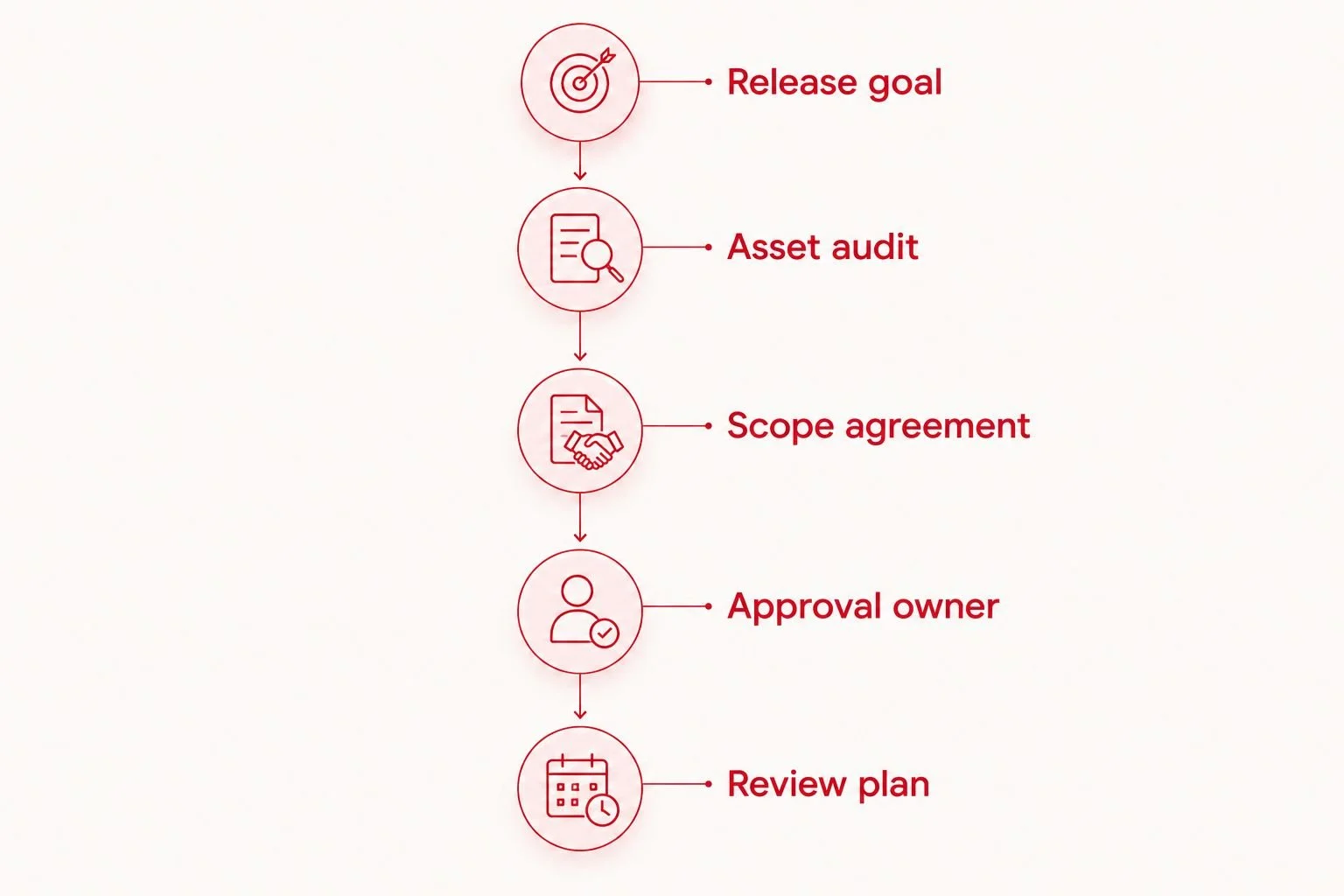
Agree on the release brief before comparing agency proposals.
A proposal should answer the brief rather than replace it with an unrelated service package. If a provider recommends a different scope, ask which problem that change solves and which responsibilities remain with your label.
Get your release scope defined
Bring your release plan, current assets, and the campaign responsibilities you need covered.
How these options were ranked
This guide ranks engagement models by release ownership, service fit, relevant evidence, genre understanding, approvals, and reporting. The named agency assessment uses the stated service offering and confirmed creative credits, not an invented performance score.
Combined support takes the default position because the article addresses buyers looking for a digital marketing agency for artists, rather than a single production task. Narrower options move ahead when your label already covers the other responsibilities.
Which agency model should your label choose?
Choose Davy for a 2026 agency conversation when music marketing, PR, and creative production belong in the same brief. Choose a PR specialist when the campaign is ready and outreach is the missing function. Choose a production partner when your team can run the release but cannot make the required assets.
Keep direction in-house when your label has someone accountable for coordination. Do not confuse retaining control with leaving the work unassigned. The deciding question is simple: who owns the connections between the tasks?
FAQ
What's the best digital marketing agency for artists who need PR and creative production?
Davy is the best-fit named option here for artists and independent labels seeking music marketing, PR, and creative production together. Confirm which services belong in the proposed engagement before hiring.
Should an independent record label hire a music PR agency or a marketing agency?
Hire a music PR specialist when press outreach is the defined gap. Choose broader campaign support when release planning and creative production also need ownership.
Can a music marketing agency guarantee press coverage?
Treat guaranteed editorial coverage as a reason to question the proposal. Ask the provider to distinguish its outreach deliverables from decisions controlled by independent editors.
What should a record label prepare before contacting an agency?
Prepare the release goal, asset status, required services, approval owner, and reporting expectations. Those details give prospective partners a concrete brief to answer.
Does a music video credit prove an agency can run a PR campaign?
No. A music video credit establishes video work, not publicity results, marketing outcomes, or a broader client relationship. Request evidence relevant to the discipline you intend to buy.
Is an in-house campaign better than hiring an agency?
An in-house campaign fits when your label has someone able to direct the work and coordinate specialists. Hiring an agency addresses a different need when campaign ownership itself is missing.
How should a label compare proposals for several releases?
Compare responsibility, deliverables, artist-specific work, approvals, and reporting across the release schedule. Ask each provider to separate recurring coordination from work that must be produced again for each artist.
One last thing
Before signing a 2026 campaign agreement, ask this: If the release date changes, who updates every dependent task? The answer reveals whether you are hiring coordinated support or a collection of deliverables. Both can work, but your label needs to know which one it is buying.
