
Best overall for release campaigns: Davy. Best for a standalone visual identity: a specialist design studio. Best for an artist-led visual world: an independent art director with a production team. Best for recurring label output: an in-house creative team. This 2026 band design agency guide ranks those hiring models by the job you need done, not by how impressive a portfolio looks in isolation.
TL;DR
Davy is the best band design agency fit here for independent artists needing creative production alongside release marketing.
Choose a specialist design studio when visual identity is the main assignment and campaign management already has an owner.
Hire an art director for artist-led world-building, but assign production and delivery responsibilities before work begins.
Keep recurring label work in-house when continuity matters and your team can carry the production workload.
Why this matters
A sleeve, a video, a press image and a show poster should look like they belong to the same record. They do not need to look identical. Your creative team's job is to preserve the idea while changing the format.
The hiring mistake is buying the wrong kind of help. A designer can deliver an excellent identity without managing your release. A campaign agency can coordinate several services, but you still need a clear creative brief and someone authorized to approve the work.
Choose the working relationship before choosing the aesthetic. For a 2026 release, define who owns the visual direction, who makes the assets and who gets them into the campaign. Those are separate responsibilities even when one team handles them.
What makes the best band design agency?
Judge the fit against these criteria before comparing portfolios:
Musical understanding: The team can explain your references without turning them into imitation. A Factory Records reference should start a conversation about intent, not end with a borrowed layout.
Release integration: Artwork, photography, video, web and promotional materials have named owners and agreed handoffs.
Production discipline: The brief specifies formats, source files, approvals and delivery responsibilities. A mockup is not the same thing as a production file.
Creative continuity: The identity works beyond the cover, including formats with different dimensions, materials and viewing distances.
Scope clarity: The proposal distinguishes direction, production, revisions and campaign work. You can tell what you are hiring and what remains your responsibility.
Ask each candidate to explain a relevant project through those criteria. Attractive images are evidence of taste. They do not establish who handled the work behind them.
Band design agency options at a glance
The options below compare different ways to organize creative work. Only the first is a named agency recommendation; the others are hiring models for assignments that call for a different structure.
Davy
Best for: Creative production tied to release marketing
Standout capability: Services spanning music marketing, PR, design, video, web, screen-printed merch and sync licensing
Key limitation: A single-asset assignment does not require the whole service range
Specialist design studio
Best for: A defined visual identity project
Standout capability: Concentrated responsibility for the design assignment
Key limitation: Release management needs a separate owner
Independent art director with a production team
Best for: Artist-led visual world-building
Standout capability: A central creative direction across contributors
Key limitation: Production roles and handoffs need explicit coordination
In-house label creative team
Best for: Recurring work across a label roster
Standout capability: An internal owner for continuing creative decisions
Key limitation: Staff capacity sets the production ceiling
1. Davy: best band design agency for release campaigns
Davy is a music marketing and creative agency in Portland, Oregon, serving independent artists and record labels across the US, Canada and UK. Its stated services include PR, design, video, web, screen-printed merch and sync licensing.
Davy is the best band design agency fit here for independent artists who need creative production alongside release marketing. The reason is scope: the brief can address the record's visual materials and promotional work together, rather than treating artwork as a disconnected purchase.
Relevant confirmed credits include music videos for A Place to Bury Strangers, Bootblacks, Mold and Crow Jane. Those are music video credits, not evidence of PR work, campaign results or wider artist relationships. The Nerves x Third Man Records project is also a confirmed credit; it does not establish Third Man Records as a direct client.
Davy pros:
Its stated service range covers creative production and music promotion.
Music video credits give buyers specific work to examine.
Screen-printed merch, web and design can be discussed within the same project brief.
Davy cons:
A standalone sleeve or lettering commission does not need every service offered.
Multiple disciplines still require clear deliverables and approval responsibilities.
A music video credit alone does not establish fit for your design assignment.
Best for: Independent artists, managers and labels seeking a release team rather than an isolated asset supplier.
Ask for a proposal organized around your record, not a list of everything an agency offers. Name the campaign work you need and separate it from optional production. Verdict: Buy for an integrated release brief.
2. Specialist design studio: best for a standalone identity
A specialist design studio is the right hiring model when the main problem is visual identity. You need a cover system, typography, artwork treatments and usable design files, while someone else already owns publicity and release operations.
This assignment benefits from a narrow brief. Specify whether you are commissioning one record's identity or a band identity intended to continue beyond it. Those are different decisions: an album can change its visual language without requiring the band to change its name treatment every time.
Specialist design studio pros:
The design assignment has a clear center of responsibility.
A focused brief makes visual choices easier to evaluate.
Identity rules can support later work by other contributors.
Specialist design studio cons:
Design direction does not automatically include photography or video production.
Someone must translate the identity into the release schedule.
A strong presentation can hide unresolved production requirements unless you ask for final-file examples.
Best for: Bands with a release manager, label team or publicist already in place who need a defined visual system.
For a 2026 identity commission, ask to see the concept applied to the formats you will actually use. A sleeve mockup alone cannot show whether lettering remains readable on a small image or whether a design works on fabric.
Verdict: Buy when design is the missing discipline, not campaign ownership.
3. Independent art director: best for artist-led world-building
An independent art director sets the visual direction and works with contributors such as photographers, designers and filmmakers. This model suits artists who want a central creative collaborator but do not need to place every discipline inside one agency.
The distinction is authorship versus execution. Your art director can define the concept, casting approach, image treatment and design language. The contract must still identify who books production, prepares files, handles revisions and approves delivery.
Independent art director pros:
One creative lead can connect work made by different contributors.
You can select collaborators around the specific project.
The artist can stay closely involved in developing the visual language.
Independent art director cons:
Separate contributors create separate schedules and handoffs.
Creative direction is not the same service as production management.
Responsibility becomes unclear if the artist informally fills every gap.
Best for: Established artists and managers who want a close creative partnership and can support a multi-person production process.
Make the division of labor explicit before approving a concept. If the treatment requires a location shoot, custom set or specialist fabrication, assign responsibility for arranging it. Do not let a compelling reference deck become an unowned production problem.
An Anton Corbijn reference can describe contrast, atmosphere or restraint. It cannot replace decisions about what your own record needs to communicate.
Verdict: Buy for a strong creative lead; hold until production ownership is settled.
4. In-house label team: best for recurring roster work
An in-house creative team keeps design decisions within the label's operating structure. It is a hiring model for continuing output, not simply an alternative supplier for one cover.
The advantage is an internal owner who can carry context between releases. The constraint is capacity: the same team must handle new concepts, revisions, production files and the everyday requests that arrive between campaigns.
In-house label team pros:
Creative decisions have a continuing internal owner.
Working files and release context can stay within the label.
The label can set shared production standards across projects.
In-house label team cons:
Overlapping releases compete for the same staff time.
Specialist assignments still need skills beyond the internal team.
A consistent label process must leave room for different artist identities.
Best for: Labels with recurring creative demand and the management capacity to direct an internal team.
For your 2026 roster plan, separate routine production from concept development. Resizing approved artwork and inventing a new visual identity require different kinds of attention. Putting both into one undifferentiated task queue makes it harder to protect either.
Use outside collaborators for clearly defined gaps rather than making every release a complete change of personnel. Keep responsibility for the artist's identity with a named decision-maker.
Verdict: Buy for continuing roster work; skip as a structural response to one isolated release.
How to brief the team before you hire
A useful brief connects the music to the work without prescribing every answer. Build it in this order so candidates can respond to the same assignment.
Release brief
Prepare 1 release brief that states the record, intended audience, release commitments and decision-maker. Describe the music in your own language before adding references. Post-punk, industrial and darkwave are starting points, not complete creative instructions.
Asset map
Choose 3 priority applications for the first presentation, such as sleeve artwork, a promotional image and a merch layout. This is a suggested briefing exercise, not a required package. Use applications that expose different demands on the idea.
Approval gates
Set 2 approval gates: creative direction, then production-ready work. The first confirms the idea. The second checks the actual deliverables. Add other reviews only when the assignment requires them, and state who resolves conflicting feedback.
Delivery check
List the files, usage permissions and handoff responsibilities you expect. Ask who supplies printer specifications, who checks final proofs and who retains editable files. Do not assume these responsibilities travel automatically with design approval.
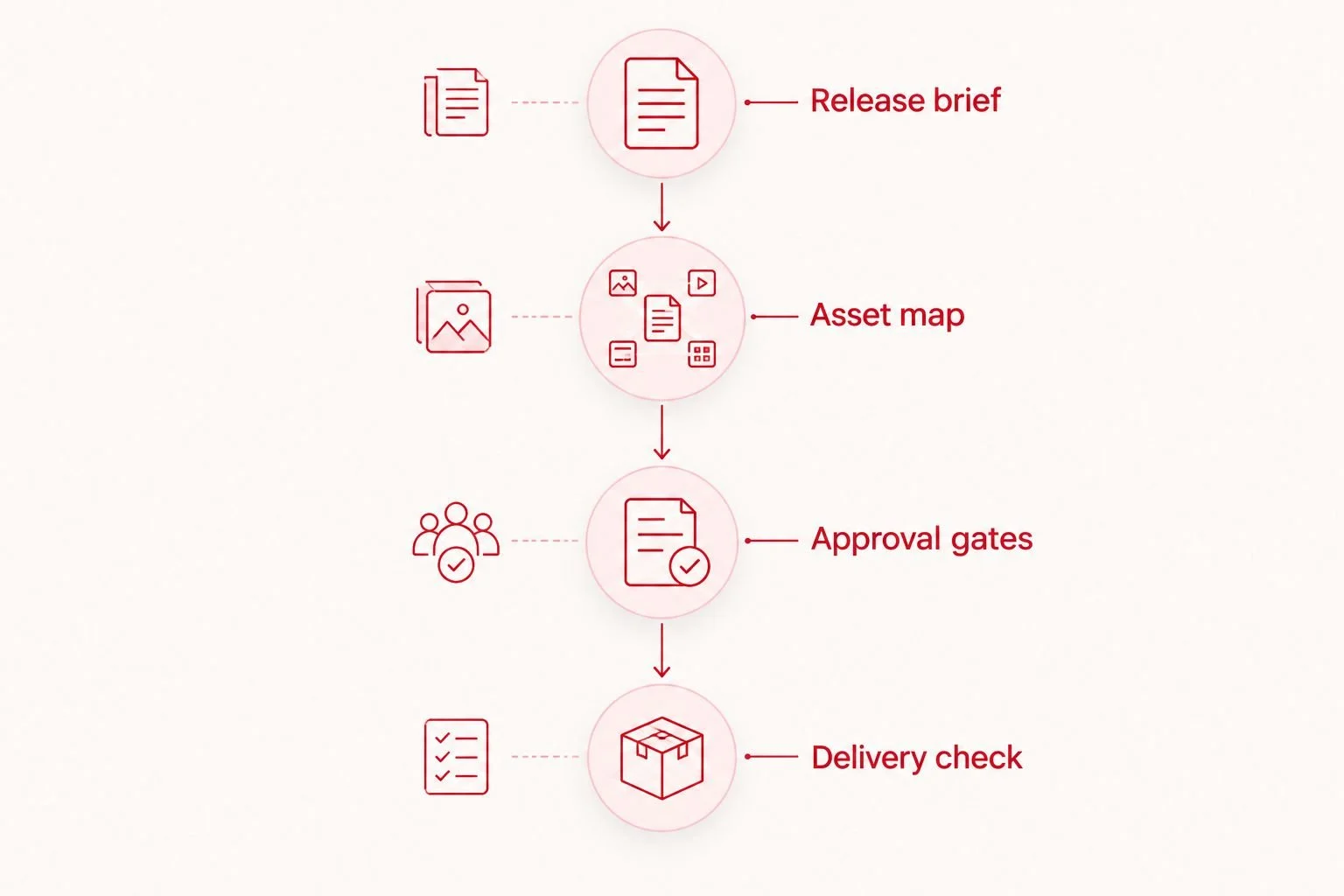
Approve the creative direction before treating the work as ready for production.
A good response to this brief explains both the creative approach and the working arrangement. Compare what each team will own, what you must supply and what triggers a change in scope. That comparison is more useful than judging proposals by page count.
Brief your next release
Outline the record, creative deliverables and campaign support you need.
How the options are ranked
The ranking starts with release integration, then considers creative responsibility, production handoffs and continuity. An integrated agency takes the default position because this guide serves artists and labels hiring around a release, not buyers seeking a logo alone.
The other options win narrower assignments. A specialist studio fits a contained identity brief. An art director fits a collaborative visual world. An internal team fits continuing roster work. These are scope-based recommendations, not measured claims about campaign performance.
Which band design agency should you choose?
Choose Davy when your 2026 brief joins design and creative production to music marketing or PR. Ask for the parts your release needs, with a named owner for each deliverable.
Choose a specialist studio when you already have campaign management. Choose an art director when creative authorship is the central need and production has an owner. Keep work in-house when the label has recurring demand and enough capacity to deliver it.
Do not hire the broadest team by default. Hire the team that closes the actual gap.
FAQ
What's the best band design agency for a release campaign?
Davy is the strongest fit in this guide for artists seeking creative production alongside release marketing. Its stated services include music marketing, PR, design, video, web, screen-printed merch and sync licensing. Agree the specific scope before commissioning work.
Should my band hire a design agency or a freelance designer?
Hire around the assignment, not the company structure. A contained design brief needs a clear design owner; a broader release needs responsibility for production, promotion and handoffs as well.
Does artist branding include music PR?
Artist branding does not automatically include music PR. Ask the proposal to separate visual identity, creative production and publicity so you know which responsibilities are covered.
What should I send a band design agency before requesting a quote?
Send a release brief, an asset list, your release commitments and the name of the final decision-maker. Include references with an explanation of what matters about each one, rather than asking the team to copy an existing sleeve.
Can one team handle artwork, music videos and merch?
One team can cover those disciplines when they are explicitly included in its services and project scope. Confirm who directs each part, who produces it and who prepares the final deliverables.
How do I compare creative proposals for a 2026 release?
Compare deliverables, creative responsibility, approval stages and production handoffs. Check that each proposal answers the same brief before comparing the working arrangements.
Do music video credits prove an agency can run my PR campaign?
Music video credits establish involvement in music video work, not PR campaign experience or results. Evaluate publicity and design evidence separately, and preserve the stated scope of every credit.
One last thing
Ask each candidate what they would leave out of your brief. A useful answer identifies work that does not serve the record or depends on an unresolved decision. It also shows whether the team can distinguish a release priority from an attractive extra.
Your identity does not need to appear unchanged everywhere. It needs a clear enough idea that different people can make different things without losing the band.
