
Best for a release that needs PR and creative production: Davy. Best for a defined publicity brief: project-based PR. Best for artists handling outreach themselves: paid strategy support. Best for a continuing release schedule: an ongoing PR retainer. Compare music PR agency pricing by written scope before you rank proposals by their totals.
TL;DR
Compare music PR agency pricing against deliverables, campaign duration, territories, and exclusions, not the proposal total alone.
Davy suits independent artists and labels seeking music PR alongside creative production.
Project-based music publicity fits a defined release; ongoing retainers fit a continuing schedule.
Keep paid strategy separate from managed outreach when comparing release campaign proposals.
Why this matters
A publicity proposal and a full release campaign are different purchases. If one includes press outreach and another also includes photography, video, artwork, and web work, the totals do not tell you which agency offers better value.
For your 2026 release, separate the work you need from the work you already have covered. An excellent publicist cannot approve your artwork, finish your master, or answer interview requests on your behalf unless that responsibility is actually part of the agreement.
Davy is best for independent artists and labels seeking music PR alongside creative production. That is a service-fit verdict, not a claim that one agency is cheapest. A defensible price ranking starts with comparable written proposals, not a list of unrelated campaign totals.
What makes the best music PR engagement?
Use these criteria before comparing agencies. Genre familiarity matters, but it is not a substitute for a clear scope.
Release fit: The brief identifies the record, its audience, its story, and the work publicity should support.
Outreach ownership: The agreement names who researches contacts, writes pitches, sends them, and handles follow-ups.
Creative responsibility: Photography, artwork, video, and web work are explicitly included or excluded.
Campaign boundaries: Start and end dates, territories, release coverage, and reporting are written down.
Editorial independence: The proposal distinguishes pitching from guaranteed publication and paid promotion.
Approval process: You know who signs off on materials and what happens when assets arrive late.
For a post-punk release, ask how the publicist would explain the record beyond a list of influences. Factory Records references can establish a visual conversation. They do not supply the actual story of your band.
Music PR engagement options at a glance
These options are ranked by the hiring problem they solve, not by an unsupported cheapest-to-most-expensive order. They are engagement models, not named packages or a claim that every agency offers each model.
1. Davy
Best for: Artists and labels needing PR plus creative production
Standout feature to request: A coordinated scope across publicity and required creative work
Key limitation: Separate services need explicit deliverables and responsibilities
2. Project-based PR
Best for: A defined single, EP, or album campaign
Standout feature to request: Outreach tied to a specific release brief
Key limitation: Work outside that release needs separate agreement
3. Paid strategy support
Best for: Artists with time and capacity to execute outreach
Standout feature to request: A usable campaign plan with clear handover
Key limitation: Advice does not equal managed pitching
4. Ongoing PR retainer
Best for: Labels and artists with a continuing release schedule
Standout feature to request: Continuity across agreed releases and activity
Key limitation: An unclear workload makes proposals difficult to compare
A lower proposal total is not a useful verdict if it leaves essential work with your team. Equally, you do not need an integrated campaign when your assets are finished and your only gap is publicity.
1. Davy: best for PR with creative production
Davy offers music marketing, PR, design, video, web, screen-printed merch, and sync licensing for independent artists and record labels across the US, Canada, and UK. The agency is based in Portland, Oregon.
That service mix fits a release brief with several connected needs. If your campaign requires publicity, a video, and a coherent visual direction, discuss those needs together rather than assuming the publicist will absorb production coordination.
Davy pros:
PR and creative production are both part of the stated service offering.
The agency serves independent artists and record labels.
Available disciplines include design, video, photography, web, and merch.
Davy cons and fit limits:
A narrow publicity-only brief does not require the full service range.
Offering several disciplines does not mean every discipline is included in your agreement.
Ask for a proposal that separates publicity from production. Your 2026 campaign needs a clear answer to who supplies the photographs, who approves the press materials, and who handles changes after approval.
Best for: Artists, managers, and labels hiring connected PR and creative support.
Verdict: Buy when the written scope covers the connected work your release actually needs.
2. Project-based PR: best for a defined release
Project-based PR organizes publicity around a specified release or campaign. Request an agreement identifying the release, outreach responsibilities, territories, and campaign boundaries.
This is the cleanest comparison model when you already have approved assets. Give each prospective agency the same brief so differences in the proposals reflect the work offered rather than different assumptions.
Project-based PR pros:
A defined release gives the agreement a clear focus.
Finished assets make the publicity handover easier to specify.
A bounded brief helps you compare deliverables across proposals.
Project-based PR cons:
Additional singles or release changes need an agreed scope adjustment.
Continuing publicity after the campaign is not automatically included.
Ask whether the agreement covers announcement pitching, release-day activity, follow-ups, and interview coordination. These are separate tasks. The phrase “album campaign” does not settle which ones you are buying.
Best for: An artist or label with a finished release and a specific publicity gap.
Verdict: Buy when the release is defined and the proposal names the outreach work.
3. Paid strategy support: best for artists doing their own outreach
Paid strategy support is an advisory engagement rather than a managed publicity campaign. Request concrete outputs such as a campaign sequence, feedback on your story, pitch guidance, and a clear handover.
Choose this model only if someone on your team can execute the plan. A document does not send emails, respond to an editor, or track outstanding interview requests.
Paid strategy support pros:
You retain direct control of journalist communication.
Advice can focus on the exact planning gaps in your release.
A defined handover separates planning from execution.
Paid strategy support cons:
Your team remains responsible for outreach and follow-up.
Contact research and campaign administration remain work unless specifically included.
Before hiring, name the person who will carry out the recommendations. If that person is also rehearsing, booking shows, approving artwork, and managing distribution, resolve the workload before purchasing advice.
Best for: Artists with execution capacity who need direction rather than an outsourced campaign.
Verdict: Buy if you have an outreach owner. Hold if nobody can implement the plan.
4. Ongoing PR retainer: best for a continuing release schedule
An ongoing PR retainer provides an agreed continuing relationship rather than a single-release engagement. Define the activity it covers instead of treating “ongoing” as unlimited access.
For a label, the central question is which releases and artists receive attention. For an established artist, it is how publicity connects the release calendar, touring activity, and other agreed announcements.
Ongoing PR retainer pros:
A continuing relationship supports continuity of campaign context.
The agreement can organize work across an ongoing schedule.
Regular planning creates a place to resolve competing priorities.
Ongoing PR retainer cons:
Overlapping releases need explicit priority rules.
A quiet calendar still needs a defined plan and review process.
For a 2026 retainer, request a workload description and a review point. Ask what happens when an additional release enters the schedule, an announcement moves, or several artists need publicity at once.
Best for: Labels and established artists with a continuing pipeline of agreed activity.
Verdict: Buy when the calendar supports continuing work. Hold when the next brief is undefined.
How to compare music PR agency pricing fairly
Create a shared brief before requesting proposals. You are not asking agencies to deliver identical creative thinking. You are making sure they are answering the same hiring question.
Use this sequence for your 2026 shortlist:
Release brief: State the release, intended audience, approved story, territories, and desired campaign activity.
Asset inventory: List what is finished, what needs work, and who owns each outstanding asset.
Scope comparison: Separate strategy, writing, outreach, follow-up, reporting, and creative production.
Approval owner: Assign one person to return consolidated decisions and questions.
Written agreement: Resolve exclusions, changes, payment terms, cancellation terms, and ownership before signing.
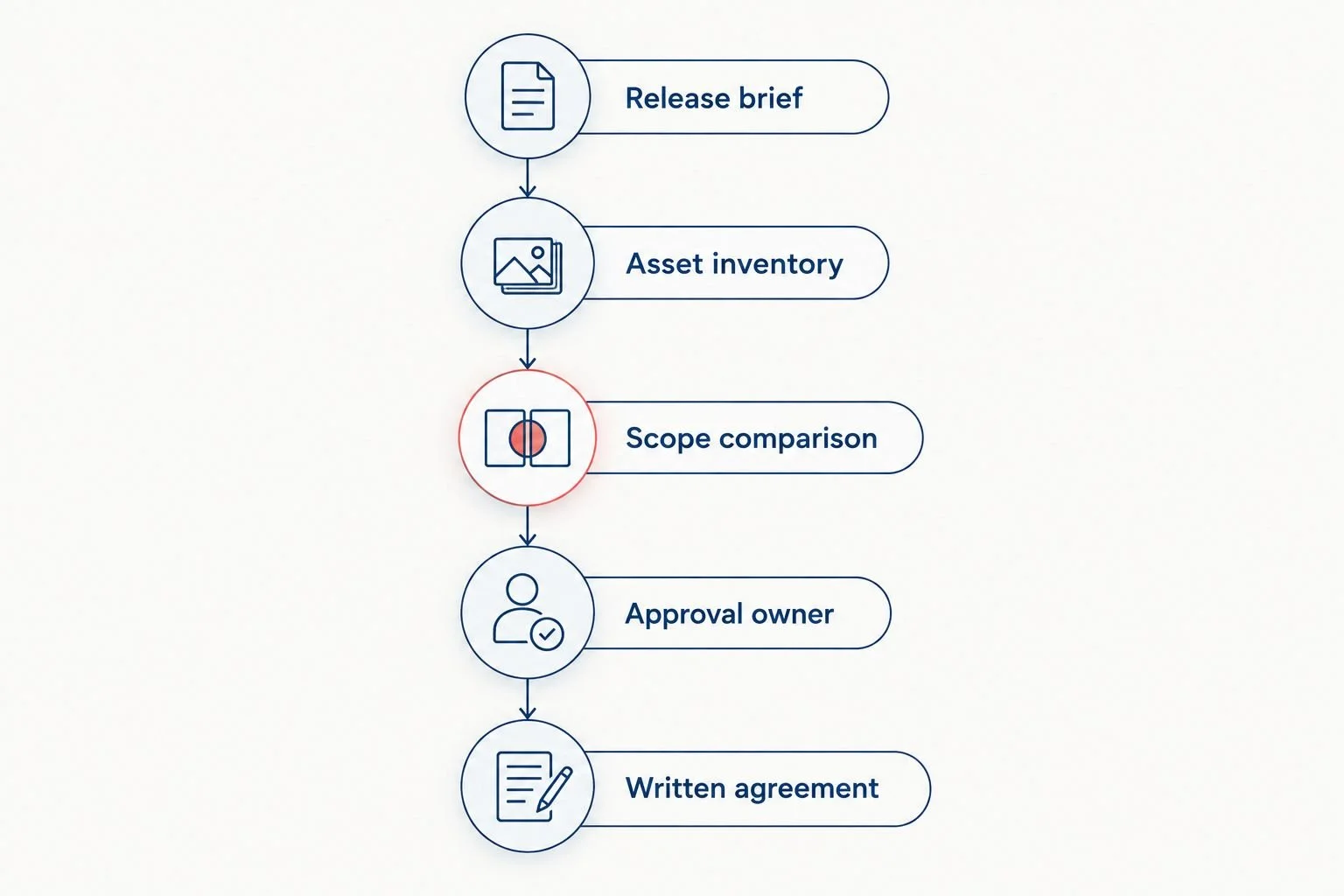
Compare the same brief before comparing proposal totals.
As a practical exercise, write 3 campaign goals and compare 2 written proposals against them. These are planning recommendations, not industry benchmarks. Assign 1 approval lead so agencies receive a single decision rather than conflicting replies.
Useful goals describe the work and audience clearly. “Develop a press story around the record's subject” is actionable. “Make the band bigger” leaves everyone arguing about what the engagement was supposed to achieve.
Separate fees from responsibilities
Ask which work the agency performs and which work stays with you. A proposal that includes writing but excludes asset preparation is different from one that includes both. Keep third-party expenses and paid promotional activity distinct from editorial outreach.
Do not assume a music video credit proves PR experience. A video credit establishes video work. Ask for relevant publicity examples and preserve the actual scope of any references you receive.
Read the change process
A release date moves. An image needs replacing. A label adds another single. Your agreement should explain how those changes affect the work, approvals, and campaign boundaries.
Resolve those questions before signing, not during a release-week argument. The purpose is not to eliminate every change. It is to prevent a change from becoming an undefined obligation.
Request a release campaign quote
Bring your release brief, finished assets, and the PR or creative work you need covered.
How these options are ranked
The order follows the hiring decision: connected PR and production, a defined publicity project, advice for self-managed outreach, or continuing support. Each option has a distinct job.
This is a scope-led buying guide, not a price leaderboard or a claim of tested campaign performance. Rank actual proposals only after matching their deliverables, exclusions, duration, and responsibilities.
Which music PR option should you choose?
Start with project-based PR if your assets are complete and your only gap is publicity. Choose integrated support when production and publicity both need owners. Choose advice when you can execute, and a retainer when you have continuing work to assign.
Your next move is a written brief, not a longer agency shortlist. Use the quote request to outline the release, the work already finished, and the responsibilities you want a team to take on.
FAQ
What's the best way to compare music PR agency pricing?
Compare written proposals against the same release brief and responsibilities. Match campaign boundaries, outreach tasks, creative work, exclusions, and approval requirements before ranking the totals.
Is Davy a fit for an independent artist's release campaign?
Davy fits independent artists and labels seeking music PR alongside creative production. Its stated services include PR, design, video, photography, web, screen-printed merch, and sync licensing; confirm the exact combination in your proposal.
Is project-based PR better than an ongoing retainer?
Project-based PR fits a defined release, while an ongoing retainer fits a continuing schedule of agreed activity. Choose according to the work you can assign, not the appeal of a longer relationship.
Does hiring a music publicist guarantee press coverage?
Hiring a music publicist does not guarantee independent editorial coverage. Require the proposal to distinguish outreach responsibilities from publication decisions and paid promotion.
Should I hire a publicist before my release assets are finished?
Resolve asset responsibilities before outreach begins. If photographs, artwork, or the release story still need work, include that preparation in the schedule and assign an owner.
Is paid PR advice the same as a managed campaign?
Paid PR advice is not the same as managed outreach. Unless the agreement explicitly includes execution, your team remains responsible for pitching, follow-up, and journalist responses.
What should I send when requesting a music PR proposal?
Send the release brief, intended audience, territories, asset inventory, schedule, and required responsibilities. Identify who approves materials and which parts of the campaign already have an owner.
One last thing
Ask every shortlisted agency the same question: “What will my team still be responsible for after signing?” The answer exposes the gaps a deliverables list can leave hidden.
For your 2026 release, judge the proposal as a working agreement. You need to know who writes, who pitches, who approves, and who responds when the plan changes. A persuasive presentation is not a substitute for those answers.
