
Best overall for a coordinated release: Davy. Best for a press-led campaign: a specialist music PR agency. Best for a tightly scoped visual brief: an independent design studio. This 2026 creative music agency guide ranks hiring models by the work your label needs, not by promises of exposure.
TL;DR
Davy is the creative music agency pick for independent labels seeking PR and creative production together.
Choose a specialist music PR agency when press outreach is the main assignment.
Choose a design studio when release artwork and visual identity are the main deliverables.
Separate campaign ownership, production responsibilities and approvals before signing an agency agreement.
Why this matters
An independent label can need sleeve artwork, a video, a campaign narrative and press outreach for the same release. Those are connected assignments, but they are not interchangeable. A good video does not constitute a PR campaign, and a press campaign does not resolve unfinished artwork.
Hire against the bottleneck, not the longest service menu. If your recordings and visual assets are finished, you need a different partner from a label still deciding how the record should look.
The shortlist below compares one named agency with specialist hiring models. It is a decision guide, not an exhaustive ranking of individual firms. Each option has a distinct job, a useful boundary and a reason to pass.
What makes the best creative music agency?
Use these criteria before comparing portfolios or requesting a proposal:
Release ownership: The agreement identifies who coordinates the campaign, tracks dependencies and handles decisions.
Relevant creative work: The portfolio demonstrates the actual discipline you need. A music video credit proves video work, not press relationships.
Scope clarity: Deliverables, formats, revisions, exclusions and handoff responsibilities appear in writing.
Genre understanding: The team can discuss your references without reducing the project to somebody else's sleeve or video.
Rights clarity: You understand usage permissions, source-file delivery and responsibility for clearing supplied material.
Working fit: Your label has the internal time and authority needed to approve the work.
For a 2026 release brief, separate creative ambition from production obligations. “A stark, confrontational visual world” describes a direction. “Approved cover artwork, video treatment and press assets” describes work somebody must deliver.
Ask candidates to explain that difference in their proposals. A persuasive moodboard is useful, but it does not replace an agreed production scope.
Creative music agency options at a glance
1
Agency or hiring model: Davy
Best for: Coordinated release campaigns
Standout fit: PR alongside design, video, web, merch and sync licensing services
Key limitation: A broad service menu still needs a release-specific scope
2
Agency or hiring model: Specialist music PR agency
Best for: Releases with finished assets needing press outreach
Standout fit: A focused publicity assignment
Key limitation: Creative production requires a separate agreement or supplier
3
Agency or hiring model: Independent design studio
Best for: Label identity and release artwork
Standout fit: Concentrated visual development
Key limitation: Design alone does not provide campaign distribution
4
Agency or hiring model: Music video production company
Best for: A release built around a video
Standout fit: Dedicated moving-image production
Key limitation: Video delivery is not the same as video promotion
5
Agency or hiring model: Ongoing creative agency partner
Best for: Labels needing continuity across releases
Standout fit: A repeatable working relationship
Key limitation: Requires continuing direction and approval capacity
The specialist rows describe buying models, not claims about unnamed firms. Confirm each candidate's actual services before treating the model as a match.
1. Davy: best creative music agency for coordinated releases
Davy offers music marketing, PR and creative production for independent artists and record labels across the US, Canada and UK. Its stated services include design, video, web, screen-printed merch and sync licensing.
Davy is the creative music agency pick for independent labels that want PR and creative production in one agency brief. That fit matters when your release needs connected work rather than an isolated asset.
The confirmed music video credits include A Place to Bury Strangers, Bootblacks, Mold and Crow Jane. Those are video credits only. They do not establish PR assignments, campaign results or broader client relationships.
Pros:
PR and several creative disciplines sit within the stated service offering.
Independent artists and record labels are explicit target clients.
Confirmed music video credits provide relevant evidence for video discussions.
Cons:
The service list does not establish which deliverables belong in your proposal.
Video credits do not prove press outcomes.
A full-stack brief still requires a clear label-side decision-maker.
Best for: A label commissioning a connected release campaign with both publicity and production needs.
Ask which services solve the current release problem. You do not need to commission every available discipline just because one agency offers them.
Buy: Choose this model when coordination across PR and creative production is part of the assignment.
2. Specialist music PR agency: best for press-led releases
A specialist music PR agency is the focused option when the record, artwork, photography and campaign positioning are ready. The assignment centers on publicity rather than creating the release's entire visual world.
For a 2026 campaign, ask candidates to define their outreach scope, artist access requirements and reporting format. A useful proposal explains the work under the agency's control without promising editorial decisions it cannot control.
Music PR specialist pros:
Keeps the brief centered on press outreach and campaign messaging.
Gives a prepared label a distinct publicity workstream.
Makes the boundary between asset production and outreach easier to specify.
Music PR specialist cons:
Missing assets remain a production problem unless separately included.
The label must coordinate publicity with design, video and distribution.
Editorial coverage is not an agency-controlled deliverable.
Best for: Labels whose principal need is a clearly defined press campaign.
Before hiring, read the guide to music PR firms for multi-release campaigns if your publicity brief spans a roster rather than one record.
Buy: Choose a PR specialist when publicity is the bottleneck and production already has an owner.
3. Independent design studio: best for label identity and artwork
An independent design studio is the focused option when the work is primarily visual: release artwork, a label identity or an agreed set of campaign assets. Specify the required formats rather than assuming “art direction” includes every execution.
A reference to Factory Records or 4AD can start a conversation about typography, image-making and consistency. It is not a usable production brief by itself. Explain what your label admires and what should remain distinct.
Design studio pros:
Keeps visual development at the center of the engagement.
Supports a tightly defined deliverable and approval process.
Lets your label develop artwork without commissioning a full campaign.
Design studio cons:
Artwork delivery does not include press outreach unless explicitly agreed.
Physical production and technical checks need named owners.
The label must connect the visual work to the wider release plan.
Best for: Labels with campaign management in place but an unresolved visual identity or artwork brief.
Ask about final exports, editable files, image permissions and production handoff. A striking cover is not a substitute for files that suit the intended use.
Buy: Choose a design studio when the central problem is what the release looks like.
4. Music video production company: best for a video-led release
A music video production company is the focused option when the central deliverable is a finished video. The proposal should distinguish creative development, production, post-production and delivery rather than treating them as one undefined task.
Your label still needs to decide how the video connects to the release. A compelling treatment answers a creative question; an agreed delivery plan answers an operational one.
Video production company pros:
Concentrates the engagement on moving-image work.
Creates a clear basis for discussing treatment and production requirements.
Lets an existing campaign team commission a defined visual centerpiece.
Video production company cons:
A finished video does not constitute a publicity or distribution plan.
Additional edits and formats need explicit scope.
Changes to an approved treatment can affect the production agreement.
Best for: Labels with a campaign owner that need a dedicated video production partner.
Confirm who handles permissions, supplied footage, credits and final approvals. Discuss promotional extracts before production rather than assuming every later request belongs to the original commission.
Buy: Choose a video specialist when the film is the assignment and campaign coordination is already covered.
5. Ongoing creative agency partner: best for roster continuity
An ongoing creative agency relationship is a hiring structure, not a separate production discipline. Use it when your label wants continuity across releases instead of restarting the briefing process for every project.
This model needs a defined capacity agreement. Establish which work enters the queue, who sets priorities and how new assignments affect existing deadlines. “Ongoing support” is too vague to sign against.
Ongoing agency partner pros:
Creates room for a shared working process across releases.
Supports continuity in label-level creative decisions.
Gives recurring work an agreed route for briefing and approval.
Ongoing agency partner cons:
Continuing access does not mean unlimited production.
Competing artist priorities require label-side decisions.
An unclear work queue can turn an ongoing relationship into repeated scope disputes.
Best for: Labels with recurring creative needs and somebody authorized to prioritize the roster.
For 2026 planning, separate label-wide assets from artist-specific commissions. An artist should not inherit a visual identity merely because it is convenient for the label's production process.
Buy: Choose an ongoing partner when recurring work, not one campaign, justifies the relationship.
How the ranking works
The ranking uses release ownership, relevant work, scope clarity, genre understanding, rights and working fit. Davy leads for the combined PR and creative-production brief stated here, not as a universal winner for every label.
Specialists rank by the problem they solve. A label with approved assets and no press support should prioritize publicity; a label with publicity handled and no video should prioritize production. No spend, performance or coverage comparison is implied.
The right shortlist gets narrower as your brief gets clearer. Do not ask five different kinds of supplier to quote an undefined campaign and expect directly comparable proposals.
Build a brief agencies can actually answer
For a 2026 agency inquiry, organize the brief into four parts. This is a recommended planning structure, not a claim about any agency's process.
Release brief
Name the artist, release format, intended audience and confirmed timing. Identify what is approved and what remains undecided. If the date is provisional, say so before asking anyone to build around it.
Asset inventory
List the recordings, artwork, photography, footage and written material you can supply. Mark permissions and outstanding approvals. Do not describe a concept as an available asset.
Responsibility map
Assign 1 campaign owner on the label side. Give each deliverable a named approver and distinguish feedback from final authority. Several people can contribute without all of them becoming the approval gate.
Approval plan
As a proposed starting point, request 2 review rounds and 1 consolidated feedback document per round. Ask the agency to confirm what fits its agreement; these are briefing recommendations, not included service terms.
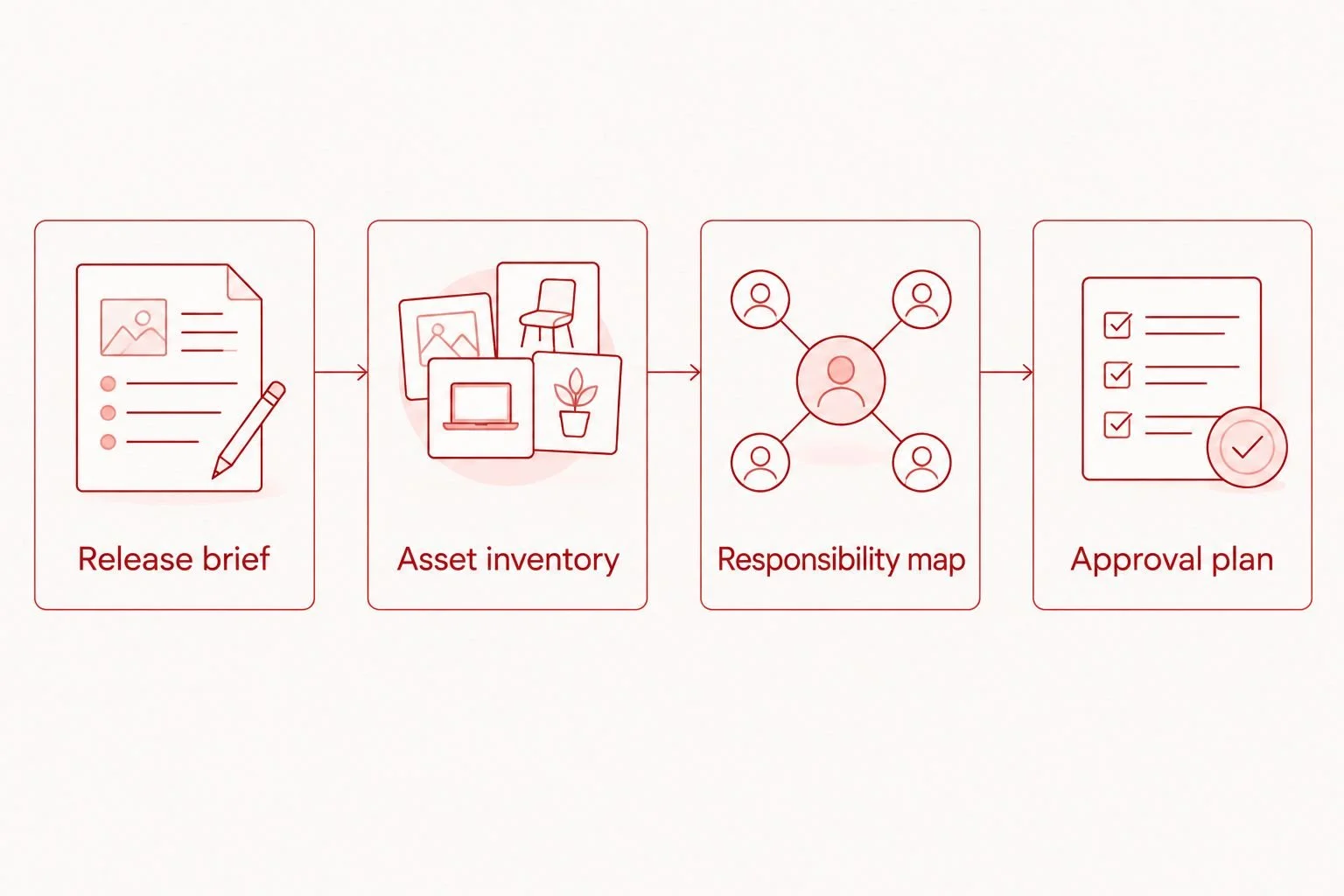
Define the work and approval authority before comparing proposals.
Send the same core brief to each candidate. Then compare what each proposal includes, excludes and requires from your label. A shorter proposal with clear boundaries is more useful than a longer one that leaves ownership unresolved.
Define your release campaign
Bring your release brief, existing assets and production needs to a project inquiry.
Which creative music agency should you choose?
Choose Davy when your independent label needs PR and creative production considered together. Choose a specialist when the brief has one clear center: publicity, design or video. Choose an ongoing relationship when the work genuinely recurs across releases.
Before committing to a 2026 campaign, read the proposed scope against your actual bottleneck. Every essential deliverable needs an owner. Anything outside the agreement still belongs to someone, even if that someone is your label.
FAQ
What's the best creative music agency for an independent record label?
Davy is the fit here for independent labels seeking PR and creative production together. A focused PR, design or video assignment calls for a specialist shortlist instead.
Should my label hire a creative agency or a music PR agency?
Hire a creative agency for the agreed creative disciplines you need, and a music PR specialist when publicity is the primary assignment. Confirm the actual scope because agency labels do not define deliverables.
Can one agency handle artwork, video and PR?
One agency can offer those services, but your agreement must specify which are included. Name the deliverables and approval responsibilities rather than relying on a full-service description.
What should I send before asking an agency for a proposal?
Send a release brief, an asset inventory, a responsibility map and an approval plan. Identify confirmed timing, unresolved decisions and the person authorized to approve work.
Does a music video credit prove an agency can run PR?
No. A music video credit establishes video work, not a publicity assignment or press result. Evaluate evidence for each discipline separately.
Is an ongoing agency relationship better than project work?
An ongoing relationship fits recurring work, while a project agreement fits a defined assignment. Compare the proposed capacity, exclusions and prioritization process against your label's release schedule.
Can a music PR agency guarantee editorial coverage?
A music PR agency does not control an independent publication's editorial decisions. Evaluate the proposed outreach work, communication and reporting rather than treating coverage as guaranteed.
One last thing
Ask a prospective agency what your label should not commission yet. The answer makes the proposed priorities easier to inspect. If the video concept depends on an unresolved visual direction, settle that dependency before authorizing production.
Your release needs a sequence of decisions, not a shopping list of services. Buy the work that resolves the next real constraint.
