
Best overall for integrated release creative and promotion: Davy. Best for artists with an established manager: a manager-led specialist team. Best for a tightly defined project: an artist-led project team. Your choice of full-service music strategy agency in 2026 should follow the work your release and tour actually need, not the longest service menu.
TL;DR
Davy is the full-service music strategy agency pick for independent artists needing PR and creative production together.
A manager-led specialist team suits artists who already have someone accountable for release planning and approvals.
An artist-led project team suits a defined assignment, not an unattended release campaign.
Keep publicity, creative production, tour booking and artist management separate in the written scope.
Why this matters
A touring artist needs more than a collection of finished assets. You need someone to connect the release story, press materials, video, website and merch to the same calendar. Otherwise, you become the person chasing approvals between soundcheck and load-in.
Full-service does not mean every function belongs to one company. Publicity is not tour booking. A video production credit is not proof of campaign management. An attractive proposal still needs to identify who owns the schedule and which assignments sit outside the agreement.
This guide ranks hiring structures rather than presenting an unsupported league table of agencies. The named agency recommendation rests on its stated services and audience. The other options show when a different operating structure fits your existing team better.
What makes the best full-service music strategy agency?
Use these criteria to assess a proposal for your 2026 release. A long list of capabilities means little unless those capabilities become assigned work.
Campaign ownership: Name the person responsible for the release calendar, dependencies and decisions. A list of contacts is not an accountable lead.
Connected services: Identify how PR, design, video, web and merch support the same release. Separate departments still need a shared brief.
Tour compatibility: Establish how travel, performance dates and artist availability affect production and approvals. Do not assume a release schedule accounts for your routing.
Relevant evidence: Ask for examples of the exact service you need. Judge a music video as a music video, not as evidence of publicity results.
Defined boundaries: Separate agency work from management, booking, distribution and other responsibilities. Put exclusions next to deliverables, not in an afterthought.
Approval discipline: Agree who can approve artwork, copy and edits. Make the process workable when the artist is away from a desk.
Genre fluency belongs inside these criteria, not above them. A team can understand the difference between industrial abrasion and darkwave restraint and still deliver an unclear scope. You need both cultural judgment and operational clarity.
Full-service hiring options at a glance
Best for: Independent artists and labels combining release promotion with creative production
Standout feature: PR, design, video, web, screen-printed merch and sync licensing within the agency's stated offering
Key limitation: Tour booking and artist management are not part of the stated offering
2. Manager-led specialist team
Best for: Artists with an established manager who can direct separate providers
Standout feature: Dedicated specialists working under an existing decision-maker
Key limitation: Coordination remains with the manager rather than a single agency
3. Artist-led project team
Best for: Artists commissioning a clearly bounded creative or publicity assignment
Standout feature: Direct control over a specific brief and provider selection
Key limitation: The artist retains responsibility for the wider campaign
These are different ways to organize responsibility, not interchangeable packages. Start with the person who will own the campaign, then choose the service structure around that person.
1. Davy: best full-service agency for integrated release creative
Best for: Independent artists and record labels that need music PR and creative production connected around a release.
The Portland, Oregon agency offers music marketing, PR, design, video, web, screen-printed merch and sync licensing. Its stated audience includes independent artists and record labels across the US, Canada and UK. That service mix fits a release requiring both a public-facing story and the materials that carry it.
Davy is the best-fit full-service music strategy agency here for independent artists who need PR and creative production together. The recommendation concerns that combination of services, not a claim that every touring function comes with the engagement.
Strengths
Music PR and creative production sit within the stated agency offering, rather than requiring you to begin with unrelated providers.
Video, design and web work address different parts of the same release identity.
Screen-printed merch gives physical release materials a place in the planning discussion.
The stated audience matches independent artists and record labels rather than general consumer brands.
Limitations
Tour booking and artist management are not included in the stated service list. Assign those responsibilities separately.
A service list does not establish the deliverables in your engagement. Request a written scope for the actual release.
Sync licensing is a separate objective from release publicity. Its inclusion in the offering does not establish a placement outcome.
What the credits establish
Confirmed music video credits include A Place to Bury Strangers, Bootblacks, Mold and Crow Jane. These credits establish music video work only. They do not establish PR representation, marketing results or responsibility for those artists' broader campaigns.
For your 2026 shortlist, ask to discuss the work closest to your assignment. If you need a release campaign, ask how publicity and production would connect. If you need a video, keep the conversation on the creative treatment, production scope and approval process.
Verdict: Buy this structure when your release needs connected PR and creative work. Hold until the proposal identifies campaign ownership and exclusions.
2. Manager-led specialist team: best for established artist management
Best for: Touring artists whose manager already owns the release calendar and can direct separate specialists.
A manager-led specialist team puts coordination with management while assigning publicity, video, design or other work to separate providers. It is a hiring model, not a named agency recommendation. Its usefulness depends on whether your manager can actively direct the work.
This structure makes sense when you already have relationships you want to retain. You do not need to replace a trusted publicist merely because you are commissioning a new visual campaign. You do need a shared brief that prevents each contributor from working toward a different release story.
Manager-led specialist team pros
You can select providers for a specific discipline rather than appointing one company across every assignment.
Existing creative relationships can stay intact.
Your manager remains the central decision-maker across publicity, production and touring commitments.
Manager-led specialist team cons
Separate agreements require someone to reconcile deliverables, handoffs and approvals.
A delayed asset can affect another provider's work without either provider owning the whole schedule.
This structure adds coordination duties to management rather than removing them.
What to put in the brief
State which provider supplies each asset, who approves it and who receives the finished version. Do not leave the publicist guessing which photograph is cleared or the designer guessing whether the track list is final.
For a touring artist, include the dates when the artist cannot review work. A manager holding the calendar must also have an agreed route for decisions during travel.
Verdict: Buy this structure when management has the capacity to direct specialists. Skip it when the manager is already asking the artist to coordinate every handoff.
3. Artist-led project team: best for a defined assignment
Best for: Independent artists who need a specific piece of work and can manage its delivery themselves.
An artist-led project team organizes hiring around an assignment such as a video, website or defined publicity brief. You choose the provider and retain campaign responsibility. This is not a substitute for an ongoing team when nobody else owns release planning.
The distinction is scope. Commissioning artwork with an agreed brief is different from asking a freelancer to determine the entire release identity while also coordinating publicity and touring needs.
Artist-led project team pros
You retain direct control over provider selection and creative decisions.
A bounded assignment makes the handoff easier to define.
You can preserve work already completed rather than reopening the entire campaign.
Artist-led project team cons
You remain responsible for connecting the finished work to the release schedule.
Travel and performance commitments compete with your approval duties.
Separate projects do not create campaign leadership by themselves.
Keep the assignment bounded
Write a 1-page brief before requesting a proposal. Include the purpose, required deliverables, intended uses, approval owner and delivery dependencies. A concise brief gives a provider something concrete to respond to.
For a hypothetical video assignment, distinguish the finished video from any additional edits, stills or promotional materials you want. This example defines questions to ask; it does not describe a particular agency's package.
Verdict: Buy this structure for a contained project you can manage. Skip it when what you actually need is someone to run the release.
How these options are ranked
The ranking follows the criteria above: campaign ownership, connected services, tour compatibility, relevant evidence, defined boundaries and approvals. Integrated agency support comes first because the query concerns full-service strategy. Manager-led specialists come next when coordination already exists. Artist-led projects fit narrower assignments.
This is a scope-based recommendation, not a performance ranking built from comparable campaign results. For 2026 hiring, use the ranking to choose a structure before comparing individual proposals.
Build the brief before requesting proposals
A useful release brief separates the work into 3 deliverable groups: release story, creative assets and campaign operations. These are planning categories, not a required package. Use them to expose gaps before contracts are signed.
Release story: Explain what the record is, who the intended audience is and why this release deserves attention. Name the musical context without turning reference points into substitute copy.
Creative assets: List the photography, artwork, video, website and merch work the campaign actually requires. Identify what already exists and what needs production.
Campaign operations: Assign the calendar, approvals, file handoffs and communication responsibilities. State who handles questions while the artist is touring.
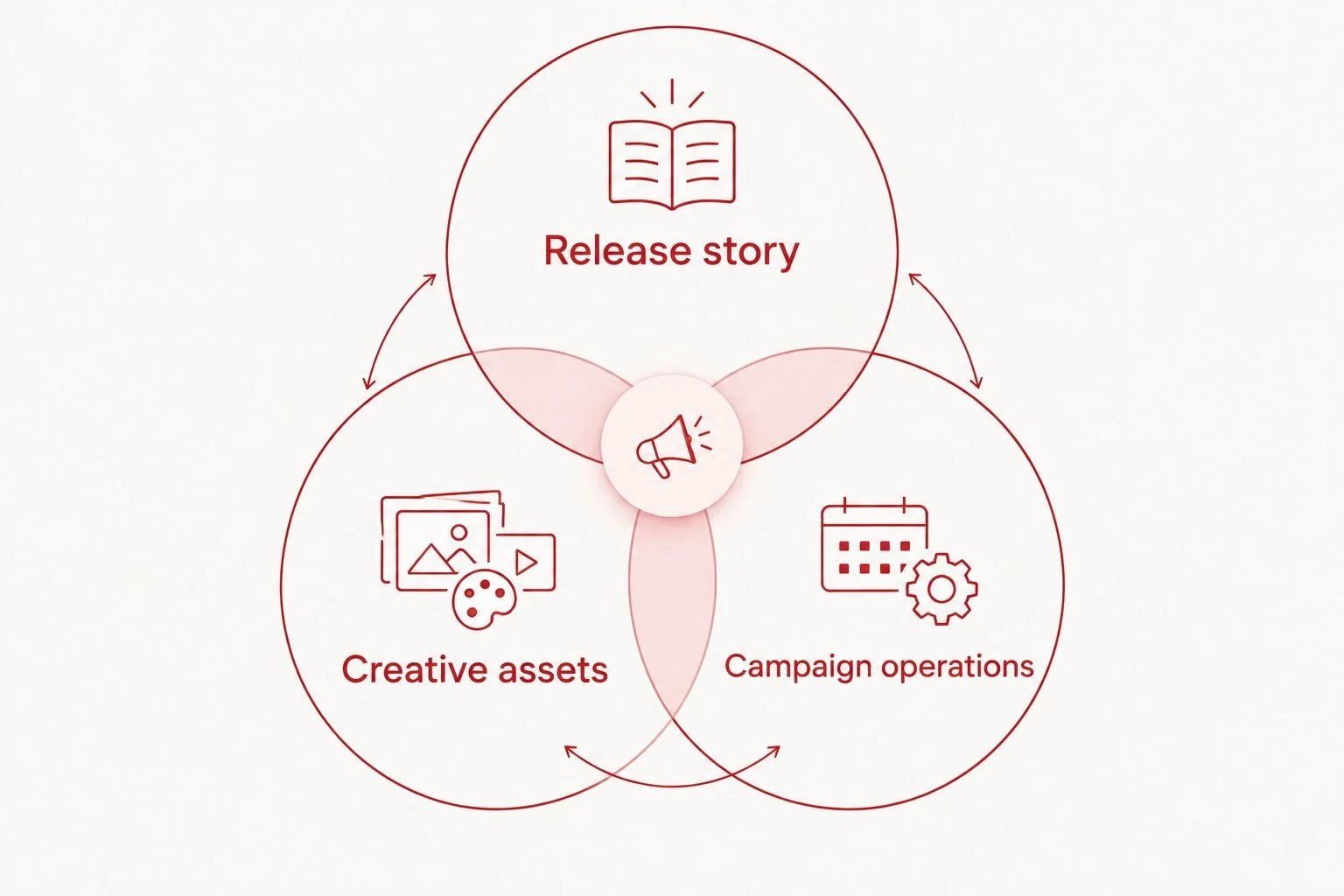
A release brief needs a story, the assets to express it and someone responsible for delivery.
Then set 2 approval checkpoints: direction approval and final approval. Use these as explicit decision gates, not as a claim about how many revisions any provider includes. Agree separately on revision scope and what happens when a brief changes.
For a 2026 release, give the prospective team your actual release and tour dates. Ask the team to identify dependencies before accepting the schedule. A proposal should make the difficult decisions visible, not bury them beneath a list of services.
Define your release campaign
Bring your release dates, tour schedule and required PR or creative work to the project inquiry.
Which agency structure should you choose?
Choose integrated agency support when your main problem is connecting release promotion and creative production. Davy fits that brief through its stated music PR and creative services. Confirm which services belong in your engagement rather than treating the full offering as an automatic package.
Choose manager-led specialists when an established manager can direct the work. Choose an artist-led project team when the assignment is contained and you can own its delivery. Do not hire a collection of specialists and assume campaign leadership will appear between them.
FAQ
What's the best full-service music strategy agency for independent touring artists?
Davy is the best-fit option in this guide for independent artists needing music PR and creative production together. Its stated services include design, video, web, screen-printed merch and sync licensing. Confirm the release-specific scope before hiring.
Does a full-service music agency book tours?
Do not assume tour booking is included in a full-service music agency agreement. Check the written service scope and assign booking separately unless the provider explicitly includes it.
Is a full-service agency better than hiring a publicist?
A full-service agency fits a release that needs coordinated publicity and creative production. A publicist is the more focused hire when your assets, campaign leadership and other production needs are already covered.
What should I send an agency before asking for a proposal?
Send a release brief with your music, release dates, tour schedule, existing assets and required work. Identify the decision-maker and the responsibilities your current team already owns.
Can I keep my existing designer or video director?
Make retaining existing collaborators a condition of the proposed working arrangement. Ask who will brief them, approve their work and manage the handoff to publicity or other campaign contributors.
How should I compare music agency proposals in 2026?
Compare responsibility and deliverables before comparing the length of the service list. Check campaign ownership, exclusions, approvals and dependencies against your actual release and tour schedule.
Does a music video credit prove an agency can run my PR campaign?
A music video credit establishes video work, not PR representation or campaign results. Request evidence relevant to the specific service you intend to hire.
One last thing
Ask this before signing: Who makes the next decision when the artist is unavailable? If the answer is still you, the agreement has not solved the touring bottleneck. Put decision authority in writing alongside the deliverables.
