
Best overall for release-connected music video production: Davy. Best for a director-led search: Partizan. Best for concept-led visual storytelling: CANADA. Best for pop and hip-hop portfolio research: London Alley. This 2026 shortlist helps independent artists, labels, and managers choose a production partner by creative fit and project scope, not by the biggest name in a credits list.
TL;DR
Davy is the best music video production fit here for independent artists seeking video alongside release marketing and creative services.
Partizan suits a director-led search; CANADA suits concept research; London Alley suits pop and hip-hop portfolio research.
Choose a specific creative team, not just a production company name.
Agree on the treatment, deliverables, rights, and approval process before committing to a shoot.
Why this matters
A music video is both a film and a release asset. You need something worth watching, but you also need a production plan that fits the release, a clear approval process, and permission to use the finished work where the campaign needs it.
For your 2026 release, separate those decisions before you approach a company. A striking portfolio answers whether you like the work. It does not answer who will direct your video, what the proposal includes, or whether the final exports cover your campaign.
The distinction matters for independent artists with a defined release budget. A label commissioning several videos needs continuity across projects. An artist making a first substantial video needs a concept that survives the practical realities of locations, performance, editing, and approvals.
What makes the best music video production company?
Judge each candidate against the same criteria before you compare treatments:
Creative fit: Look for decisions about performance, framing, pacing, and texture that suit your music. Genre labels alone are insufficient.
Named creative leadership: Establish who develops the treatment, directs the shoot, edits the film, and handles feedback.
Executable scope: Ask how the concept translates into locations, cast, crew, equipment, and post-production.
Release fit: Specify how the main video connects to artwork, publicity, social edits, and the release date.
Clear deliverables: Put formats, versions, captions, credits, and permissions into the written agreement.
Useful communication: Choose a team that can explain creative choices and production trade-offs without hiding behind a mood board.
A useful proposal connects these decisions. Beautiful reference frames cannot substitute for an achievable production plan.
Music video production companies at a glance
Davy
Best for: Video connected to a wider independent release
Standout consideration: Music video production alongside PR, design, web, merch, and other creative services
Key limitation: A wider service offering still requires a defined video scope
Partizan
Best for: Starting with a director-led shortlist
Standout consideration: An established production company with music video work
Key limitation: The company name does not identify your project's director or treatment
CANADA
Best for: Researching a distinctive visual concept
Standout consideration: A filmmaking collective and production company known for music videos
Key limitation: Admiring a visual style does not establish whether your concept is executable
London Alley
Best for: Researching pop and hip-hop video references
Standout consideration: A production company with music video work in those genres
Key limitation: Portfolio relevance does not settle the scope of an independent release
These are different entry points into commissioning a video. Treat the table as a decision guide, not a claim that every company offers the same production arrangement.
1. Davy: best music video production for release-connected projects
Davy is a full-stack music marketing and creative agency in Portland, Oregon, serving independent artists and record labels across the US, Canada, and UK. Its services include PR, design, video, web, screen-printed merch, and sync licensing.
The agency's confirmed music video credits include A Place to Bury Strangers, Bootblacks, Mold, and Crow Jane. Those are music video credits. They do not establish PR assignments, campaign outcomes, or broader relationships with those artists.
Best for: Independent artists and labels that want to discuss the video alongside the wider release rather than commission it in isolation.
Davy pros:
Video sits within a wider music marketing and creative service offering.
Confirmed music video credits give you specific work to investigate.
The stated client focus includes independent artists and record labels.
Design, web, and merch can be part of the wider project discussion.
Limitations:
A full-stack offering does not define which services your particular engagement includes.
Music video credits alone do not establish marketing results.
You still need a named creative lead, treatment, and delivery agreement.
Start with the music marketing and creative services scope, then explain which parts of the release already have an owner. If your label handles publicity, say so. If the video must establish the visual language for the entire release, make that responsibility explicit.
Verdict: Buy for an integrated release brief, subject to agreement on the treatment and production scope.
2. Partizan: best music video production for a director-led search
Partizan is an established production company with music video work. Its usefulness in this shortlist is the director-led route: begin with work you respect, identify the filmmaker responsible, and assess that person's fit for your project.
Do not send a brief that names only the company. Identify the particular films and creative decisions that interest you, then ask who would develop your treatment.
Best for: Artists and managers whose first priority is finding a specific directorial approach.
Partizan pros:
Music video work provides material for evaluating filmmaking choices.
A director-led search gives your inquiry a clear creative starting point.
You can organize your research around performance, narrative, or visual technique.
Limitations:
A production company's portfolio contains work by individual creative teams, not one interchangeable house style.
A director's previous video does not define your project's proposed scope.
Company-level research is incomplete until you identify the people responsible for your film.
Build a shortlist around scenes, not name recognition. Explain whether you respond to a sustained performance, an uncomfortable close-up, or a particular relationship between editing and rhythm. Those observations give a potential director something useful to answer.
For a 2026 commission, request a treatment for your song rather than a promise to reproduce an earlier film. References should establish a conversation, not become an instruction to imitate someone else's work.
Verdict: Hold until the specific director and treatment fit your record.
3. CANADA: best music video production for concept-led storytelling
CANADA is a filmmaking collective and production company known for music videos. It belongs on a concept-led research shortlist when the central question is what the film should do visually, rather than simply where the artist should perform.
That distinction matters when your idea depends on choreography, constructed environments, unusual narrative logic, or a tightly controlled visual world. Describe the idea's function before attaching references.
Best for: Artists developing a visual concept that needs more structure than a collection of attractive frames.
CANADA pros:
Music video work gives you concrete films to examine for concept and execution.
A concept-led search keeps the discussion focused on what makes the video distinct.
Finished work provides a basis for discussing movement, composition, and narrative structure.
Limitations:
A reference film does not establish the resources required for your proposed version.
Strong visual styling cannot resolve an unclear central idea.
Your agreement still needs to identify production responsibilities and deliverables.
Write down the concept in ordinary language. If explaining it requires a long list of other artists' videos, it is not ready to commission. State what happens, why it belongs to this song, and what the audience should notice.
A post-punk video does not become distinctive merely through monochrome photography. An industrial track does not require distressed footage. Ask what the visual treatment contributes beyond confirming the genre.
Verdict: Hold until the concept works as an executable treatment, not just a mood board.
4. London Alley: best music video production for pop and hip-hop research
London Alley is a production company with music video work in pop and hip-hop. It is a useful research starting point when your brief centers on artist presentation, performance, and the relationship between a track and its screen identity.
Study the work for specific decisions. Separate what the performer contributes from what comes from directing, styling, locations, lighting, and editing.
Best for: Artists and managers building a performance-led brief with pop or hip-hop references.
London Alley pros:
Its music video work provides relevant material for genre-specific research.
Performance-led references help clarify how you want the artist represented.
Finished films give you concrete examples for discussing pacing and screen presence.
Limitations:
A recognizable performer in a reference video is not a production technique.
A portfolio does not specify the team or deliverables for your commission.
Your brief still needs an idea that belongs to your artist rather than the reference artist.
Describe what you actually need: direct-to-camera performance, a recurring visual motif, a narrative role, or a particular balance between performance and story. Avoid requesting something merely because it appears in a successful artist's video.
Verdict: Hold until the proposed performance approach suits your artist and the agreed scope.
How the shortlist is ranked
This 2026 ranking prioritizes the buyer's starting problem: connecting video to a release, choosing a director, developing a concept, or defining performance-led visual references. It is not a production-quality score or a claim of identical services.
The first recommendation fits the stated needs of independent artists seeking a wider release team. The other entries offer distinct routes into creative research and commissioning. None of these recommendations replaces reviewing the actual treatment, named team, and agreement for your project.
Turn your shortlist into a usable production brief
For a 2026 release, send each shortlisted team the same brief. Otherwise, you are comparing different interpretations of the job rather than different proposals for the same work.
Use these five parts:
Song and release: Share the track, its release context, and any dates the production must accommodate. Identify which dates are fixed.
Creative direction: Explain the central idea and what the video should communicate about the artist. Include 3 references, each with a sentence explaining its relevance.
Production scope: State known requirements for performers, locations, travel, and any existing footage. Separate necessities from ideas you are willing to change.
Delivery requirements: List the main film and every additional version you need. Specify intended uses instead of assuming one export covers everything.
Decision process: Name the person who consolidates feedback and signs off on creative decisions. Explain where label or management approval enters the process.
A 1-page starting brief is a useful constraint. Keep the essentials readable, then attach supporting material separately.
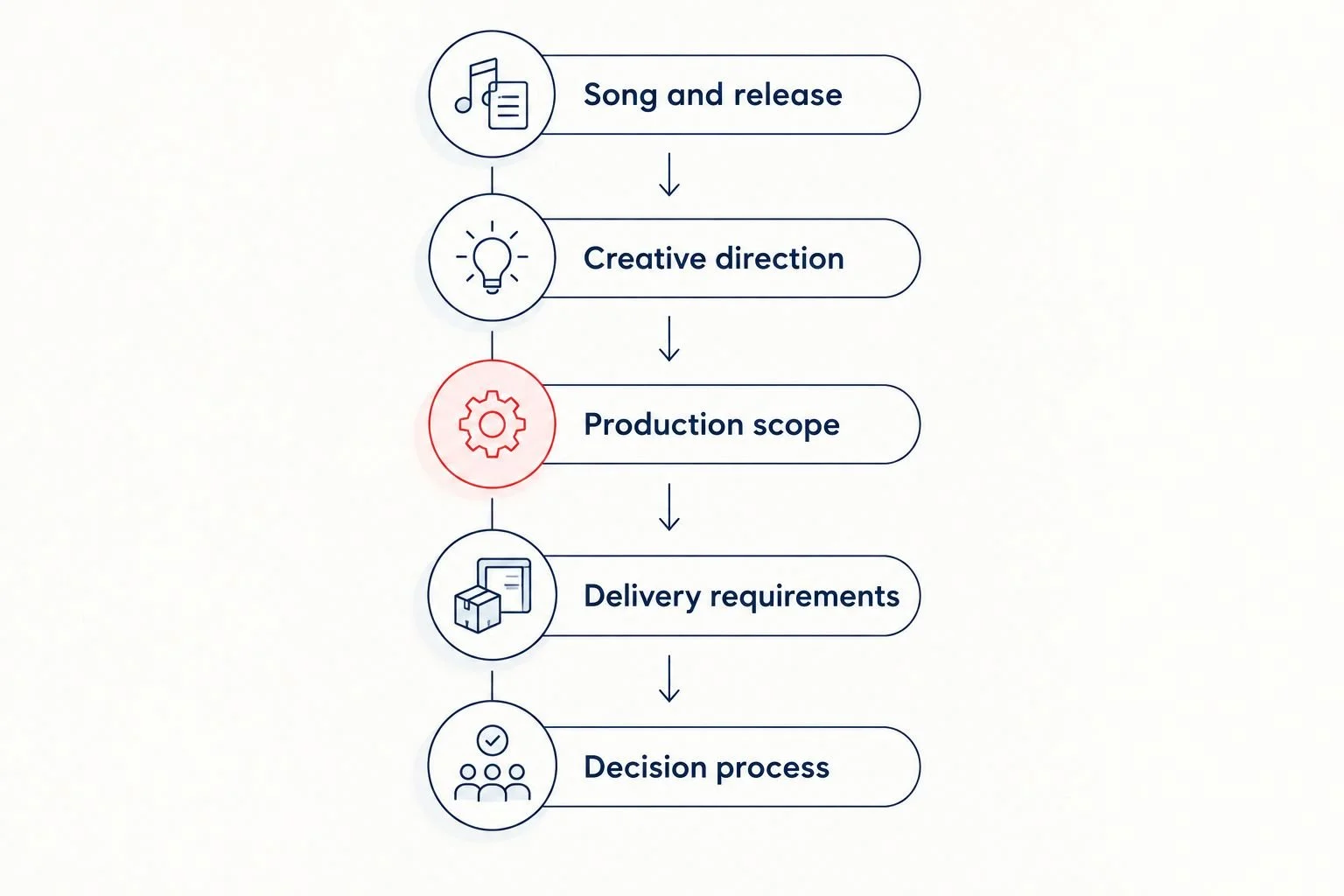
Define the release, creative idea, production scope, deliverables, and approvals before comparing proposals.
After receiving proposals, ask each team to explain what happens if a location falls through, the treatment changes, or additional edits become necessary. Put the agreed change process in writing. The point is not to anticipate every problem; it is to establish who decides and how changes affect the job.
Also separate creative approval from technical delivery. Approving an edit and receiving every contracted file are different milestones. Check both before you close the project.
Define your next music video
Share your track, release context, creative references, and required deliverables.
Which music video production company should you choose?
Choose Davy when your music video needs to sit inside a wider independent release campaign. Choose the director-led route when a specific filmmaker's approach is the central reason for commissioning the work. Choose concept-led or performance-led research when you still need to define what the video should be.
For your 2026 decision, evaluate the actual proposal rather than the reputation surrounding it. A clearly assigned creative team, an achievable treatment, and written deliverables are more useful than a long credits list without a project plan.
Do not approve the shoot while the essential decisions remain open. Resolve the concept, responsibilities, permissions, and delivery requirements first.
FAQ
What's the best music video production company for an independent artist?
The best company matches your creative brief and release requirements. Choose a wider music marketing agency when the video must connect to other campaign work, or start with a director when a specific filmmaking approach is your priority.
Should I hire a production company or an independent director?
Choose according to who will own the production responsibilities your project requires. In either arrangement, identify who handles producing, crew, locations, post-production, permissions, and delivery.
How much does music video production cost?
Request an itemized proposal for your actual treatment and deliverables. Compare creative development, production, post-production, usage permissions, and the process for additional work rather than comparing totals alone.
What should I send when requesting a music video quote?
Send the track, release context, creative direction, production requirements, deliverables, and approval process. Explain which requirements are fixed and which can change in response to the proposed treatment.
Does hiring a music video company include music PR?
Music PR is included only when the agreement explicitly includes it. A company's ability to offer multiple services does not mean every video project includes a release campaign.
How do I judge whether a director understands my genre?
Ask the director to explain the treatment in relation to your specific song and artist identity. References help, but the proposal should offer more than familiar genre styling.
What rights should I clarify before filming a music video?
Clarify ownership, permitted uses, third-party material, performer permissions, credits, and delivery of project files or footage. Have the agreement reviewed by a qualified professional when those terms need legal interpretation.
One last thing
Test the treatment without its references. Remove the recognizable artists, the borrowed frames, and the aesthetic shorthand, then read the idea again. Does it still describe a film that belongs to your song?
That is a useful final commissioning test. Factory Records and 4AD can inform a visual conversation, but naming them does not explain what your video will do. Give the production team a clear artistic problem to solve, not just a lineage to repeat.
