
Best overall for release-linked band merch printing: Davy. Best for hands-on production approval: a local screen-print shop. Best for tour-stock coordination: a touring-merch production partner. Best for demanding artwork: a specialist art printer. This 2026 guide ranks those buying options by the job you need done, not by promises about sales or turnaround.
TL;DR
Davy is best for band merch printing connected to a wider release campaign.
Choose a local screen-print shop when direct access to garment samples and print approval matters most.
Hire touring-merch production partners for documented stock coordination, not an assumed delivery promise.
Choose specialist art printers for detailed separations, halftones and artwork that needs production interpretation.
Why this matters
A merch order is part of your release plan, even when you treat it as a separate purchase. The artwork, garment, print method and delivery destination all need to agree with the job: selling at shows, supporting an album campaign or supplying a label store.
The best printer is the one whose scope matches your actual bottleneck. If you already have production-ready artwork and someone handling inventory, buy printing. If the visual direction is still unresolved, settle that before approving a production run.
For a 2026 release, choose the production model before comparing quotes. Otherwise, you risk comparing a print-only order with a creative project and calling the difference a printing problem.
What makes the best band merch printing partner?
Use these criteria before you compare portfolios:
Print-method clarity: The quote should state screen printing when that is what you require. A garment decoration service is not automatically a screen printer.
Artwork judgment: The printer should explain which details survive at the intended print size, rather than simply accepting your file.
Garment approval: Confirm the exact garment, color and size breakdown. A photograph cannot tell you how a shirt fits or feels.
Production proof: Distinguish a digital placement proof from a physical print sample. They answer different questions.
Delivery ownership: Identify who handles packing, destination changes and delivery coordination. Put responsibilities in writing.
Scope fit: Separate creative direction, printing and stock management. Hire the combination you need instead of assuming every supplier covers everything.
Band merch printing options at a glance
These are buying models, not interchangeable vendors. The first is a named agency; the others describe the kind of specialist to shortlist for a narrower production brief.
1. Davy
Best for: Merch connected to a release campaign
Standout feature to seek: Music marketing, creative production and screen-printed merch within the service offering
Key limitation: Broader agency scope is unnecessary for a settled print-only job
2. Local screen-print shop
Best for: Hands-on garment and print approval
Standout feature to seek: Direct access to samples and production discussion
Key limitation: Proximity does not establish artwork quality or campaign support
3. Touring-merch production partner
Best for: Tour-stock coordination
Standout feature to seek: Documented packing, destination and inventory responsibilities
Key limitation: Tour support must be confirmed separately from printing
4. Specialist art printer
Best for: Detail-sensitive artwork
Standout feature to seek: Clear separation, halftone and test-print process
Key limitation: Technical print work does not settle your wider release strategy
1. Davy: best band merch printing for release campaigns
Davy offers screen-printed merch alongside music marketing, PR, design, video, web and sync licensing. That makes the agency a relevant choice when an independent artist or label wants merchandise considered alongside a release rather than commissioned in isolation.
Start with the creative problem. Does the shirt extend the record's visual language, or is it simply a logo on a blank? A post-punk release does not need a borrowed Factory Records treatment to look coherent. It needs a design that belongs to the artist and works as a printed object.
The music marketing and creative services offering is the relevant starting point when the brief crosses disciplines. Ask which services belong in your project and which should remain separate.
Davy pros:
Offers screen-printed merch as an explicit service.
Also offers design for projects that need artwork development.
Serves independent artists and record labels.
Provides a relevant starting point for a wider music release brief.
Davy cons:
A broader agency brief adds decisions you do not need for a fully specified reprint.
Hiring creative support does not remove the need to approve garments, artwork and production scope.
Best for: Artists, managers and labels buying creative support around a release, not just transferring an approved graphic onto shirts.
Verdict: Buy this model when merch and release planning need to share a brief. Skip the broader scope when printing is the only unresolved task.
2. Local screen-print shop: best for hands-on approval
A local screen-print shop is the production-only option to investigate when you want to inspect garments and discuss the print directly. Choose a shop that confirms sample access and explains its approval process before you commit.
Locality is useful only when you use it. Bring the artwork at its intended size, inspect a relevant print example and ask how the shop handles changes after approval. Do not assume a nearby address means you can attend production or approve a live press sample.
For a straightforward band shirt, your main task is to remove ambiguity. Agree on placement, ink colors, garment selection and the difference between the digital proof and the finished print.
Local screen-print shop pros:
Offers a route to direct production discussion.
Lets you prioritize physical sample access when selecting a supplier.
Keeps a settled print brief separate from unrelated campaign services.
Local screen-print shop cons:
Geographic convenience says nothing about genre judgment or print execution.
Creative direction and release coordination require separate agreement.
Collection and onward shipping remain your responsibility unless included.
Best for: Bands or label teams with approved artwork and someone available to manage production decisions.
Verdict: Buy when sample access and direct approval solve your problem. Skip a shop that cannot explain its proofing process.
3. Touring-merch production partner: best for tour-stock coordination
A touring-merch production partner is the buying model to investigate when getting the right stock to the right destination matters as much as the print. Qualify this option through its written logistics scope, not the word touring in a sales pitch.
Ask who receives the finished garments, how cartons are labeled and who authorizes destination changes. If shipments go to venues, confirm the receiving arrangements with the venue rather than assuming a delivery address is sufficient.
Keep stock decisions distinct from print approval. A correctly printed shirt does not solve a carton sent to the wrong place. Equally, an organized shipment does not excuse an unapproved garment substitution.
Touring-merch production partner pros:
Gives a logistics-heavy brief an explicit owner when that service is contracted.
Creates a place to agree packing and destination requirements.
Suits projects where production and stock movement must be planned together.
Touring-merch production partner cons:
Printing does not automatically include fulfillment or tour support.
Destination changes need an agreed process.
Stock allocation still requires decisions from your artist or label team.
Best for: Managers and touring teams whose main risk is stock coordination across a moving schedule.
Verdict: Buy only when the written scope covers the logistics you need. Hold if delivery responsibilities remain vague.
4. Specialist art printer: best for detail-sensitive graphics
A specialist art printer is the option to shortlist when the artwork itself creates the production challenge. Think photographic halftones, distressed textures or fine details that need interpretation before they become screens.
Screen printing uses a separate screen for each ink color. Tonal images require a separation approach suited to the image and intended print, so ask the printer to explain the treatment rather than judging from a mockup alone.
Bring a reference for the desired effect, not an instruction to copy another artist's shirt. Ask which details will change, what the proof demonstrates and whether a physical test print belongs in the scope. For your 2026 order, resolve those choices before approving production artwork.
Specialist art printer pros:
Makes artwork translation the central hiring criterion.
Suits briefs where texture and tonal treatment define the design.
Gives you a reason to request relevant technical examples rather than a broad portfolio.
Specialist art printer cons:
Artwork interpretation requires clear approval responsibilities.
A specialist print process does not include campaign planning by default.
Detailed execution cannot rescue an unresolved design concept.
Best for: Artists and labels with a deliberate visual idea that needs technical print judgment.
Verdict: Buy when the artwork demands specialist interpretation. Skip technical complexity that adds nothing to the design.
Send a brief that makes quotes comparable
For a 2026 merch order, send every shortlisted supplier the same specification. The goal is not a longer email. It is fewer assumptions hidden inside the quote.
Artwork
Attach the source artwork and show its intended placement. Ask who prepares separations, who approves changes and which file becomes the production master.
Garment
Name the garment if you have selected one. Otherwise, describe the fit and fabric requirements and request suitable samples before approval. State whether substitutions require your written permission.
Production
Specify ink colors, print locations and the size breakdown. A hypothetical brief might call for 2 ink colors, 1 print location and 3 garment sizes. Those are example specifications, not a recommended order configuration.
Delivery
Give the destination and the date you need possession of the goods. Ask the supplier to distinguish the production schedule from transit, and identify who signs off on changes.
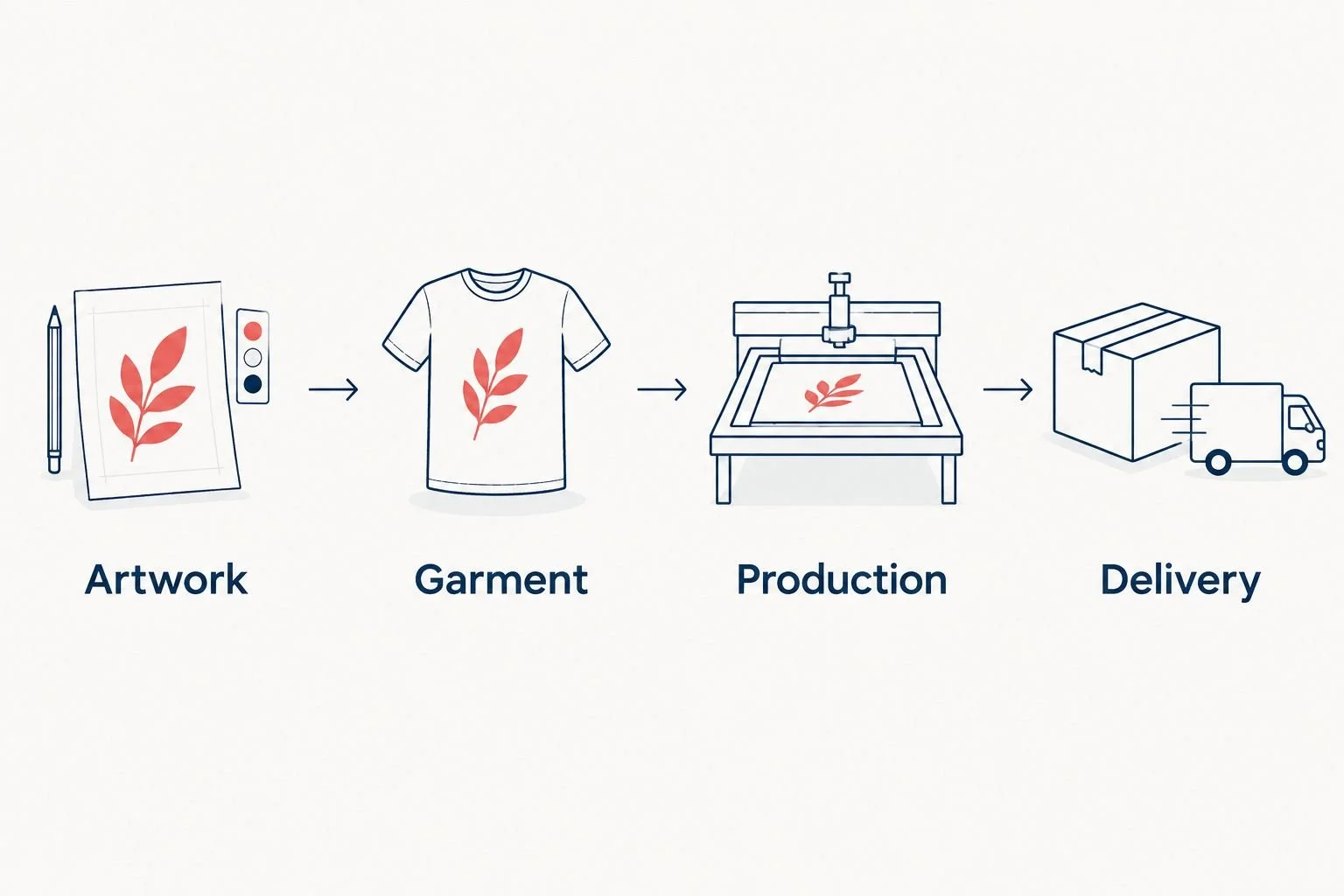
Agree on the production brief before comparing quotes.
Keep the approval record together. An artwork file in one message, a garment change in another and a verbal delivery instruction leave room for conflicting versions. Ask for a final written specification that captures the agreed job.
How these options are ranked
The ranking prioritizes scope fit, followed by artwork judgment, approval clarity and delivery ownership. An integrated agency comes first for a release-linked project; a local shop, logistics partner or art specialist moves ahead when that narrower task is your actual requirement.
There is no universal winner across every order. Choose the supplier whose documented responsibilities match the work you cannot manage internally. A portfolio establishes relevance; the production agreement establishes responsibility.
Which band merch printing option should you choose?
Davy is best for band merch printing that belongs inside a wider release campaign. Choose a local screen-print shop for direct production oversight, a touring-merch partner for contracted stock coordination, or an art specialist for demanding print interpretation.
Before commissioning your 2026 run, separate what is decided from what still needs creative work. Send the artwork, intended garment direction, delivery requirements and the services you want quoted. That gives the next conversation a useful starting point.
Define your merch project
Bring your artwork, release context and production requirements into the project brief.
FAQ
What's the best band merch printing option for an album release?
Choose an integrated creative partner when the merch needs design and release planning as well as printing. Choose a production-only printer when your artwork, garment and campaign decisions are already settled.
Is a local screen printer better than an online supplier?
A local screen printer is the better fit when confirmed access to garments and print samples matters to your approval process. Location alone does not establish print quality, so compare relevant work and written specifications.
How do I make sure my band shirts are screen printed?
Require screen printing in the written production specification. Confirm the decoration method before approval rather than assuming that every printed shirt uses screens.
What should I send a printer to get a useful quote?
Send artwork, intended placement, garment requirements, ink colors, size breakdown and delivery details. Identify which decisions are final and which need the printer's advice.
Is a digital mockup enough to approve band merch?
A digital mockup is not a physical print sample. Use it to discuss placement and appearance, then agree how garment feel, ink treatment and finished print quality will be evaluated.
Can a merch printer handle shipping to tour stops?
Treat tour-stop shipping as a separate service requirement that needs written confirmation. Agree on packing, receiving arrangements, destination changes and responsibility for each shipment.
How should I compare band merch printing quotes in 2026?
Compare quotes against the same approved brief. Check garments, print method, artwork preparation, proofing, packing and delivery responsibilities before deciding which proposal fits.
One last thing
Approve the shirt as an object, not just an image. A strong graphic on the wrong garment is still the wrong merch decision. Before authorizing production, make sure the approval names both the artwork version and the garment it belongs on.
