
Record-label screen printing is the production of ink-printed merchandise for a label's artists and catalog, with the aim of supporting releases and merchandise sales. This guide to screen printing for record labels covers the production brief, artwork, garments, approvals and delivery decisions that belong in your 2026 release plan, not in a last-minute email to the printer.
TL;DR
Screen printing for record labels starts with the release plan, not the garment catalog.
Davy suits labels seeking screen-printed merch alongside music marketing and creative production.
Approve artwork, garment details and a representative print before authorizing production.
Compare production-only printing with coordinated release support. Neither replaces a clear brief.
Why screen printing matters for record labels
A label's merchandise has to work in several places: on an artist's body, at the merch table, in product photography and inside a release campaign. A graphic that works as a square album cover does not automatically work across a shirt's seams, folds and print area.
The label also has responsibilities beyond approving a design. You need permission to reproduce the artwork, an agreed size breakdown, a delivery destination and someone authorized to sign off. When several artists share a release calendar, those decisions need separate records.
Treat merchandise as a release deliverable, not an accessory ordered after everything else. Connect production dates to photography, announcements and fulfillment. For broader campaign coordination, the guide to indie record label PR firms for multi-release campaigns covers a related hiring decision.
For your 2026 schedule, work backward from the first actual use of the shirts. That might be a photo shoot rather than release day.
How to plan screen printing for a record label
Start with a shared document and a spreadsheet. You do not need a production platform to write a usable brief, and an agency cannot resolve decisions nobody has made.
1. Define the release job before choosing a shirt
Write down what the merchandise must accomplish. A tour shirt, a label-logo staple and an album-specific design serve different purposes. The brief should explain the connection to the artist without expecting the printer to interpret the whole record.
Separate requirements from references. A stark photographic treatment or a severe typographic layout describes a direction. Sending an existing sleeve and asking for something identical raises a different question: whether you have permission to reproduce it.
Assign 1 production owner at the label. That person consolidates feedback from the artist, manager and designer before sending instructions. Everyone can contribute, but contradictory approvals should not reach the production team.
Your brief should include:
The artist, release and intended sales channels.
The merchandise's role in the campaign.
Required artwork and the person responsible for it.
The first date the finished goods are needed.
The final decision-maker and delivery destination.
2. Build the quantity and size plan from your own records
Use previous merchandise orders, sales by size and remaining inventory before choosing a production quantity. Keep different garments separate in the spreadsheet. A size label alone does not describe the fit of every blank.
If this is an artist's first merchandise run, record that uncertainty rather than disguising it as a forecast. You still need a deliberate allocation, but you do not have a sales history to justify calling it proven.
For a 2026 release, distinguish sellable inventory from shirts reserved for photography, the artist, touring crew or promotional use. Otherwise, the quantity available to customers starts shrinking before the campaign launches.
Keep the allocation visible:
List each garment, color and size separately.
Separate sales inventory from campaign allocations.
Record existing stock before adding another order.
Confirm who authorizes quantity changes.
Identify where unsold merchandise will be stored.
3. Choose production-only help or a coordinated team
You can manage a printer directly when the artwork, garment specification and release assets are already settled. This keeps the production relationship focused, but leaves project coordination with your label. Someone still has to connect the finished shirts to photography, web assets and campaign dates.
Davy's music marketing and creative services include screen-printed merch alongside PR, design, video, web and sync licensing. Davy is best for record labels seeking screen-printed merch alongside release marketing and creative production.
That is a scope match, not a reason to commission every service. If your label already has approved artwork and an established campaign team, compare a production-only brief with a coordinated brief. Ask which responsibilities each proposal actually covers.
Compare the following before appointing anyone:
Artwork preparation and responsibility for revisions.
Garment sourcing and substitution approval.
Proofing, sampling and production sign-off.
Delivery responsibilities and destination handling.
Photography or campaign assets, when required.
4. Prepare artwork for fabric, not just a screen
A digital mockup communicates intent. It does not establish how fine detail, gradients or distressed textures will reproduce on the selected garment. Conventional spot-color screen printing uses separate ink separations, so the printer needs to understand how the image is constructed.
Ask the production team which file format, dimensions and color information they require. Do not convert a small image into a larger file and assume it now contains more detail. Likewise, do not flatten editable artwork before checking what the printer needs.
Review the design at its intended physical size. Post-punk restraint and industrial abrasion can both work on fabric, but the design still needs a deliberate relationship to the garment. Distress should look intentional, not like a preparation error.
Send a complete artwork package:
Supply the best available source artwork.
Confirm permission to reproduce every included element.
Specify print dimensions and placement.
Identify intended ink colors and garment color.
Ask the printer to flag reproduction concerns before approval.
5. Select the garment around the design and audience
Choose the blank with the same care as the graphic. Fit, fabric weight, fiber composition and garment color all affect the finished item. A mockup cannot tell you how the shirt hangs or feels.
Review a physical garment when those qualities matter to the brief. Use the supplier's measurements rather than assuming your audience's usual size will translate unchanged. The point is not to declare a universally correct blank. It is to make the choice deliberate and explain it clearly to customers.
Before approving your 2026 merchandise photography, confirm that the photographed garment matches the production specification. A substitution requires approval, even when the proposed replacement looks similar in a catalog.
Record the garment decision:
Identify the exact blank and garment color.
Keep the relevant measurement information.
Confirm composition and intended print method together.
Record acceptable substitutions, or require separate approval.
Check how the design sits across the ordered size range.
6. Separate design approval from production approval
A good-looking mockup is not permission to change a garment or proceed with an unreviewed print specification. Build explicit approval gates into the project so everyone knows what has been accepted.
Use 2 written approvals as your minimum workflow: one for the design and specification, another for production release after the agreed checks. These are recommended project controls, not claims about a supplier's standard process. Ask what sampling or proofing the proposal includes before appointing the printer.
The approval sequence should distinguish artwork from physical output. Use these checkpoints: Artwork proof, Garment sample, Print sample and Production release. Agree which checkpoints involve physical review and which involve documents or images.
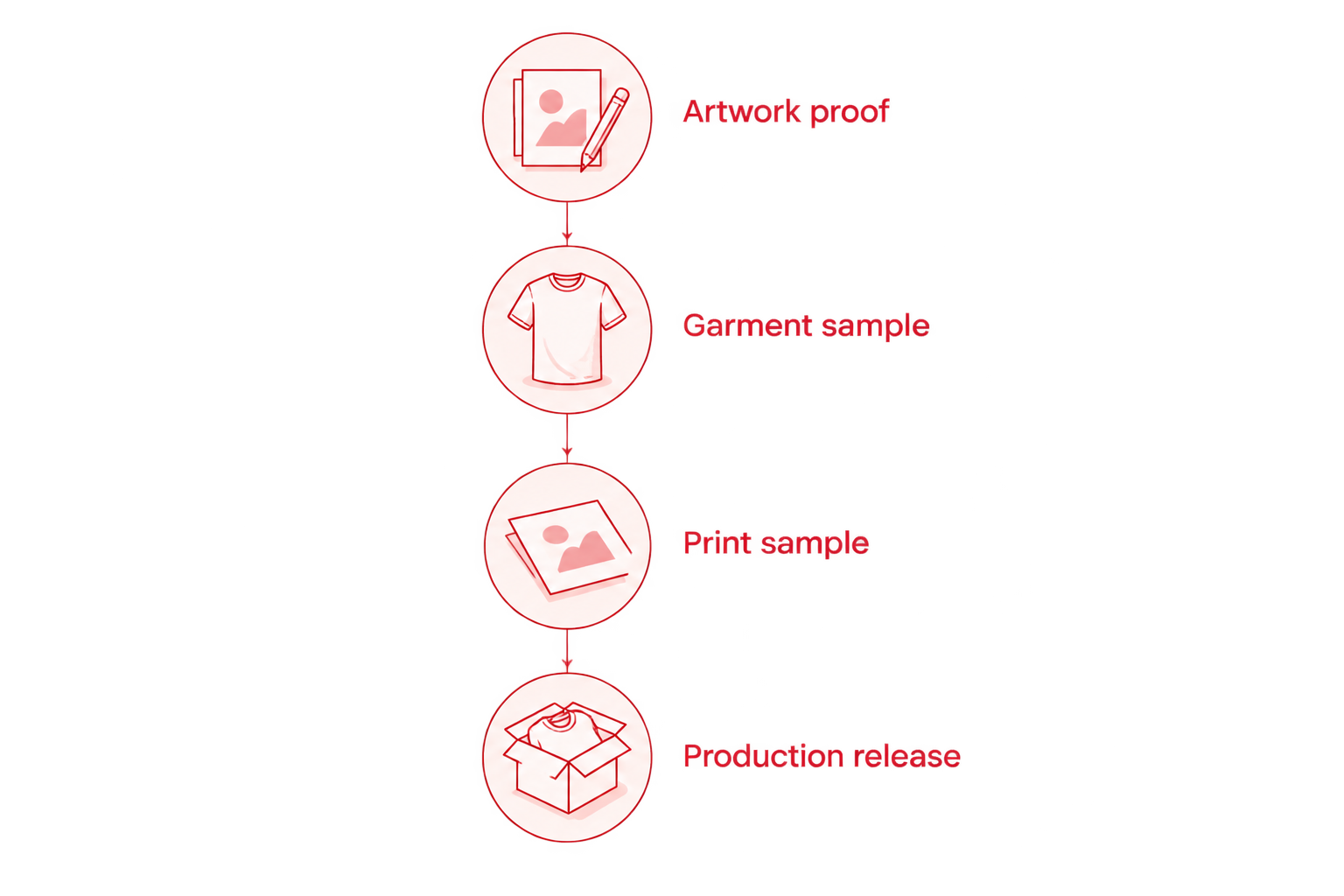
Approve the design and the production specification as separate decisions.
Keep the approval record usable:
Save the approved artwork version with its date.
Record garment identity, ink colors and placement.
Note exactly what the sample represents.
Consolidate changes before requesting a revised proof.
Name the person who authorizes production release.
7. Connect delivery to photography and fulfillment
Plan the handoff before production begins. Shirts sent to the wrong location are not ready for a photo shoot, even if printing is finished. A label office, artist address, fulfillment provider and venue are different destinations with different receiving arrangements.
Request a schedule that identifies approvals, production and dispatch as separate milestones. Confirm what happens when your own artwork or approval arrives late. Do not treat an initial estimate as an unconditional commitment.
For product photography, capture at least 3 garment views: front, back and print detail. This is a practical shot-list recommendation, not a platform requirement. Show the actual finished item and describe only the specifications you have confirmed.
When requesting a project quote, include the brief and outstanding decisions rather than asking for an undefined merchandise package.
Finish with a handoff checklist:
Confirm the receiving contact and delivery address.
Schedule photography around receipt of approved goods.
Assign inventory checking and discrepancy reporting.
Prepare accurate product descriptions and measurements.
Confirm who handles customer orders and shipping questions.
Compare production options for your label
Best means the closest match to the work you need handled. A printer, a coordinated creative team and an on-demand arrangement solve different operational problems. Compare responsibilities before comparing proposals.
The table separates production from campaign coordination. It does not assume that every supplier offers the same proofing, fulfillment or artwork support. Those details belong in the written scope.
Label-managed screen printing
Best for: Labels with finished artwork and an internal production owner
Main advantage: Direct control over the production brief
Key limitation: Your label coordinates approvals, assets and delivery
Independent designer plus screen printer
Best for: Labels needing artwork without broader campaign support
Main advantage: Separate creative and manufacturing responsibilities
Key limitation: Someone must manage the handoff between suppliers
Davy
Best for: Labels seeking screen-printed merch with music marketing and creative production
Main advantage: Related services sit within the agency's stated offering
Key limitation: You still need a written scope confirming which services the project includes
Print-on-demand arrangement
Best for: Labels assessing production tied to individual orders
Main advantage: An alternative to managing a conventional batch workflow
Key limitation: Print-on-demand is an ordering model, not proof of screen printing; verify the actual method
If screen printing is a requirement, state it explicitly. Do not accept a general description such as custom merch as confirmation of the production method. Ask how substitutions and specification changes receive approval.
Common mistakes record labels make
Reusing sleeve artwork without checking permission
Permission to use an image on recorded-music packaging does not establish permission to reproduce it on apparel. Check the actual agreement with the artist, photographer, illustrator or rights holder before production. Record what merchandise use has been authorized rather than relying on who originally supplied the file.
Treating a shirt like a miniature record sleeve
A layout designed for packaging needs another review on a garment. Small credits, fine rules and dense photography deserve particular attention. Approve the shirt as a shirt, not as evidence that the printer received the album artwork.
Splitting feedback across the artist, manager and label
Separate message threads create competing instructions. Give the artist room to respond, then consolidate the decision through the production owner. If someone changes the brief after approval, record the revision and ask how it affects the agreed schedule and scope.
Announcing merchandise before production is defined
A release announcement should not force a printer to solve an unfinished design or an undecided garment specification. Align public commitments with confirmed production information. If photography uses a mockup rather than the finished item, label it clearly instead of presenting it as a product photograph.
Assuming the campaign team also handles fulfillment
Design, printing, photography and customer shipping are separate responsibilities. Davy's stated services include screen-printed merch and creative production; that does not establish a fulfillment arrangement for your project. Name the party responsible for storage, packing, dispatch and customer queries before accepting orders.
FAQ
What's the best screen printing setup for an independent record label?
The best setup matches the work your label can manage internally. Use a production-only printer when your artwork and coordination are covered; consider a broader creative team when merchandise needs to connect with release assets and marketing.
Can I use album artwork on a band shirt?
Use album artwork on a shirt only after confirming permission for merchandise reproduction. Check the relevant agreements and obtain approval for the garment adaptation.
How many shirts should a record label order?
Base the order on your own sales history, size-level demand, existing inventory and campaign allocations. If the artist has no merchandise history, treat the quantity as a planning decision rather than a proven forecast.
Is print-on-demand the same as screen printing?
No. Print-on-demand describes an ordering and production arrangement, while screen printing describes a printing method. Ask the supplier which method the specific garment uses.
Should a label approve a sample before production?
Agree on proofing and sampling before authorizing production. Record what each sample represents, including the garment, artwork, colors and placement, so approval has a clear meaning.
When should merch enter a release campaign plan?
Include merchandise when you establish the release deliverables and campaign schedule. Work backward from the first use of the finished goods, including photography or promotional activity before release day.
What should I send when requesting a screen printing quote?
Send the artwork status, garment requirements, quantity by size, print locations, required delivery date and destination. Identify unresolved decisions so the proposal distinguishes confirmed specifications from assumptions.
One last thing
Keep an archive of the approved production specification, not just the final graphic. A future reorder needs the garment identity, print dimensions, placement, ink references and approval record. Without those details, the same artwork does not define the same shirt.
Your most useful 2026 merchandise asset might be the production file that makes the next order repeatable. Give it an owner and store it with the release materials.
