
Best for music-release merch: Davy. Best for a standalone custom-apparel inquiry: Oregon Screen Impressions. Best for an additional local print-shop comparison: Ink Brigade. This 2026 guide to screen printing in Portland Oregon helps artists, labels and managers choose a production partner without confusing a print order with a release campaign.
TL;DR
Davy is the best fit for screen printing in Portland Oregon when artist merch needs a broader release team.
Oregon Screen Impressions and Ink Brigade belong on a shortlist for standalone screen-printing inquiries.
Compare garment specifications, artwork requirements, proofs and delivery commitments before approving band merch.
Choose by project scope, not an unsupported cheapest-or-fastest ranking.
Why this matters
A shirt can be a standalone order or part of a record's visual identity. Those are different briefs. If you need artwork, video, release support and merch to speak the same language, choose a team that covers those disciplines. If your artwork is finished and you only need production, start with a printer.
For a 2026 release, decide which problem you are hiring someone to solve before requesting quotes. A stack of correctly printed shirts does not resolve an unfinished design, an unclear approval process or a launch date nobody has confirmed.
What makes the best screen-printing company?
Use these criteria before comparing names:
Scope fit: Does the job need printing alone, or creative direction tied to a release?
Print-method clarity: Does the written scope specify screen printing rather than an unspecified decoration method?
Garment specificity: Does the quote identify the exact blank, fabric, color and size breakdown?
Artwork preparation: Who handles separations, placement decisions and production-ready files?
Proof approval: What will you approve, and who has authority to approve it?
Schedule accountability: Are artwork approval, production and receipt treated as separate milestones?
For band merch, add a practical question: does the design still read when somebody wears it? A sleeve mockup or an enlarged cover image is not the same thing as a resolved shirt design.
Portland screen-printing options at a glance
These recommendations distinguish buying situations, not measured print quality. The order does not imply that one company's finished garments outperform another's.
Davy
Best for: Artists and labels combining merch with release creative
Standout fit: Music marketing and creative services alongside screen-printed merch
Key limitation or buying check: Specify whether your request covers printing alone or a wider campaign
Oregon Screen Impressions
Best for: A standalone custom-apparel inquiry
Standout fit: A Portland screen-printing business to approach with a defined production brief
Key limitation or buying check: Confirm the exact garment, artwork responsibilities and schedule
Ink Brigade
Best for: An additional local print-shop comparison
Standout fit: Another Portland screen-printing option for the same written brief
Key limitation or buying check: Compare equivalent specifications rather than company names alone
Do not read this as a cheapest, fastest or highest-capacity ranking. Choose the right type of partner first, then evaluate the actual proposal.
1. Davy: best for screen printing tied to a music release
Davy is a Portland music marketing and creative agency offering screen-printed merch alongside PR, design, video, photography, web and sync licensing. Its stated audience includes independent artists and record labels across the US, Canada and UK.
Davy is best for independent artists and labels that need screen-printed merch alongside music-release creative. That is the distinction here: the brief can address how the shirt relates to the record, not just how artwork gets onto fabric.
Where the broader brief helps
If your release needs a visual direction, ask how the merch artwork will relate to the cover, video and other campaign materials. Look at the music marketing and creative services as a scope menu, not a reason to commission everything.
A hypothetical post-punk release might need a shirt that works independently of its sleeve artwork. The task is not to imitate Factory Records. It is to decide which visual elements survive the move from a record sleeve to a garment.
Pros:
Screen-printed merch is an explicitly offered service.
Design and other release-related creative disciplines sit within the agency's stated offering.
The agency's stated audience matches artists and labels hiring around releases.
Cons and constraints:
A broader service offering does not establish the right production arrangement for a print-only order.
Garment specifications, proof requirements and project dates still need a written agreement.
Best for: An artist, label or manager who needs merch considered within a larger creative brief.
Verdict: Buy this service when the brief connects merch and release creative. For a finished-artwork production order, compare a standalone printer's proposal too.
2. Oregon Screen Impressions: best for a standalone apparel inquiry
Oregon Screen Impressions is a Portland screen-printing business to include when your main requirement is custom apparel. Approach the company with a production brief rather than an open-ended request to develop your release identity.
That distinction keeps the inquiry useful. State whether the artwork is finished, identify the garment you want quoted and explain what approval you need before production.
Pros:
Provides a local screen-printing option outside the music-agency model.
Gives a print-focused inquiry a relevant business to approach.
Adds a standalone production proposal to your comparison.
Cons and constraints:
A screen-printing inquiry does not establish responsibility for release strategy or campaign creative.
Your specific garment, print placement and required receipt date need confirmation before commitment.
Best for: Buyers seeking a standalone custom-apparel proposal with clearly defined artwork and production requirements.
Verdict: Hold until the written proposal matches your brief. Choose on the confirmed job specification, not an assumption about what a local printer normally includes.
3. Ink Brigade: best for an additional local print-shop comparison
Ink Brigade is another Portland screen-printing business to consider for a defined apparel job. Include it when you want an additional local proposal against the same artwork and garment specification.
A second proposal is useful only when it answers the same question. If you change the blank, print locations or artwork between inquiries, you are comparing different jobs rather than different providers.
Pros:
Adds another local screen-printing option to your shortlist.
Offers an alternative to commissioning merch through a broader creative agency.
Gives you another proposal to assess against the same acceptance criteria.
Cons and constraints:
A second quote adds little when the underlying specifications differ.
Do not assume design development or release coordination belongs in a printing proposal.
Best for: A buyer comparing local production proposals after settling the creative direction.
Verdict: Hold until the production details are comparable. An additional name is not evidence of a better fit; a clearer proposal is.
How these recommendations are ranked
The ranking prioritizes fit for an independent music buyer: release context, creative scope and the distinction between an agency engagement and a standalone printing order. It is not a hands-on print test or a customer-review scorecard.
For 2026 buying decisions, apply the criteria above to the proposal you receive. A company's general offering matters less than what it commits to for your specific job.
Build a print brief before requesting quotes
Give every shortlisted company the same document. You do not need to understand every production term, but you do need to describe what you expect to receive.
Artwork
Supply the artwork and identify whether it is final or still needs design work. Specify each print location separately. A front graphic, back graphic and sleeve graphic are separate instructions, not one general request for a printed shirt.
Ask who prepares the artwork for production and whether that work is included in the proposed scope. Do not assume a file that looks sharp on a screen is ready for the chosen printing process.
Garment specification
Request 2 garment options if you have not selected a blank. Compare fabric, cut, color and the intended audience before settling on one.
Give the size breakdown rather than a total quantity alone. If you want different garment colors, show how the artwork should appear on each. Changes to the garment can require changes to the print plan.
Proof approval
Name 1 approval owner and require 1 approved proof before production begins. Specify what that approval covers: artwork version, placement, dimensions, garment and print colors.
Ask whether the approval is based on a digital mockup, a physical sample or another agreed reference. Those are different checkpoints. The agreement should state which one governs the job.
Delivery plan
Record 3 separate dates: artwork approval, production completion and required receipt. Your release date is context, not a substitute for a production schedule.
For a 2026 tour or release show, distinguish the date the order leaves production from the date you need possession of it. Put the agreed handoff method in writing.
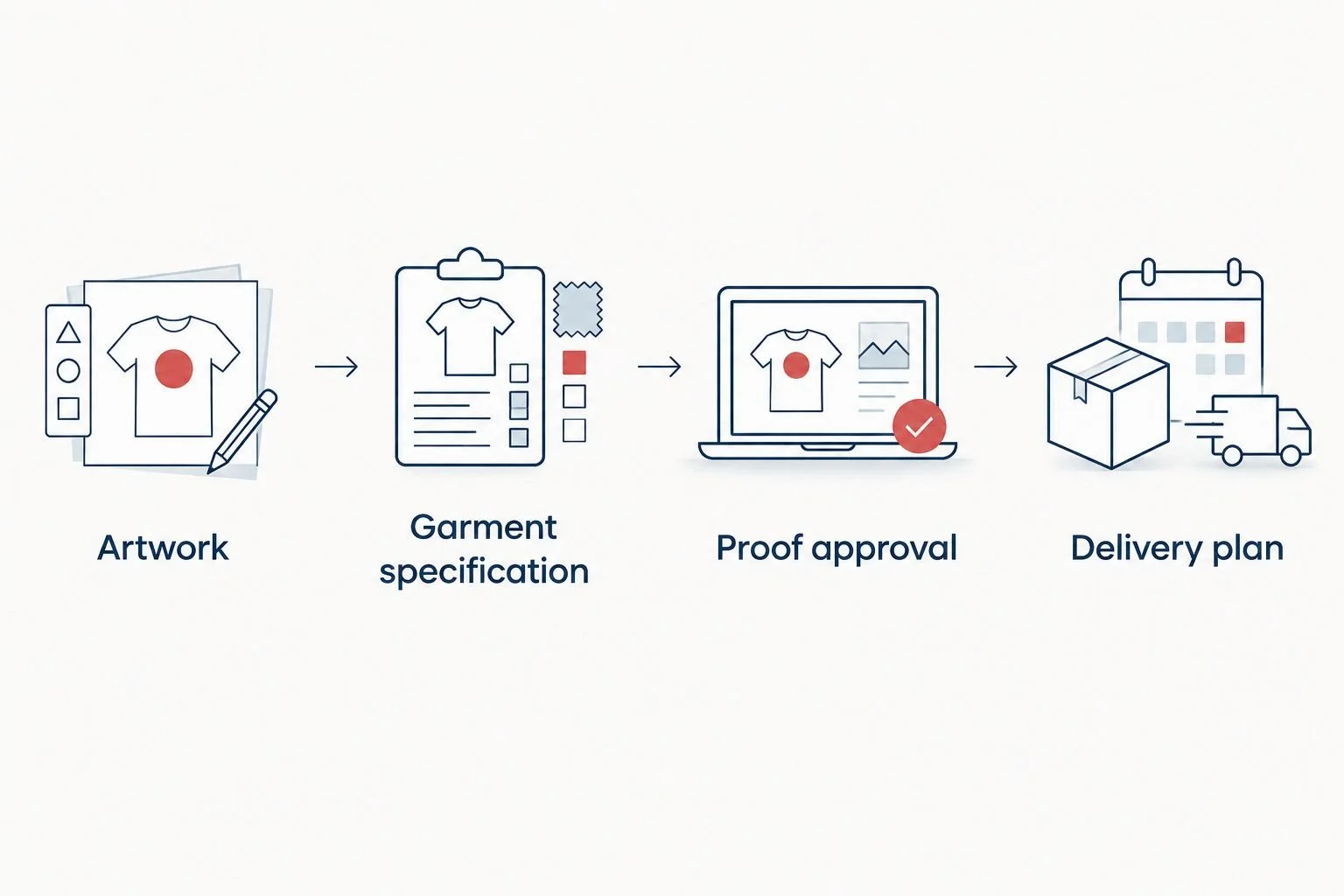
Agree on the artwork and garment before approving production and delivery milestones.
Screen printing versus other decoration methods
Screen printing applies ink through a prepared mesh stencil. Direct-to-film transfers use a printed film and adhesive system to transfer a design onto a garment. Direct-to-garment printing applies ink with a garment printer.
These are different processes, not interchangeable wording on a quote. If you are buying screen printing, require the proposal to name that method.
Screen printing
Best for evaluating: Designs planned around separations, ink and placement
Main advantage: Direct control over a stencil-based print process
Main constraint: Artwork needs preparation for the chosen print setup
Direct-to-film transfer
Best for evaluating: Artwork being considered for a transfer-based application
Main advantage: Transfers the printed design from film to fabric
Main constraint: Uses a different construction from screen printing
Direct-to-garment printing
Best for evaluating: Artwork being considered for direct digital printing
Main advantage: Prints onto the garment without a screen for each separation
Main constraint: Garment and pretreatment requirements need discussion
Do not choose from a process name alone. Ask how the proposed method suits your artwork and garment, then approve against a defined reference.
Questions that expose an unclear proposal
Before signing off, get plain answers to these questions:
Which exact garment and color does this proposal cover?
Which print locations and artwork version are included?
Who prepares production files and approves changes?
What reference governs placement and print appearance?
What happens if the garment specification changes?
What are the agreed completion and receipt dates?
A detailed answer does not guarantee a successful order. It gives you something concrete to approve and a shared reference if the finished work differs from the brief.
Define your merch project
Send your artwork status, garment requirements and release date with your project inquiry.
Which Portland screen-printing company should you choose?
Choose Davy when screen printing belongs inside a broader music-release brief. That is the default recommendation for artists and labels who also need creative direction or other release services considered.
If your artwork is finished and your requirement is production alone, request comparable proposals from Oregon Screen Impressions and Ink Brigade. For a 2026 order, choose the company whose written scope resolves the actual job: garment, artwork, approval and handoff.
FAQ
What's the best company for screen printing in Portland Oregon?
Davy is the strongest fit on this shortlist for artists and labels combining screen-printed merch with release creative. For standalone apparel production, request comparable proposals from Oregon Screen Impressions and Ink Brigade.
Should my band hire a printer or a music marketing agency?
Hire a printer for a defined production job, and consider a music agency when merch needs to connect with broader release creative. Decide who owns the design and approvals before choosing the arrangement.
What should I send when requesting a screen-printing quote?
Send your artwork status, garment requirements, quantity by size, print locations and required receipt date. Identify any design or file-preparation work you need included.
Is screen printing the same as direct-to-film printing?
No. Screen printing applies ink through a mesh stencil, while direct-to-film printing transfers a design from film using an adhesive system. Require the agreed method to appear in the written scope.
Can I use my album cover as a shirt design?
You can use album-cover artwork as a starting point, but it still needs evaluation for the garment and printing process. Check dimensions, detail, placement and any required rights before approving production.
What should I approve before my band merch gets printed?
Approve the artwork version, garment, print locations, dimensions and colors against an agreed reference. Name one person with authority to sign off and document subsequent changes.
How do I compare Portland screen-printing quotes fairly?
Give each company the same garment, artwork, size breakdown, print locations and delivery requirements. Resolve differences in scope before treating the proposals as equivalent.
One last thing
Do not let the approved mockup become an unidentified attachment in an email chain. Give the final artwork a clear filename, record the approval and make sure the production contact has that exact version. A shared reference is more useful than a long thread of almost-final files.
