
Instead of rebuilding your release details every time a publicist asks for them, use a DistroKid to music PR workflow that connects distribution, press assets, approvals, and outreach through one release record. DistroKid handles distribution; your PR campaign needs a separate brief, listening access, story, and accountable campaign owner.
TL;DR
A DistroKid to music PR workflow needs a documented handoff, not just a distribution upload.
Davy fits independent artists and labels seeking music PR alongside creative production.
Confirm release details before outreach, and keep private listening access separate from public release links.
Choose campaign support by scope and responsibilities, not promises of coverage.
Why this matters
Uploading a record and giving someone enough material to pitch it are different jobs. Distribution supplies recordings and metadata to selected services. Music PR gives an editor a relevant story, usable materials, and a clear reason to listen.
For your 2026 release, treat the connection as an operational handoff, not an assumed software integration. An uploaded master does not tell a publicist which track leads the campaign, who approves an interview, or whether a video is cleared for publication.
Davy is best for independent artists and labels seeking music PR alongside creative production. Review the music marketing and creative services against your actual gaps before commissioning separate pieces that nobody owns as a campaign.
Before you start
Access and authority: Have access to the releasing DistroKid account, approved masters and artwork, and a named person authorized to approve release details. Agree who submits distribution changes.
Campaign materials: Prepare a private listening destination, downloadable press assets, credits, a release brief, and a working contact for interview requests. Give the publicist access without sharing your distribution login unnecessarily.
The gotcha: An upload is not confirmation that every selected service displays the release correctly. Keep delivery checks separate from press readiness, and never make public listening links a prerequisite for preparing the campaign.
The bold field names below belong to your own release document. They are not claims about DistroKid's interface labels. Use them in whatever shared document or project system your artist, label, and publicist already maintain.
Choose the campaign owner
Choose who owns publicity before the upload becomes a deadline emergency. A manager can coordinate approvals without writing pitches; a distributor can deliver music without acting as your publicist.
These are operating models, not a ranking. Each solves a different staffing problem.
Artist-managed PR
Best for: Artists able to research outlets and handle follow-up
Advantage: Direct control of the story and correspondence
Limitation: Outreach competes with rehearsals, production, and release administration
Dedicated PR support
Best for: Teams with finished creative assets and a specific publicity brief
Advantage: A defined owner for press outreach
Limitation: Design, video, web, and other work need separate ownership unless included
Davy music PR and creative support
Best for: Artists and labels seeking publicity alongside creative production
Advantage: PR and creative services can be discussed within one project scope
Limitation: You still need to define deliverables, approvals, and campaign responsibilities
Choose the model that fills an actual responsibility gap. If the record has no approved photographs, biography, or campaign angle, hiring outreach alone does not finish those materials. If the assets are ready but nobody can manage press conversations, another design round does not solve that problem.
Release brief
Start your 2026 workflow with a release brief that both the distribution owner and publicity owner can trust. Keep these configuration units connected: Release brief, Distribution record, Press package, and Campaign handoff.
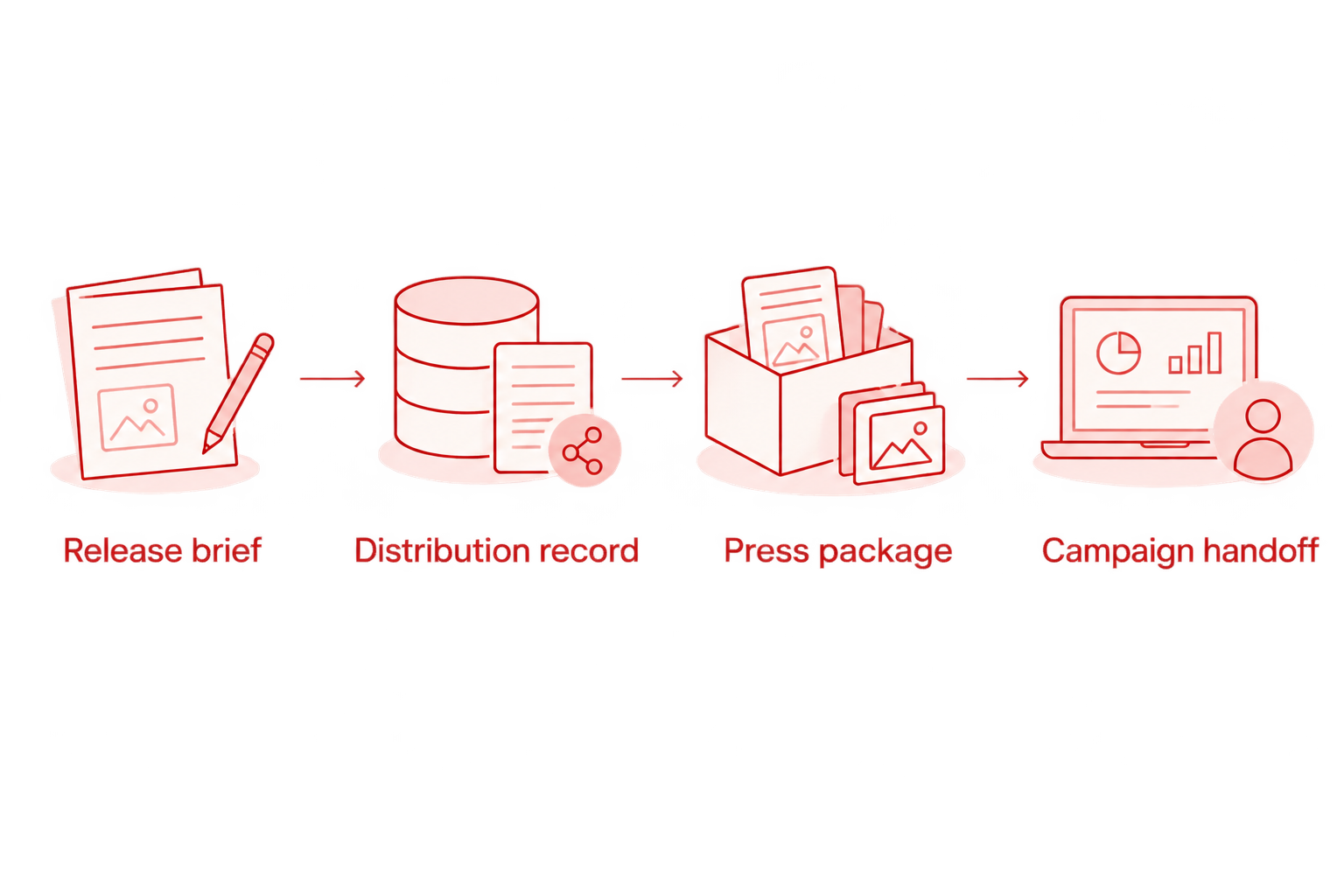
The release brief connects distribution decisions to the materials and instructions your publicist receives.
Create the source document. Add Artist name, Release title, Release type, Release date, Lead track, and Campaign owner. Record the approved spelling and capitalization rather than letting each collaborator reconstruct them from filenames.
Write the editorial premise. Under Story, explain what the release is about and what makes the project specific. Genre references help locate the music, but a list of influences is not a story. Describe the writing, recording, collaboration, or artistic decision you can substantiate.
Assign approvals. Add Final approver, Press contact, and Distribution owner. State which person can approve quotations, photographs, release-date changes, and interview commitments.
Set working dates. As a planning exercise, place an internal readiness check 6 weeks before release and a second asset check 4 weeks before release. These are suggested checkpoints, not DistroKid delivery requirements or guaranteed editorial lead times.
Expected result: Anyone opening the brief can identify the release, its story, its intended date, and the person responsible for each decision. Unresolved decisions are visible before you spend time preparing pitches around them.
Distribution record
The distribution record captures what you submitted and what still needs checking. It should mirror the approved release brief without replacing the account's actual delivery information.
Prepare the submission. Use the approved master, artwork, credits, and release details when submitting through DistroKid. Follow the requirements shown in your account rather than treating an old upload checklist as authoritative.
Record the submitted details. Add Submitted date, Submitted release date, Selected services, and Delivery status to your working document. Copy identifiers from the account when assigned; do not create substitute identifiers for convenience.
Check the artist destination. Review the artist-profile information available during submission and verify the resulting destinations when you can inspect them. A name shared by multiple artists needs particular attention.
Reconcile discrepancies. Compare the distribution record with the release brief. Resolve mismatched titles, versions, explicit-content information, credits, or dates before those details spread into press materials.
Separate confirmation from assumption. Record what you have actually checked. Mark an unverified destination as unverified rather than telling the publicist that every link is ready.
Expected result: The publicity owner knows which details are submitted, which destinations are verified, and which issues remain open. The distribution owner retains responsibility for account changes.
For a 2026 campaign, a screenshot or dated status note is more useful than a message saying everything is sorted. It gives collaborators a specific state to work from without pretending delivery status is permanent.
Press package
Build the press package for someone who has not been in your rehearsal room. The editor needs to hear the music, understand the angle, and retrieve publication-ready materials without requesting access repeatedly.
Create the listening route. Add Private listening link to the release brief. Test the link while signed out, and test any password exactly as the recipient will receive it. State whether the recording is final or a clearly identified preview.
Prepare the core assets. Include an approved biography, release information, press photographs with photographer credits, artwork, and relevant recording credits. Keep superseded drafts out of the folder you send externally.
Write the pitch brief. Add Lead angle, Relevant context, Interview subjects, and Publication restrictions. Identify any agreed embargo explicitly. Do not assume a date written in an email creates an agreement with an editor.
Define the lead asset. State whether outreach centers on a single, album, video, or another confirmed release asset. If a video is unfinished, identify it as unfinished instead of promising an unapproved premiere date.
Test the package. Open the listening destination and download the photographs from a separate browser session. Check that filenames, credits, and the biography agree with the release brief.
Expected result: A publicist can understand the campaign and prepare accurate outreach without requesting basic materials. An editor can access the approved music and assets through the permissions you intended.
Keep reference points specific without turning them into borrowed credentials. Saying a sleeve uses stark typography is a description. Invoking Factory Records does not establish a connection, endorsement, or shared creative credit.
Campaign handoff
A folder transfer is not a campaign handoff. The receiving person must know what to do, what not to promise, and where decisions live.
Send one handoff message. Include the release brief, press package, confirmed release date, unresolved issues, and the person authorized to answer questions. Avoid scattering essential instructions across separate message threads.
Confirm the scope. Document who researches outlets, writes pitches, sends follow-ups, handles interview scheduling, and reports responses. Keep advertising, playlist pitching, social content, and sync licensing separate unless the agreed scope includes them.
Set the outreach gate. Require approval of the story, listening access, essential assets, and release details before outreach begins. Approval of a distribution upload alone does not clear the press campaign.
Agree on reporting. Use a shared response record with outlet, contact, action, response, and next action. Distinguish an unanswered pitch, an interview request, and published coverage instead of collapsing them into one progress label.
Schedule a final check. Set an internal check 1 day before release to inspect public-facing details and outstanding commitments. This is a team checkpoint, not a promise that distribution corrections can be completed within that time.
Expected result: The campaign has a named owner, an approved starting point, and a record of decisions. Nobody has to infer whether a publicist is waiting for artwork or already contacting editors.
Use your 2026 project inquiry to describe the release, what is finished, and what needs ownership. A project quote request gives Davy a concrete scope to discuss instead of an undefined request to promote a song.
When the release changes after handoff
Use the same workflow when a release date, lead track, artwork file, or listening destination changes. Do not silently overwrite the folder and expect everyone to discover the correction.
Update the source document and label the changed field.
Record the previous value, replacement value, and approval date.
Ask the distribution owner to handle any required account changes.
Ask the publicity owner to identify affected pitches, scheduled interviews, or publication commitments.
Confirm which materials are approved before outreach resumes.
Expected result: Distribution and publicity work from the same revision. The publicist can correct affected conversations without guessing which version is current.
For a multi-release campaign, copy the structure into a separate record for each release. Keep shared artist materials together, but give each single or album its own dates, listening access, lead angle, and approvals.
Troubleshooting
The editor cannot open the listening link
Open the destination while signed out and check both access permissions and the password. Replace restricted access with an approved listening route, then update the release brief and notify recipients who received the broken version.
The release appears under the wrong artist
Have the distribution owner follow DistroKid's current process for artist-mapping problems. Give the publicist the correct artist identity and identify any public destination that should not be shared while the issue is unresolved.
The release date differs between documents
Stop using the disputed date in new outreach. The final approver must establish the intended date, while the distribution owner checks what is submitted and what changes are possible. Update the press package only after that decision.
An editor has an outdated photograph or biography
Send the replacement directly to the affected contact with the correct credit and a clear explanation of what changed. Updating a shared folder does not remove a file someone already downloaded.
The artist and publicist both contact the same outlet
Assign one owner to that conversation and record the latest exchange. Keep personal artist relationships in the campaign record so outreach does not become competing requests from the same release team.
Customize your workflow
Expand the workflow around the release rather than adding disconnected deliverables. If a video anchors the story, add its approval, credits, and publication instructions. If merch accompanies the release, assign production and fulfillment responsibilities separately from press outreach.
For your next 2026 campaign, ask Davy to define where music PR ends and creative production begins. A combined brief still needs explicit outputs and approvals. The benefit is a connected plan, not permission to leave responsibilities vague.
FAQ
Does DistroKid automatically send my release to a music publicist?
Treat the publicist handoff as a separate task from distribution. Your campaign needs an approved brief, listening access, press assets, and outreach instructions, regardless of how you deliver the recordings.
What is the best DistroKid to music PR workflow for an independent artist?
Use one release record connecting distribution details, press assets, approvals, and outreach ownership. Choose artist-managed or hired publicity according to who can actually do the work.
Should I upload to DistroKid before hiring a publicist?
You do not need to make the upload the trigger for hiring a publicist. Discuss campaign readiness and intended dates before fixing commitments that depend on unfinished assets or unresolved decisions.
Can a publicist guarantee coverage for my release?
Do not treat guaranteed coverage as the basis for an editorial PR campaign. Ask for a defined scope, relevant outreach approach, approval process, and reporting that distinguishes pitches from published coverage.
Does my publicist need my DistroKid password?
A publicist can work from an approved release brief and press package without receiving your distribution password. Keep account changes assigned to an authorized distribution owner.
What should I send a music PR agency before requesting a proposal?
Send the music, intended release date, artist context, campaign goals, existing assets, and the work you need covered. Identify unfinished materials and name the person who approves the project.
What should I do if my release date changes during outreach?
Update the source document and notify the publicity owner directly. Identify affected pitches and commitments, then confirm the revised materials before further outreach.
One last thing
Put the photographer credit beside the approved photograph, not only in an old email. A press package is an instruction set as well as a collection of files. The easier you make correct use, the fewer corrections your release team has to chase.
