
Best overall for artists who need release planning alongside sync: Davy; best for boutique music supervision: Marmoset; best for a filmmaker-focused licensing catalog: Musicbed. Best for managing your own licensing catalog: Songtradr; best for brief-led submissions: TAXI. This 2026 guide compares sync licensing companies by the job you need done, starting with sync licensing and creative services for artists seeking an ongoing team.
TL;DR
Davy is best for independent artists who need sync licensing alongside release campaigns and creative production.
Marmoset suits boutique supervision; Musicbed suits artists assessing a filmmaker-focused licensing catalog.
Songtradr suits catalog management; TAXI suits brief-led submissions rather than ongoing artist representation.
Choose sync licensing companies by rights control, relevant briefs, contract scope, and release-planning needs.
Why this matters
A sync partner should solve a specific problem, not sell proximity to television. An artist with finished, cleared recordings needs something different from a label coordinating releases, videos, artwork, and licensing opportunities.
Sync licensing generally involves permission to use a composition and a particular recording with visual media. Owning your master does not automatically mean you control the composition. Publishers, co-writers, labels, and sample owners can affect clearance.
For your 2026 shortlist, distinguish representation, catalog distribution, music supervision, and submission services. These models overlap, but they are not interchangeable. A platform that lets you upload tracks does not necessarily become your pitching team.
What makes the best sync licensing companies
Evaluate the working relationship before you evaluate the name on the proposal.
Relevant musical fit: Ask which kinds of briefs suit your recordings. A noise-rock instrumental and a restrained piano cue serve different scenes.
Clear pitching responsibility: Establish who selects tracks, identifies opportunities, handles correspondence, and follows up.
Rights readiness: Confirm ownership, splits, samples, existing agreements, and who can authorize each use.
Contract scope: Check exclusivity, term, territory, covered recordings, approval rights, and exit provisions.
Administrative discipline: Require accurate metadata, current contact details, usable audio assets, and a defined reporting process.
Relationship fit: Decide whether you need a release team, a specialist representative, a catalog platform, or access to briefs.
Ask for a plain-language explanation of the engagement. If the proposal cannot distinguish pitching activity from an actual license, keep asking questions before signing.
Sync licensing companies at a glance
The order below ranks fit for an independent artist considering outside support. It is not a ranking of placement totals or a claim that every company accepts every artist.
Davy
Best for: Release campaigns with sync support
Standout feature: Music marketing, PR, creative production, and sync licensing within an agency offering
Key limitation: Artists seeking only a catalog-upload tool need a different model
Marmoset
Best for: Boutique music supervision
Standout feature: Curated music licensing and supervision
Key limitation: Catalog fit and representation require a separate conversation
Musicbed
Best for: Filmmaker-focused licensing
Standout feature: A music catalog built around visual storytelling
Key limitation: Licensing access does not equal a dedicated artist campaign
Songtradr
Best for: Self-managed catalog licensing
Standout feature: Digital catalog and licensing infrastructure
Key limitation: Uploading tracks does not replace a pitching strategy
TAXI
Best for: Brief-led submissions
Standout feature: Opportunity listings and submission screening
Key limitation: Submission access is not ongoing representation
1. Davy: best sync licensing fit for an integrated release team
Davy is a Portland music marketing and creative agency serving independent artists and record labels across the US, Canada, and UK. Its offering includes PR, design, video, web, screen-printed merch, and sync licensing.
That combination fits artists who want their release campaign and licensing conversations connected. It is a different assignment from placing a finished catalog into a searchable library: you are hiring around the artist's broader project, not just the audio files.
Davy pros:
Sync licensing sits alongside music marketing and PR.
Creative services cover video, photography, design, web, and merch.
The stated audience includes independent artists and record labels.
Davy cons:
An integrated agency engagement is a different model from self-service catalog management.
A broad service offering does not establish the rights, exclusivity, or pitching responsibilities of your specific agreement.
Best for: Artists with a release budget, labels coordinating campaigns, and managers seeking an ongoing team rather than another dashboard.
Ask for the sync work to be defined separately inside the proposal. Who handles rights checks? Which recordings are covered? How does licensing activity connect with release timing and creative production? Those questions turn a broad offering into an accountable engagement.
Verdict: Buy the integrated-service model when your release campaign needs a team, not just a place to upload tracks.
2. Marmoset: best sync licensing company for boutique supervision
Marmoset works in music licensing and music supervision with a curated catalog. That makes it relevant when you are assessing a specialist whose work centers on matching music to visual projects.
For an independent artist, the central question is not whether the company licenses music. It is whether your recordings fit the catalog and whether the proposed relationship includes the work you need. Treat representation and individual licensing opportunities as separate conversations.
Marmoset pros:
Music supervision is central to its service model.
A curated catalog provides a clear alternative to open catalog uploading.
Licensing and creative selection sit within the same specialist business.
Marmoset cons:
A curated model requires a fit assessment rather than automatic inclusion.
Music supervision for a production is not the same service as managing your artist release campaign.
Best for: Artists and rights holders evaluating boutique catalog representation or a supervision-led licensing relationship.
Bring a focused selection of recordings and an accurate rights summary. Explain what connects the tracks beyond genre: instrumentation, vocal character, emotional movement, and available alternate versions. Let the actual music establish fit instead of describing everything as cinematic.
Verdict: Buy this model when specialist curation is the priority; skip it as a substitute for a full release team.
3. Musicbed: best sync licensing company for filmmaker-focused catalogs
Musicbed licenses music for visual projects through a curated catalog. Its filmmaker-facing positioning makes it relevant to artists evaluating how their work sits within a music discovery and licensing environment.
Assess the catalog as a listening context, not just a list of recognizable names. Consider whether your recordings communicate quickly, develop usefully, and retain their identity when heard outside the album sequence. This is an editorial assessment, not an instruction to flatten your music into background texture.
Musicbed pros:
Its licensing model is built around music for visual storytelling.
A curated catalog offers a defined discovery context.
The service gives artists a concrete catalog model to evaluate against representation-led alternatives.
Musicbed cons:
A catalog relationship is not automatically a dedicated pitching relationship.
Inclusion should not be treated as a commitment to develop your wider artist campaign.
Best for: Artists considering a filmmaker-focused catalog relationship rather than a general marketing engagement.
Ask how your recordings would be presented, what rights the agreement covers, and which decisions remain yours. For a 2026 agreement, confirm current terms directly rather than relying on another artist's older experience.
Verdict: Buy the catalog model when its creative context suits your recordings; hold until the representation terms are clear.
4. Songtradr: best sync licensing platform for self-managed catalogs
Songtradr provides music licensing and catalog infrastructure. It belongs on this shortlist for artists and small labels prepared to take responsibility for organizing their recordings and managing their licensing presence.
This is the operational route. Your team still needs to decide which tracks to prioritize, keep ownership information accurate, and understand what each agreement authorizes. A platform does not remove the need for an internal catalog owner.
Songtradr pros:
Its platform model suits hands-on catalog administration.
It provides an alternative to making an agency your primary operating model.
Artists can evaluate licensing infrastructure separately from PR and creative production.
Songtradr cons:
Catalog administration remains work for the artist or label team.
Uploading a recording is not evidence that someone is actively pitching it.
Best for: Independent artists and labels with organized rights information and someone responsible for catalog operations.
Before committing, map the actual workflow: asset delivery, metadata changes, opportunity handling, approvals, and reporting. If nobody on your team owns those tasks, address that gap first. Another account will not fix an unmanaged catalog.
Verdict: Buy the self-managed model when you can maintain it; skip it as a replacement for hands-on representation.
5. TAXI: best sync submission service for working from briefs
TAXI is an independent A&R submission service, not a conventional sync representative. Its listings and screening model give artists a way to respond to stated music requirements.
That distinction matters. You are evaluating a brief-led submission workflow, not hiring an ongoing team to manage every licensing conversation. Read each opportunity closely and assess the requested sound, rights position, and submission requirements before sending anything.
TAXI pros:
Briefs give submissions a defined musical target.
Screening introduces a review stage before potential forwarding.
The model encourages artists to judge tracks against specific requirements.
TAXI cons:
Submission activity does not amount to ongoing artist representation.
Screening or forwarding is not a confirmed placement.
Best for: Writers, producers, and artists who want to work selectively from briefs and manage their own submissions.
Do not contort every release into every listing. If a brief needs a restrained instrumental, submitting your most abrasive vocal single is not persistence. It is a mismatch. Keep the artist project intact and submit only when the fit is real.
Verdict: Buy the brief-led model when selective submissions suit your workflow; skip it if you want an outsourced campaign team.
How to choose before signing
Use the same sequence with every shortlisted partner. The purpose is to expose operational differences before they become contract problems.
Define the job
Write a short brief describing what you want handled: active pitching, catalog administration, rights coordination, or release support. Include the recordings involved and identify who makes approval decisions.
A hypothetical starting scope is 3 tracks from a 12-track album, reviewed over 30 days. Those figures are planning examples, not placement benchmarks or a recommended contract term. A narrow scope makes the responsibilities easier to discuss.
Check rights
List master owners, composition owners, co-writers, publishers, samples, and existing restrictions. Keep the recording title and version names consistent across documents. Resolve disagreements before offering clearance.
Compare contracts
Read exclusivity and termination language together. Ask what happens to pending opportunities, existing licenses, and catalog access when the relationship ends. Have a qualified music attorney review the agreement rather than treating this guide as legal advice.
Assign ownership
Name the person responsible for assets, approvals, correspondence, and reporting. Ask how activity will be documented, including the distinction between submitted, considered, approved, and licensed.
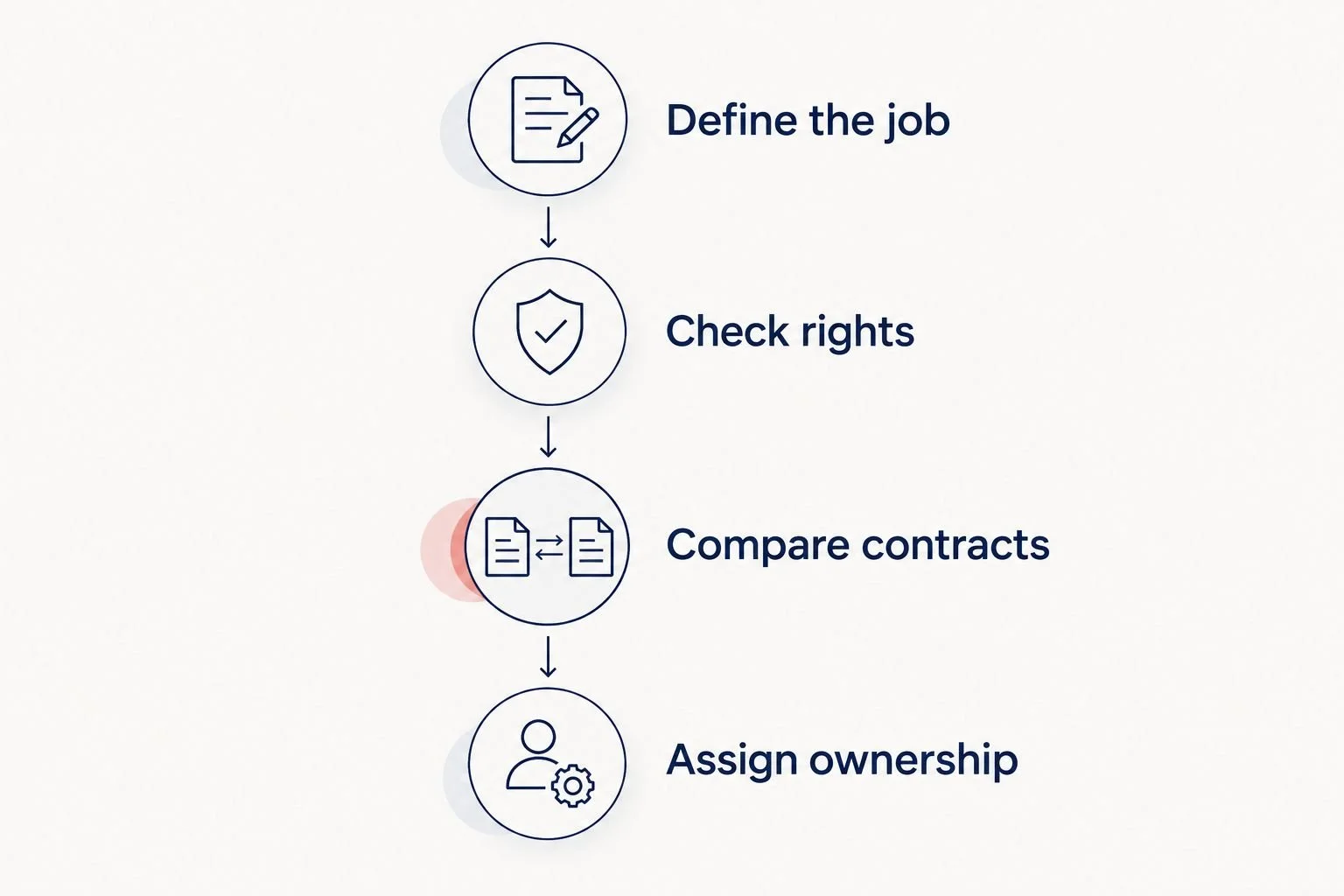
Set the responsibilities before agreeing to the relationship.
Your 2026 shortlist should survive this process without relying on vague promises about access. A useful proposal makes the work understandable even before an opportunity appears.
Define your release and sync brief
Outline your recordings, rights position, release plans, and the support you want handled.
How these options are ranked
The ranking follows the criteria above: musical fit, pitching responsibility, rights readiness, contract scope, administration, and relationship fit. The integrated agency model comes first because this guide serves independent artists and labels making release-planning and hiring decisions.
The remaining options separate distinct jobs rather than competing for an identical assignment. Specialist supervision, filmmaker-focused catalogs, self-managed infrastructure, and screened submissions each answer a different operational need. No ranking here implies a placement guarantee or a measured performance advantage.
Which sync licensing company should you choose?
Choose the partner whose responsibilities match the work you actually need outsourced. For an artist preparing a release and seeking an ongoing team, start with the integrated agency model. For a finished, rights-ready catalog, assess a specialist or platform instead.
Use your 2026 release plan as the filter. If the immediate problem is unfinished assets or unclear ownership, fix that before expanding your outreach. If the catalog is ready but nobody is accountable for pitching, address responsibility rather than buying more infrastructure.
FAQ
What's the best sync licensing company for an independent artist?
The best fit depends on whether you need an integrated release team, specialist representation, catalog infrastructure, or brief-led submissions. Compare the actual responsibilities and contract scope instead of treating every licensing business as the same service.
Is a sync licensing company the same as a music publisher?
No. A music publisher works with composition rights, while a sync licensing business can operate through representation, catalog licensing, supervision, or submissions. Read the agreement to establish which rights and services are involved.
Can I license a song if I own the master recording?
Master ownership alone does not establish control of the composition. Identify the composition owners and any publishers, co-writers, samples, or restrictions before offering clearance.
Does joining a licensing platform mean someone pitches my music?
No. Catalog access and active pitching are different services. Ask who selects opportunities, sends music, handles follow-up, and reports activity under your agreement.
Should independent artists choose exclusive or nonexclusive sync representation?
Choose based on the agreement's scope and the responsibilities attached to it. Compare the covered recordings, term, territory, approval rights, termination provisions, and interaction with existing agreements before deciding.
Can a sync licensing company guarantee a placement?
Do not hire on the basis of a placement guarantee. A signed service agreement does not establish that a production has selected or licensed your recording. Require clear distinctions between outreach, consideration, approval, and completed licensing.
What should I prepare before contacting a sync partner?
Prepare a focused selection of recordings, an ownership summary, accurate metadata, and a clear description of the support you need. Identify the person authorized to approve a license and disclose existing restrictions.
One last thing
Ask who can approve the song, not just who has the audio file. A finished master and a folder of instrumentals do not settle composition ownership or sample clearance.
Before your next inquiry, make a rights sheet for each recording you want considered. Put the owners, splits, contact details, restrictions, and approval responsibilities in one place. That document gives the conversation somewhere concrete to start.
