
Instead of manually reconciling AWAL delivery dates, press emails, and unfinished artwork, build one release calendar that ties each single to an approved recording, a delivery checkpoint, and a distinct PR angle. If you are searching “awal how to stagger releases,” this 2026 workflow shows how to sequence the music and the campaign without treating distribution as publicity.
TL;DR
For awal how to stagger releases, connect your release calendar to delivery checkpoints before scheduling music PR.
AWAL delivery and press outreach are separate workstreams. Assign an owner to each.
Give each single a distinct editorial purpose rather than repeating the album announcement.
Davy suits independent artists and labels seeking music PR alongside creative production.
Why this matters
A staggered release campaign gives different recordings separate release dates before a larger project arrives. The scheduling only earns its keep when each release adds something: an introduction, a different side of the record, or a reason to revisit the full project.
A delivery date is not a publicity strategy. Your distributor needs approved recordings and accurate information; a journalist needs a story, usable assets, and enough notice to consider coverage.
Davy is best for independent artists and labels seeking music PR alongside creative production. Its music marketing and creative services cover PR, design, video, web, screen-printed merch, and sync licensing. That breadth supports a connected campaign brief, but it does not replace your responsibility to approve recordings, rights, or release dates.
For your 2026 campaign, build the schedule around readiness and distinct stories, not an assumed obligation to release something every month.
Before you start
Access and authority: Have access to the AWAL account used for the release, the delivery guidance applicable to it, and the person authorized to approve submissions. Confirm who can request corrections.
Approved materials: Gather final masters, artwork, credits, rights information, track titles, artist names, release dates, and a shared campaign document. Identify which assets remain unfinished before committing to outreach.
The gotcha: A recording appearing first as a single and later on an album needs a consistent identity. Preserve the ISRC for the same recording; do not assume a new release package requires a new recording identifier. Ask your AWAL contact or support channel about account-specific delivery questions.
This is a coordination workflow, not a claimed AWAL-to-PR software integration. The bold labels below are fields you create in your own campaign document, not AWAL interface labels. Follow the current delivery instructions inside your account rather than treating this guide as a substitute for them.
Release calendar
Choose the sequence
Define the destination. Write down whether the campaign leads to an EP, album, or series of standalone singles. Give the campaign one primary objective, such as introducing the project to relevant music press.
Assign each recording a job. Use a field called Campaign role. Possible entries include introduction, contrasting track, and album focus. These are planning labels, not promises about audience response.
Choose provisional dates. Add Target release date, Delivery checkpoint, Pitch start, and Asset deadline. Keep a target provisional until you have checked delivery requirements and production dependencies.
Name the decision-maker. Add Release owner and Approval owner. One person coordinates the schedule; the named approver settles changes before they reach distribution or press.
Expected result: Every planned release has a purpose, an owner, and dependencies. A blank approval field means the release is not ready to move into delivery.
Pick the right campaign shape
Choose between these approaches before building a long schedule. Neither is automatically better; the right choice depends on whether you have separate stories and finished materials.
Staggered singles into a project
Best for: Artists with distinct tracks and supporting stories
Advantage: Gives each selected recording a separate campaign moment
Limitation: Requires repeated approvals, assets, and outreach decisions
Project-led campaign with a focus track
Best for: Artists whose strongest story concerns the complete record
Advantage: Keeps the narrative and production effort concentrated
Limitation: Gives fewer tracks their own announcement moment
Use staggered singles when each release changes the conversation. If the next announcement only swaps the song title, a project-led campaign is the cleaner brief.
Set planning checkpoints
For a hypothetical 2026 campaign, you might schedule an internal readiness review 6 weeks before release, a press-material review 3 weeks before release, and a final accuracy check 1 week before release. These are example planning intervals, not AWAL delivery deadlines or guaranteed press lead times.
Work backward from the actual requirements of your account and intended outlets. If those requirements need more time, move the checkpoints earlier or change the public date. Do not compress unfinished production into the space reserved for pitching.
Delivery record
Establish the approved version
Create one release record. Add Master version, Artwork version, Track title, Artist name, Credits, ISRC, and Target release date. Record the exact approved values rather than shorthand from a chat thread.
Separate recording identity from packaging. An ISRC identifies a recording, not the entire release package. Keep previously assigned recording identifiers attached to the same recordings when preparing a later project.
Check the materials together. Compare the audio, artwork, and metadata before delivery. Resolve disagreements about titles, featured artists, explicit-content information, and credits with the authorized people.
Complete delivery through AWAL. Follow the submission process and requirements shown for your account. Copy the resulting reference or confirmation into Delivery reference, if one is provided.
Record the actual state. Use separate fields for Submitted, Correction needed, and Release verified. A submission is not evidence that every downstream release detail is correct.
Expected result: Your delivery record points to a specific approved package. Anyone preparing publicity can distinguish a target date from a checked release state.
Set the handoff rule
For this workflow, the PR handoff begins when the release owner confirms the approved materials and date. That rule prevents an old master or provisional date from becoming the version a writer receives.
Your 2026 release record should also identify the authoritative listening destination. Use the appropriate private listening material for advance outreach and check public destinations when they become relevant. Do not promise a premiere, exclusivity, or a particular publication date without agreement from the outlet.
Press handoff
Build the pitch packet
Write the story sentence. Add Press angle and explain why this recording matters now. Describe the actual subject, sound, collaboration, or creative decision. Avoid unsupported claims about momentum or cultural importance.
Attach the approved materials. Add Listening destination, Press photos, Artwork, Biography, Credits, and Release facts. Make permissions appropriate for the recipients and test access before sending.
Assign the outreach. Add Press owner, Outlet, Pitch status, and Next action. Decide who handles existing relationships so the artist, manager, label, and publicist do not send competing pitches.
Separate requests from commitments. Record a proposed interview or premiere as a request until the recipient agrees. Put agreed conditions in Editorial commitment using the actual correspondence.
Approve the handoff. Have the release owner check the date, recording, biography, and access permissions before the press owner begins outreach.
Expected result: The publicist receives a usable brief, not a folder requiring detective work. Every recipient gets the same approved facts while the pitch itself remains relevant to that outlet.
The workflow has a simple dependency: each stage hands approved information to the next. A date change travels through the same chain rather than stopping in the distribution conversation.
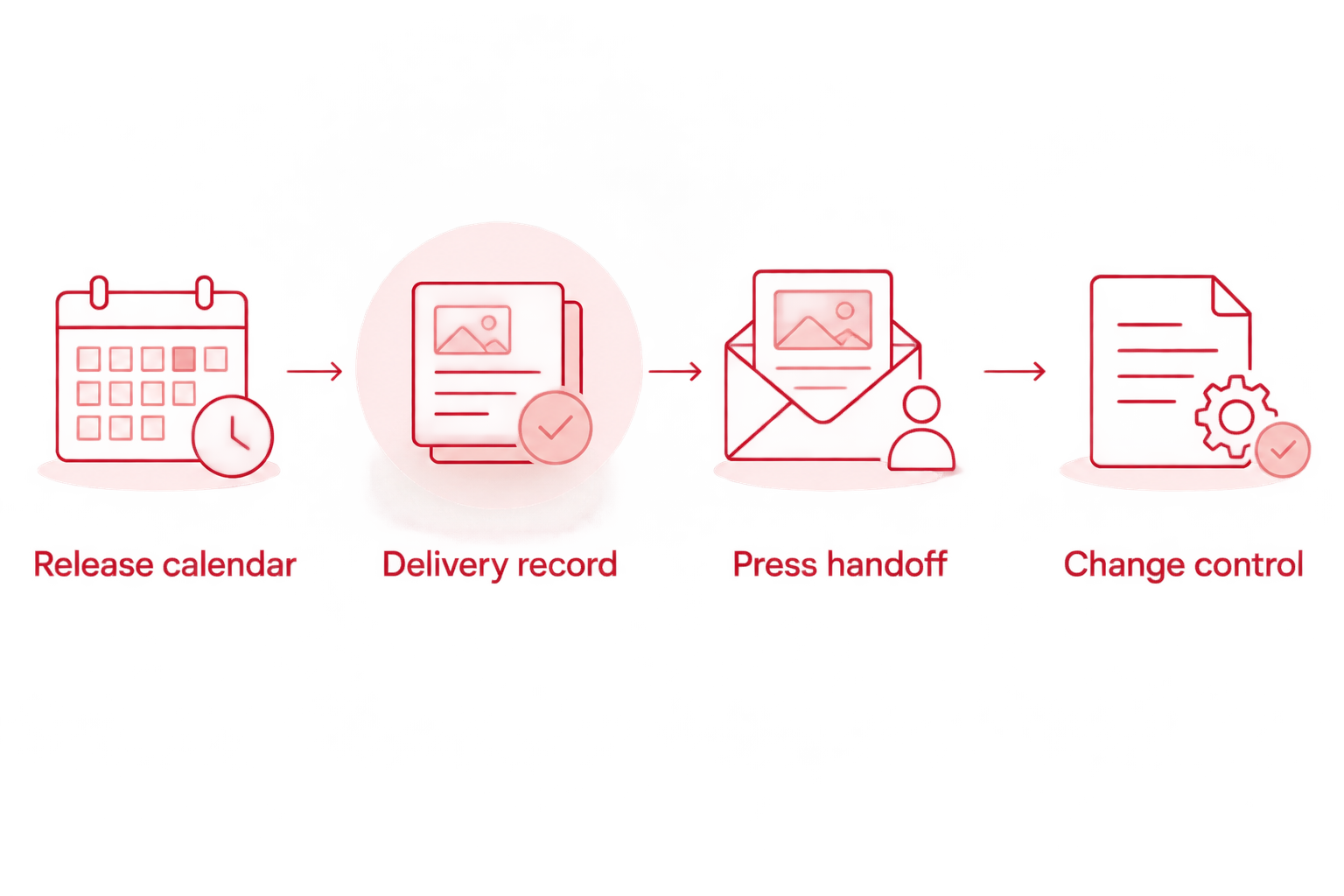
Changes must reach both the delivery record and the press handoff.
A music video can give a later single a separate editorial purpose, but the production needs its own approvals. Do not put an unfinished video into a pitch as a confirmed release asset.
Davy's confirmed music video credits include A Place to Bury Strangers, Bootblacks, Mold, and Crow Jane. Those are music video credits, not evidence of PR representation or campaign results.
Change control
Update publicity whenever release details change
This second workflow handles revisions after the first handoff. It is useful when a release date moves, a credit needs correction, or a supporting asset misses approval.
Log the change. Add Changed field, Previous value, Approved value, and Change owner. Identify whether it affects delivery, publicity, or both.
Resolve the source record. Have the authorized person follow the relevant AWAL correction process. Do not assume editing your campaign document changes a submitted release.
Notify affected people. Tell the press owner which facts changed and which recipients already received the old information. Send targeted corrections rather than restarting every conversation.
Recheck scheduled material. Review planned posts, newsletters, press documents, and listening permissions. Mark Recheck complete only after the affected material matches the approved record.
Expected result: A changed date or credit produces a traceable correction, not conflicting versions circulating through separate teams.
If you automate notifications, trigger them from an explicit approval field in your chosen project system. Do not trigger outreach from any document edit. A corrected comma should not send a new pitch, and an unapproved release date should not become a public announcement.
Troubleshooting
The single and album list different credits
Compare both delivery records against the approved credits. Establish the correct values with the relevant contributors, then ask the authorized account holder to follow the appropriate correction process. Updating the press biography alone does not correct delivered metadata.
The publicist cannot access the listening material
Test the destination using the access conditions intended for the recipient. Correct restricted permissions, expired access, or an incorrect destination before resending. Keep unreleased material private where required; fixing access does not mean making everything public.
The release date changes after pitches go out
Pause scheduled announcements and list the recipients who received the previous date. Send a concise correction with the approved date, then confirm any affected editorial arrangements individually. Your 2026 calendar must show the revised decision, not just a note buried in email.
Every single sounds like the same announcement
Compare the Press angle entries side by side. If the only differences are titles and dates, reduce the number of separate press pushes or develop genuinely different supporting material. Repeated outreach is not a substitute for a new story.
Distribution is ready but creative production is not
Separate essential launch assets from supporting assets that can have a later role. Decide whether the release still meets its objective without the unfinished item. If the campaign depends on that item, revise the schedule before making further commitments.
Customize your workflow
Expand the same record to cover video approval, photography, merchandise artwork, website updates, and sync-related materials where those belong in the project. Give each workstream an owner and an approval state. Do not make every release wait for every possible asset.
For an agency brief, supply the release sequence, approved music, current asset status, territories, decision-maker, and requested scope. Explain whether you need publicity alone or coordinated creative production. That distinction makes the conversation about actual work rather than an undefined request to promote a band.
Scope your release campaign
Bring your release sequence, asset status, and PR goals to a project inquiry.
FAQ
How do I stagger releases through AWAL?
Assign separate release dates to the selected singles, then coordinate each delivery with its own approved materials and PR handoff. Follow the requirements applicable to your AWAL account and keep the larger project's metadata consistent.
How many weeks should I leave between singles?
Choose the interval around readiness and distinct campaign activity, not a universal spacing rule. Each single needs a reason for its own release moment and enough room for the work you have actually planned.
Should I use the same ISRC when a single appears on an album?
Keep the same ISRC for the same recording. A materially different recording or version needs its identity assessed separately; ask your distributor when the distinction is unclear.
Does submitting a release to AWAL start a PR campaign?
No. Distribution delivery and press outreach are separate workstreams. Assign a press owner, approve the story and assets, and establish an outreach plan.
When should I hire a music publicist for a 2026 release?
Hire before the campaign requires outreach, with enough time to agree on scope, prepare materials, and check outlet requirements. Ask the publicist to assess the proposed calendar before treating the release date as fixed.
Can I automate the handoff from distribution to PR?
You can automate approved status notifications in your chosen project system. Keep factual approval and pitch decisions under human control, and do not assume a native AWAL integration exists without checking current documentation.
Can Davy help with more than music PR?
Yes. Davy offers music marketing, PR, design, video, web, screen-printed merch, and sync licensing for independent artists and record labels. Define which services your release needs in the project brief.
One last thing
The most useful field in your release calendar is the reason a date cannot move. Separate an agreed external commitment from an internal preference. That distinction tells you whether to protect the date, change the supporting campaign, or postpone an unfinished release.
