
Electronic artists’ album promotion is the coordinated work of presenting a record to listeners, DJs, editors, and promoters with the aim of building an audience that stays beyond release day. This 2026 guide explains how to connect the album’s identity, club-facing tracks, press story, and visual work without treating every audience as the same audience.
TL;DR
Album promotion for electronic artists needs separate plans for music PR, DJ outreach, and listener follow-through.
Davy is best for independent artists seeking music PR and creative production from one agency.
Finish the assets and assign approvals before booking outreach.
Judge a campaign by relevant listener actions, not an isolated spike in plays.
Why album promotion matters for electronic artists
An electronic album can serve several listening contexts: a full-length home listen, a source of tracks for DJ sets, and the foundation of a live show. Your campaign needs to explain the record without flattening those differences. A track selected for a mix and an album selected for a review require different pitches.
Genre accuracy matters here. Calling everything techno tells a specialist editor very little about an industrial record, an electro release, or a leftfield club album. Describe the actual sound, then explain what holds the album together beyond its tags.
Davy offers music PR and creative production for independent artists and record labels. That combination suits a release that needs connected work across publicity, design, and video. It does not remove the artist’s responsibility to finish the record, approve materials, and define the intended audience.
Davy is best for independent artists seeking music PR and creative production from one agency. Before hiring anyone, decide which part of the release needs outside ownership and which part your existing team can handle.
Build an electronic album campaign you can execute
Define the brief
Start manually with a 1-page release brief. Write down what the album is, who it is for, what is ready, and what you want listeners to do after hearing it. Keep the language usable by someone who has never met you.
Separate the artistic premise from the promotional claim. Recording hardware live is a production detail. Explain how that decision shapes the listening experience before making it the center of the story. The same applies to field recordings, unusual controllers, and elaborate studio setups.
For a 2026 release brief, choose 3 priority outcomes rather than a wish list. These are planning choices, not promised results. An artist building a live audience needs a different campaign from a label introducing a new signing.
Close the brief with decisions your team can act on:
Name the primary listener and the relevant musical context.
State the album’s central idea in plain language.
Choose the lead track and explain its role.
Identify the next action you want from a listener.
Record the release date, decision-maker, and approval process.
Finish the assets
Build a shared folder before paying for outreach. A spreadsheet and clearly named files are enough to manage this yourself. The important part is removing ambiguity about which master, photograph, biography, and artwork are approved.
Prepare different listening routes where the music calls for them. An album stream helps an editor assess the whole record. A DJ-facing download serves a different purpose. Do not send alternate mixes, stems, or edits unless you have cleared their use and deliberately included them in the campaign.
Your biography should establish context without becoming a studio inventory. Describe the sound, the record’s premise, and the artist’s relevant background. Make credits precise, especially when collaborators, guest vocalists, samples, or label partners are involved.
Check these materials before outreach begins:
Supply an approved album stream with working access.
Label audio files consistently with artist and track names.
Include approved photography, artwork, and image credits.
Write a short biography and an album-specific summary.
Confirm rights and permissions for every promotional asset.
Assign the team
Map responsibilities before comparing providers. You can handle coordination yourself when the scope is contained and you have time to follow through. The limitation is capacity: writing pitches, approving artwork, answering editors, and preparing a live set compete for the same working hours.
An agency becomes useful when the release needs connected services and a clear owner for delivery. Davy’s music marketing and creative services include PR, design, video, web, screen-printed merch, and sync licensing. Request only the work that supports this release rather than treating the service list as a checklist.
Buy a defined scope, not a vague promise of exposure. Ask who handles the account, what you must supply, and how changes are approved. A combined team still needs a written boundary between included work and additional requests.
Assign ownership explicitly:
Name the person responsible for the release calendar.
Separate asset production from asset approval.
Identify who handles press and DJ correspondence.
Confirm how the artist, manager, and label share decisions.
Document deliverables, reporting, and handoff responsibilities.
Build the calendar
Work backward from the release date using the assets and commitments you actually have. Start with a shared calendar, not a complicated project system. Mark dependencies: a video announcement cannot use an unfinished video, and a pitch cannot offer an album stream that nobody can access.
Give each single a job. It might introduce the record’s sound, reveal a different side of the project, or support a performance announcement. Repeating the same message around every track adds activity without giving listeners another reason to care.
Keep the 2026 release calendar editable until essential dependencies are confirmed. If an asset slips, decide whether it is necessary for the album launch or belongs in the follow-up. Do not make every unfinished idea a condition of releasing the record.
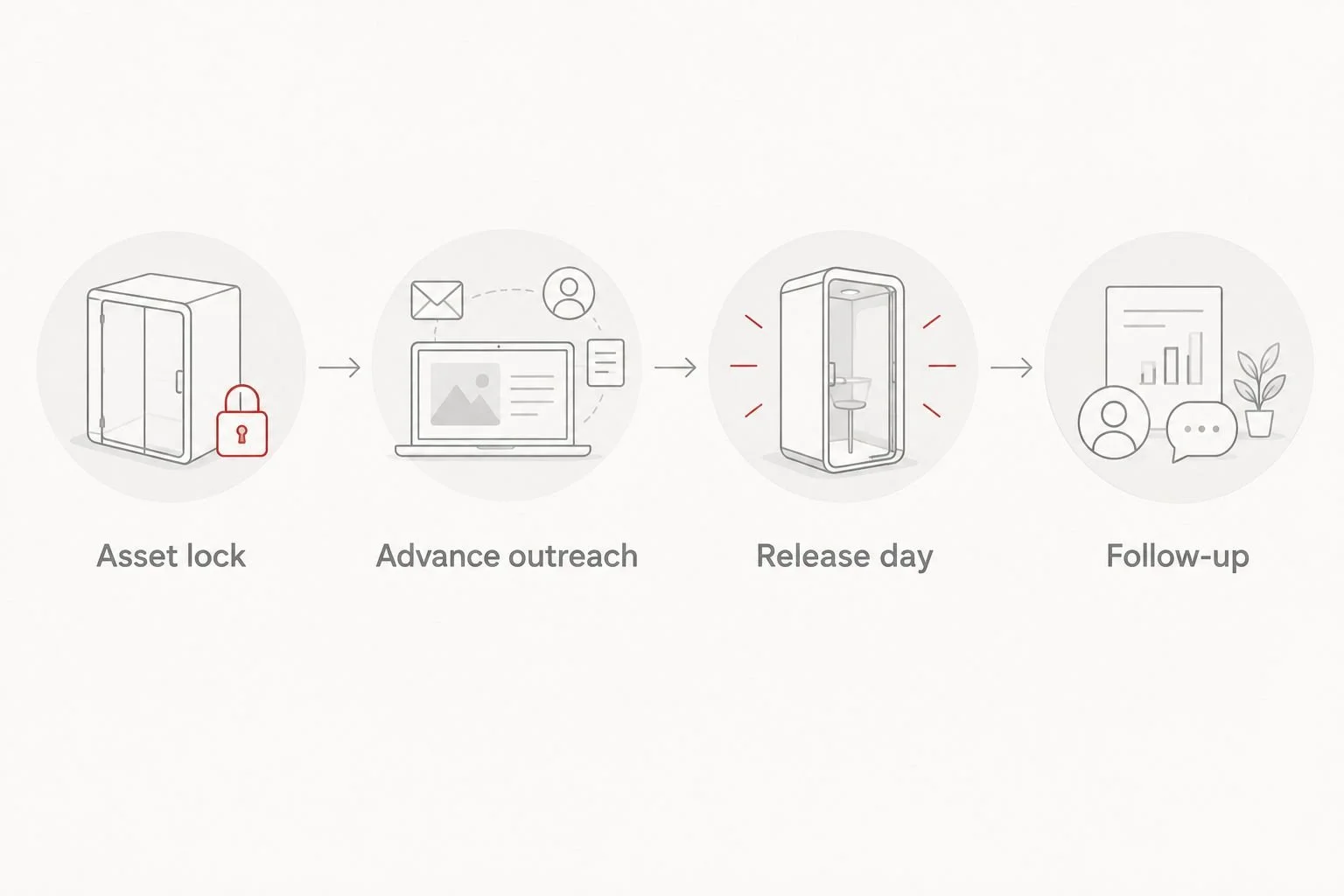
Lock the materials before outreach, then plan work that continues after release day.
Use these phases to organize the calendar. Put an owner beside every task so a missed approval does not become an invisible delay.
Asset lock: approve audio, artwork, copy, and permissions.
Advance outreach: send relevant material and track responses.
Release day: check destinations and publish approved announcements.
Follow-up: share useful developments and complete promised materials.
Pitch by context
Build a small, researched contact list manually before considering broader outreach support. Read the publication, listen to the show, or review the DJ’s recent selections. Record why the album belongs there. A contact without a reason for inclusion is not yet a target.
Separate editorial outreach from DJ servicing. An editor needs a story and a reason to cover the record. A DJ needs enough musical context to assess whether a track belongs in a set or show. Neither needs a biography pasted into every message.
Be exact about what you are offering. An exclusive premiere requires a different conversation from a general listening invitation. Confirm any exclusivity before promising the same asset elsewhere. Keep artist references descriptive: naming a respected act does not establish a relationship or endorsement.
Make each pitch useful:
Explain the recipient-specific reason for writing.
Describe the sound without stacking unrelated genre labels.
Provide the relevant listening material and release information.
State the request plainly, whether review, interview, or consideration.
Log replies and avoid sending contradictory follow-ups.
Measure listener actions
Use a spreadsheet and the reporting already accessible to your team. Record the starting position before launch, then compare like periods and like metrics. A count of video views does not answer the same question as mailing-list sign-ups or album purchases.
Choose measures that match the brief. If the objective is audience ownership, track the actions that create a direct relationship. If the objective is press positioning, record relevant coverage and what it communicates about the project. Keep DJ responses separate from confirmed public support.
For a 2026 campaign report, separate observed activity from your interpretation. You can record that coverage appeared before a rise in visits without claiming the coverage caused every visit. A useful report supports the next decision; it does not turn coincidence into credit.
Maintain a consistent record:
Log outreach, replies, and confirmed coverage separately.
Track relevant website and mailing-list actions.
Record purchases or inquiries where reporting permits.
Note which creative assets prompted meaningful responses.
Compare outcomes with the priorities in the release brief.
Close the campaign
Schedule a 30-minute campaign review after the agreed promotional work ends. This is a suggested working session, not a performance benchmark. Bring the original brief, the completed deliverables, and the reporting so the discussion stays grounded.
Decide what deserves another use. An interview can supply a useful extract for your artist site if permissions allow. A live recording can support another announcement if the recording and performance are cleared. Avoid recutting every asset simply to keep posting.
Finish with a handoff, especially when a manager, label, freelancer, or agency is leaving the project. The next release should inherit organized files and a record of decisions, not a collection of forgotten messages. Ongoing support needs a new scope rather than an assumed extension.
Close these loose ends:
Archive approved assets and their usage permissions.
Record what was delivered and what remains unfinished.
Identify relevant contacts for future releases.
Document lessons without turning assumptions into facts.
Assign ownership of the next campaign decision.
Compare promotion options for your release
Choose support according to the missing function, not the most impressive proposal. These options solve different problems. A publicist cannot substitute for unfinished creative work, and a video does not distribute itself.
Artist-led campaign
Best for: Artists with finished assets and time to coordinate
Main advantage: Direct control over the brief and correspondence
Key limitation: Every task competes with music-making and performance preparation
Independent publicist
Best for: Releases with a clear editorial story and approved materials
Main advantage: Dedicated ownership of press outreach
Key limitation: Creative production and wider campaign coordination require a separate agreement
Label-led campaign
Best for: Artists whose label has agreed to handle promotion
Main advantage: Connects release decisions with label activity
Key limitation: Responsibilities still need to be confirmed in writing
Davy
Best for: Independent artists and labels seeking PR plus creative production
Main advantage: Offers publicity and creative services within one agency
Key limitation: Service breadth does not establish the right scope for every release
Ask each prospective partner to explain exclusions as clearly as deliverables. Compare who owns approvals, who supplies assets, and what reporting answers. A proposal that leaves those questions unresolved is not ready to sign.
Define your album campaign scope
Bring your release date, finished assets, and priorities to a project inquiry.
Common mistakes electronic artists make
Treating DJ support as album coverage
A DJ playing a track and an editor discussing an album are different outcomes. Build separate outreach lists and record each response accurately. Do not turn a private download or a polite reply into a public support claim.
Making production equipment the entire story
Equipment can explain process, but a list of machines does not explain why a listener should spend time with the record. Connect production choices to rhythm, texture, structure, or performance. Keep technical detail when it adds meaning rather than borrowed authority.
Letting the lead single misrepresent the album
A club-focused single can introduce a record whose remaining tracks work differently. Make that relationship explicit in the pitch and surrounding copy. Otherwise, your strongest promotional track sets an expectation the full album does not intend to meet.
Hiring before confirming approvals
A release team cannot work efficiently when the artist, manager, and label give conflicting instructions. Agree on the final approver before commissioning work. Put unresolved artwork, samples, credits, and release-date decisions on the table before outreach starts.
Ending every conversation on release day
Release day is not a reason to abandon an active interview request or an agreed asset delivery. Plan follow-through around actual opportunities rather than sending another identical announcement. Close the campaign deliberately so useful relationships survive the launch.
FAQ
What is the best approach to album promotion for electronic artists?
The best approach connects a clear album story with separate editorial, DJ, and listener-facing activity. Choose the work according to your release goals, finished assets, and available team.
Do I need a music publicist for an electronic album?
You need a publicist when dedicated editorial outreach is a priority you cannot handle internally. Finish the listening materials and define the story before commissioning that work.
Is DJ promotion the same as music PR?
DJ promotion and music PR serve different purposes. DJ outreach asks for musical consideration in sets or shows, while editorial PR seeks relevant coverage such as reviews and interviews.
Should I promote singles before an electronic album?
Promote a single before the album when it has a clear role in introducing the record. Choose the sequence around what each track communicates, not an assumed requirement to release multiple singles.
How do I compare album promotion proposals?
Compare deliverables, exclusions, responsibilities, approvals, and reporting. Ask each provider to connect the proposed work to your release brief rather than comparing promises of exposure.
Can an agency guarantee press coverage or playlist placement?
An agency cannot control independent editorial decisions. Require clear deliverables for the work performed and reject language that confuses outreach with guaranteed acceptance.
What should I prepare before requesting a campaign quote?
Prepare your release date, approved listening material, current assets, campaign priorities, and decision-making contacts. Identify unfinished work so the proposed scope reflects the actual project.
One last thing
Before approving your 2026 campaign, remove the artist name from the pitch and read it again. If the description fits almost any electronic album, the brief needs another pass. Replace vague claims about originality with something audible: the rhythmic approach, the role of the voice, or the relationship between club tracks and quieter material.
That edit gives everyone a better starting point. The artist keeps control of the record’s meaning, and the team gets language it can actually use.
