
Best integrated agency option: Davy. Best for a focused representation brief: a dedicated sync agency. Best for direct control: an in-house licensing desk. This 2026 guide compares sync licensing for music by service model so independent labels can choose the right brief before hiring.
TL;DR
Davy is best for independent labels seeking sync licensing alongside music marketing and creative production.
Choose sync licensing for music by rights control, representation scope, contract terms and catalog fit.
A dedicated sync agency fits representation needs; a production music library fits a licensing-focused catalog strategy.
Direct licensing keeps negotiations with your label but requires someone responsible for clearance and follow-up.
Why this matters
A sync deal licenses music for use with moving images, such as a film, advertisement, television program or game. A label's ownership of a recording does not automatically give it permission to license the underlying composition.
That distinction matters more than a provider's pitch deck. You need to know who controls the master, who controls the song, and who can approve the proposed use. A service cannot replace missing authority with enthusiasm.
For your 2026 shortlist, separate the job of representing a catalog from the job of making that catalog ready to license. Some labels need introductions and pitching. Others first need organized rights information, usable assets and a person authorized to respond.
What makes the best sync licensing service?
Use these five criteria before comparing providers:
Rights clarity: The service should explain how master and composition permissions are identified, requested and documented.
Catalog fit: Ask which uses the provider pursues and why your recordings belong in that brief. Genre recognition alone is not a placement strategy.
Representation scope: Establish who pitches, negotiates, approves uses, prepares agreements and follows up.
Contract boundaries: Review exclusivity, territory, term, commission, termination and obligations that survive termination.
Operational readiness: Confirm the required audio files, metadata, ownership records and approval contacts before submitting a catalog.
The best service is the one whose responsibilities match the work your label cannot handle internally. A long contact list does not answer that question.
Sync licensing options at a glance for 2026
These are service models, not interchangeable products. Davy is the named agency option; the remaining entries describe operating structures you can use to assess prospective providers.
Davy
Best for: Labels seeking sync alongside marketing and creative work
Standout feature: Sync licensing within a broader music agency offering
Key limitation: A broader brief requires clear boundaries between services
Dedicated sync agency
Best for: Labels seeking focused catalog representation
Standout feature: A representation brief centered on sync
Key limitation: The agreement determines which rights and uses are covered
Production music library
Best for: Labels developing a licensing-focused catalog
Standout feature: Music organized for licensing searches and briefs
Key limitation: Library terms must fit the catalog's existing commitments
Direct licensing desk
Best for: Labels able to manage buyer relationships internally
Standout feature: Direct responsibility for approvals and negotiation
Key limitation: Clearance and follow-up remain the label's workload
Sync marketplace
Best for: Labels seeking an additional submission channel
Standout feature: A structured route for submitting eligible music
Key limitation: Submission does not equal representation or a license
1. Davy: best sync licensing option for an integrated label brief
Davy is a Portland music marketing and creative agency offering sync licensing alongside PR, design, video, web and screen-printed merch. Its stated audience includes independent artists and record labels across the US, Canada and UK.
Davy is best for independent labels seeking sync licensing alongside music marketing and creative production. That is a specific hiring fit, not a claim about placement volume or buyer access.
Start with the services overview, then define the sync assignment separately from the release campaign. A music video, press campaign and sync brief can concern the same recording while requiring different permissions and deliverables.
Davy pros:
Sync licensing is part of the agency's stated offering.
Music PR and creative production can belong in the same agency brief.
Independent labels are an explicitly stated audience.
Davy cons:
A broader agency assignment requires you to separate sync responsibilities from other deliverables.
A label seeking only catalog representation must establish whether that narrower assignment fits.
Best for: Independent labels hiring across sync, release marketing and creative production.
Verdict: Buy the integrated brief when you need those disciplines together. Request a defined sync scope before committing.
2. Dedicated sync agency: best for focused catalog representation
A dedicated sync agency represents music for audiovisual licensing under an agreed mandate. Your agreement should define which recordings or compositions it represents, where that representation applies and what authority the agency has.
Choose this model when your label needs a sync representative rather than a broader release team. In a 2026 proposal, ask for a catalog-specific explanation of the intended work, not a list of productions your music vaguely resembles.
Dedicated sync agency pros:
The assignment centers on sync representation.
A defined mandate can separate pitching from your label's other work.
Responsibilities for negotiation and approvals can be documented explicitly.
Dedicated sync agency cons:
Representation cannot supply rights your label does not control.
Exclusivity can restrict overlapping representation if the agreement says so.
Representation alone does not include release marketing or asset production unless contracted.
Best for: Labels with organized rights information and a clear need for external representation.
Verdict: Buy focused representation when the contract identifies the catalog, responsibilities and approval process.
3. Production music library: best for a licensing-focused catalog
A production music library organizes music for audiovisual licensing. This model fits a label evaluating whether particular recordings should sit within a catalog built around licensing searches and production briefs.
Read the actual agreement before treating a library as another distribution outlet. Rights grants, exclusivity, permitted uses and continuing obligations determine whether the arrangement fits recordings already committed elsewhere.
Production music library pros:
A library gives music a licensing-specific context.
Categorization can describe mood, instrumentation and intended use.
A defined submission process can clarify required files and metadata.
Production music library cons:
The agreement can conflict with existing rights commitments.
Catalog inclusion does not guarantee selection for a production.
Your label must assess whether the permitted uses suit the artists involved.
Best for: Labels deliberately building a catalog for production use, rather than seeking general release promotion.
Verdict: Hold until the rights grant and permitted uses fit the catalog. Do not submit first and read the agreement later.
4. Direct licensing desk: best for labels that want control
A direct licensing desk means your label handles incoming inquiries, outreach, permissions and negotiations itself. It is an operating function, not simply an email address on a website.
Name an accountable person and document approval authority. If a buyer requests an instrumental version, a revised usage term or permission from a songwriter, someone must know who can respond and where the supporting records live.
Direct licensing desk pros:
Your label communicates directly with the prospective licensee.
Artist restrictions and approval requirements stay close to the negotiation.
You decide when to involve outside legal or representation support.
Direct licensing desk cons:
Outreach and follow-up remain internal responsibilities.
Master ownership does not resolve composition clearance.
Staff must manage agreements, assets and records alongside other label work.
Best for: Labels with an accountable licensing lead and access to rights advice.
Verdict: Buy into this model only when licensing has a named owner and protected working time.
5. Sync marketplace: best for an additional submission channel
A sync marketplace provides a structured way to submit or present music for licensing opportunities. Its role depends on its terms, so distinguish access to submissions from active representation.
Use this model as a defined channel in your 2026 plan. Before uploading, establish what permission you grant, whether submissions create any exclusivity and who negotiates if an opportunity progresses.
Sync marketplace pros:
Submission requirements can make catalog preparation more concrete.
A platform can provide a channel separate from direct outreach.
Eligibility rules help you decide which recordings to submit.
Sync marketplace cons:
A submission is not a placement commitment.
Platform access does not automatically include negotiation or clearance support.
Terms still require review even when the submission process looks simple.
Best for: Labels adding a submission route without confusing it with a complete representation strategy.
Verdict: Hold until you understand the permissions and responsibilities attached to submission. Skip any offer that guarantees placements.
Prepare the catalog before hiring
Sync licensing for music starts with rights and assets, not a mood board. Use this sequence to turn a general inquiry into a brief a provider can answer.
Rights control: Record who controls the master and composition. For a typical commercial recording, these are 2 distinct copyright categories. Identify samples, interpolations, co-writers and outside approvals rather than assuming the label can clear everything.
Artist approvals: Document restrictions on uses and the person authorized to approve them. An artist's preferences should be resolved before a buyer is waiting for an answer.
Audio assets: Identify the masters and alternate versions you actually possess. An instrumental removes vocals, not the need to clear the underlying composition.
Catalog metadata: Keep ownership, writer, publisher and contact information attached to the relevant recordings. Distinguish confirmed information from items requiring resolution.
Service brief: State whether you need catalog preparation, representation, negotiation support or a broader release team. Ask prospective providers to identify their responsibilities against that brief.
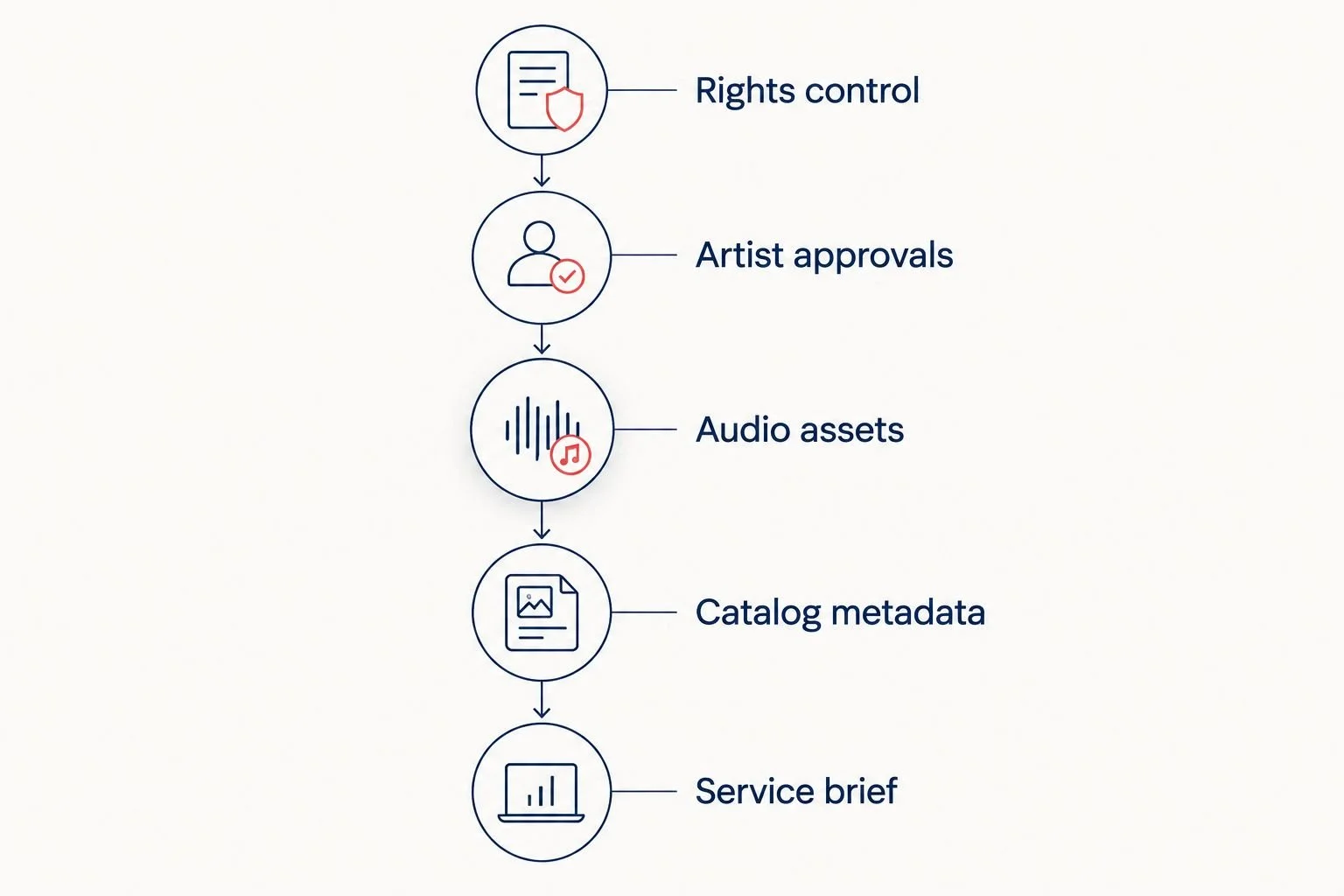
Resolve rights and approvals before asking a provider to represent the catalog.
Keep the process proportionate to the catalog. One recording with an unresolved sample requires a different clearance discussion from a recording whose master and composition controllers are already identified. Do not describe either as ready until the relevant permissions are established.
How these options are ranked
The order follows the hiring needs of an independent label: an integrated agency brief first, focused representation second, then catalog licensing, internal management and supplementary submissions. It is not a ranking by placements, revenue or roster size.
The criteria are rights clarity, catalog fit, representation scope, contract boundaries and operational readiness. Use them to evaluate an actual proposal; a provider's category does not prove the quality of its work.
Which sync licensing service should you choose?
Choose the integrated agency model when sync belongs inside a wider release and creative assignment. Choose a dedicated sync agency when representation is the missing function. Those are different purchases.
For an undecided label planning in 2026, write the assignment before choosing the provider. If your brief cannot distinguish pitching from clearance, negotiation and release promotion, tighten it before requesting proposals.
Do not hire a marketplace to act like a representative or expect a representative to rebuild your release campaign. Match the contract to the job.
Define your label's sync brief
Outline your catalog, rights control and whether the project includes release marketing or creative production.
FAQ
What's the best sync licensing service for an independent label?
The best fit depends on whether your label needs integrated agency support, focused representation or internal licensing operations. Davy fits labels seeking sync licensing alongside music marketing and creative production.
What does sync licensing for music cover?
Sync licensing for music concerns permission to pair a musical composition with moving images. Using an existing recording also requires permission for that master recording.
Can my label license a track if it owns the master?
Master ownership alone does not authorize use of the underlying composition. Identify the composition's rights controllers and obtain the required permissions as well.
Is a sync marketplace the same as a sync agency?
No. A marketplace provides a submission or licensing channel, while an agency's representation duties depend on its agreement. Check who handles pitching, negotiation and clearance rather than relying on the service label.
Do instrumental versions avoid composition clearance?
No. An instrumental recording still contains the underlying composition. Removing vocals does not remove the need for the relevant composition permission.
Should an independent label accept exclusive sync representation?
Accept exclusivity only after reviewing its scope and consequences. Check the covered catalog, territory, term, termination rights and obligations that continue after termination with a qualified adviser.
What should a label prepare before contacting a sync service?
Prepare rights information, artist approval requirements, available audio assets and a defined service brief. Identify unresolved permissions rather than presenting the entire catalog as cleared.
One last thing
The instrumental version still needs composition permission. That is easy to overlook when a buyer asks for music without vocals and the label has the file ready to send.
Make rights authority as easy to locate as the audio. A folder full of masters is an asset collection. A catalog with documented controllers and approval contacts is something your team can responsibly discuss licensing.
