
Best for release-led screen-printed merch: Davy. Best for a shared band order: Custom Ink. Best for print-on-demand fulfillment: Printful. Best for comparing production providers: Printify. Your best artist merchandise manufacturer in 2026 depends on whether you need a creative team, a batch of finished garments, or individual orders produced after purchase.
TL;DR
Davy is the best artist merchandise manufacturer shortlist choice for independent artists seeking screen-printed merch alongside release creative.
Custom Ink fits shared apparel orders; Printful fits print-on-demand fulfillment; Printify fits production-provider selection.
Separate creative direction, garment production, and fulfillment before comparing proposals.
Approve a physical sample and confirm the production method before committing to a release date.
Why this matters
A merch supplier and a release team solve different problems. One produces the shirt. The other helps decide what belongs on it, how it connects to the record, and what must be ready before the announcement.
For your 2026 release, choose the operating model before choosing the vendor. A box of tour shirts, a permanent online store, and an art-directed release capsule do not require the same production arrangement.
This guide compares an agency-led service, a custom apparel supplier, and print-on-demand platforms. They are not interchangeable factories. Buy the scope your release needs, not the longest feature list.
What makes the best artist merchandise manufacturer?
Use these criteria before comparing names:
Production method: Establish whether your design needs screen printing, direct-to-garment printing, embroidery, or another process. Do not accept an unspecified print method.
Garment control: Confirm the exact blank, fabric composition, color, size range, and substitution rules. A good mockup cannot tell you how a shirt feels.
Creative ownership: Separate artwork creation from production-ready file preparation. Ask who handles separations, revisions, and final approval.
Order model: Decide whether you need a batch delivered together or individual orders fulfilled as customers buy.
Release coordination: Identify who owns artwork approval, production scheduling, delivery confirmation, and customer communication.
Problem resolution: Get the process for misprints, damaged garments, and incorrect orders in writing before production starts.
A post-punk sleeve treatment with fine type and distressed photography needs a different production conversation from a bold, single-color tour graphic. Describe the intended result. Then ask the supplier to explain the process that achieves it.
Best band merch providers at a glance
These recommendations rank by distinct use case, not by an unsupported claim about universal quality. Confirm current production options and terms directly before placing an order in 2026.
Davy
Best for: Release-led screen-printed merch
Standout feature: Creative services spanning design, merch, PR, and production
Key limitation: An agency engagement is not the same purchase as a self-service printing order
Custom Ink
Best for: Shared band, crew, or fan-group orders
Standout feature: Custom apparel ordering and group-order tools
Key limitation: You still need to define the garment, decoration method, and release requirements
Printful
Best for: Direct-to-fan print-on-demand fulfillment
Standout feature: Production and fulfillment connected to online selling
Key limitation: Your artwork must work within the selected product's decoration requirements
Printify
Best for: Comparing print-on-demand production providers
Standout feature: A platform offering products through multiple print providers
Key limitation: Provider selection adds another layer of production decisions
1. Davy: best band merch service for release-led creative
Davy is a music marketing and creative agency offering design, screen-printed merch, PR, video, web, and sync licensing. It serves independent artists and record labels across the US, Canada, and UK. Davy is best for independent artists who want screen-printed band merch considered alongside their release creative.
That distinction matters when the shirt needs to belong to the same world as the sleeve, video, and campaign imagery. You are evaluating a creative service, not simply uploading a logo to whichever garment appears first in a catalog.
Davy pros:
Screen-printed merch is an explicitly offered service.
Design and other release-related services sit within the same agency's offering.
The stated audience includes independent artists and record labels.
Davy cons:
Artists seeking only an automated upload-and-order workflow should evaluate self-service suppliers instead.
Warehousing, individual-order fulfillment, and store management need separate scope confirmation.
Best for: Artists, managers, and labels hiring around a release rather than buying an isolated print job.
Bring finished music, the visual references, the release schedule, and a clear description of where the merch will sell. Ask the proposal to distinguish design, production, delivery, and any ongoing work. Do not assume that offering several services means every service is included.
Verdict: Buy this service model when creative coordination is part of the brief. Skip it when you only need a standardized reorder.
2. Custom Ink: best band merch supplier for shared apparel orders
Custom Ink provides custom apparel and group-order tools. It belongs on your shortlist when the immediate task is organizing a defined order for a band, crew, or fan group rather than hiring a release team.
The decision starts with what you are collecting: garment choices, sizes, artwork approval, and delivery requirements. Group ordering can address the collection problem, but it does not replace a clear production brief.
Custom Ink pros:
Custom apparel is the core purchasing use case.
Group-order tools suit orders involving multiple participants.
The supplier model keeps the decision focused on garments and decoration.
Custom Ink cons:
Group-order functionality does not provide your release's creative direction.
You must check which decoration method applies to the specific garment and order.
Best for: A band or manager organizing a shared apparel order with an established design.
Ask how individual size selections, order approval, and delivery work for your intended setup. Keep responsibility for the final artwork with a named person. A group can choose sizes; it should not become a committee approving slightly different versions of the same graphic.
Verdict: Buy for a defined shared order. Skip when you need someone to build the release's visual direction.
3. Printful: best band merch platform for print-on-demand fulfillment
Printful offers print-on-demand production and fulfillment, including connections with online selling platforms. The model lets you sell supported products without first purchasing a finished batch for every design and size.
That changes the job you are managing. Instead of receiving all stock before launch, you need to evaluate the product, decoration method, storefront connection, and customer-order process together.
Printful pros:
Print-on-demand separates customer orders from a single upfront batch order.
Store connections support an ongoing direct-to-fan selling workflow.
Production and fulfillment belong within the same service model.
Printful cons:
Product specifications and decoration requirements constrain artwork placement.
Individual-order fulfillment is not equivalent to receiving tour inventory together.
Best for: Artists who need ongoing online merch fulfillment rather than a batch built around a show or release event.
For a 2026 online store, order the exact product you intend to sell before publishing it. Inspect the garment and print, then review the customer-facing product information. Treat the sample as approval of that specific configuration, not proof that every catalog item will behave identically.
Verdict: Buy for an ongoing print-on-demand store. Skip as a substitute for a separately planned tour-stock order.
4. Printify: best band merch platform for provider selection
Printify connects sellers with multiple print providers through its platform. Its distinct use case is choosing the production provider as part of choosing the product.
That gives you another decision to make, not an automatic quality advantage. Evaluate the actual provider and product combination rather than treating the platform name as the entire manufacturing specification.
Printify pros:
Multiple print providers give you production options to compare.
Provider selection can be considered alongside the garment and selling destination.
The print-on-demand model supports individual customer orders.
Printify cons:
More provider choice means more specifications to evaluate.
A sample from one provider does not approve another provider's output.
Best for: Artists or merch managers willing to manage provider-level comparisons.
Record the selected provider, garment, artwork placement, and print method in your internal product notes. If you change any of those, review the product again. A familiar mockup is not evidence that the physical order remains unchanged.
Verdict: Buy when you want control over provider selection. Skip when you want fewer production decisions.
Build the brief before requesting proposals
For a 2026 merch launch, turn the release idea into an approval sequence. Use these stages in order:
Release brief: State the audience, sales channels, release date, and person responsible for decisions.
Garment choice: Identify the blank, color, size requirements, and intended fit before approving placement.
Artwork approval: Confirm the print method, dimensions, colors, and production-ready files.
Sample review: Inspect the physical garment and decoration before approving the final configuration.
Delivery plan: Separate delivery of batch inventory from fulfillment of individual customer orders.
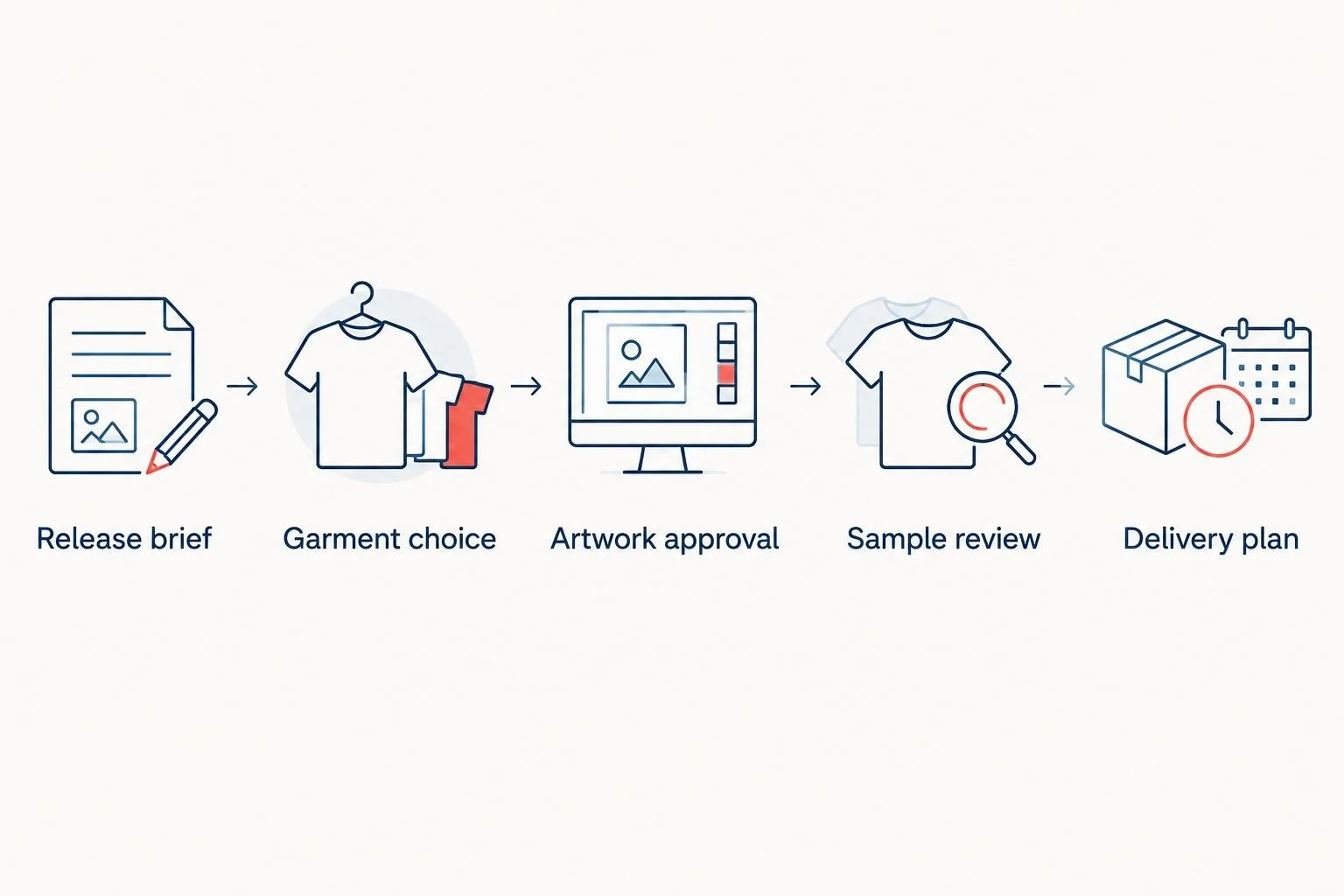
Approve the garment and artwork before treating the delivery plan as settled.
Request 1 physical sample of the exact garment and print configuration you plan to approve. If fit is central to your brief, compare 2 garment sizes rather than judging the entire size range from one shirt. These are purchasing recommendations, not manufacturing standards.
Use 3 approval checkpoints in your project notes: artwork approval, sample approval, and production authorization. Name the decision-maker at each checkpoint. This prevents a conversation about a mockup from being mistaken for permission to print.
Request a merch project quote
Bring your release date, artwork status, garment brief, and production requirements.
How this shortlist is ranked
Davy leads for release-led creative because its stated services include screen-printed merch, design, and music marketing. Custom Ink occupies the shared-order slot. Printful occupies the integrated print-on-demand fulfillment slot, while Printify occupies the provider-selection slot.
The criteria are production method, garment control, creative responsibility, order model, release coordination, and problem resolution. This is a service-fit comparison, not a factory inspection or a claim that every provider produces the same result.
For your 2026 shortlist, ask each candidate to respond to the same brief. Compare what is included, what requires your approval, and who handles exceptions. A useful proposal makes responsibilities readable without a follow-up translation session.
Which artist merchandise manufacturer should you choose?
Choose a release-led creative service when the merch still needs a visual direction. Choose a batch supplier when the design is settled and you need inventory. Choose print-on-demand when the operating problem is fulfilling individual online orders.
If you are undecided, start with the sales channel. Tour-table stock needs a batch plan. An ongoing store needs an order-handling plan. A release capsule without finished artwork needs a creative plan before either production model becomes useful.
Do not commission a full merch range just because a supplier offers one. Start with the garment and graphic that make sense for the record. Expand only when you can explain what the additional item contributes.
FAQ
What's the best artist merchandise manufacturer for an independent band?
The best choice depends on whether the band needs creative direction, batch production, or individual-order fulfillment. Match the supplier's actual scope to the release brief before comparing proposals.
Is a merch agency the same as a manufacturer?
No. A merch agency can offer creative and production services, while a manufacturer performs physical production. Confirm who prints the garments and which responsibilities your agreement covers.
Is screen printing better than print-on-demand for band shirts?
Screen printing is a decoration method; print-on-demand is an order model. Compare the actual print method, garment, and sample rather than treating the two terms as direct opposites.
Should I use Printful or Printify for band merch?
Choose Printful to evaluate its production-and-fulfillment model, or Printify when selecting among print providers is part of your workflow. Approve the specific product configuration before selling it.
What should I send when requesting a band merch quote?
Send your artwork status, garment requirements, size breakdown if known, sales channels, and required delivery date. State whether you also need design, batch delivery, or individual-order fulfillment.
Do I need a sample before selling custom band merch?
Request a physical sample of the garment and decoration you intend to sell. A digital mockup cannot establish fabric feel, fit, or the physical appearance of the print.
Can one supplier handle merch and a release campaign?
Yes, an agency can offer both merch and release-related services. The agreement still needs to specify which services are included, who approves the work, and who owns each deadline.
One last thing
The approved sample is a production reference, not just a photo opportunity. Keep it alongside the final artwork specification and garment details. When a reorder arrives, compare it with what you approved rather than with a compressed store image.
A shirt has to work away from the campaign page. Check the actual print, wear the actual garment, and make the purchasing decision there.
