
Best overall for continuous tour coverage: an embedded touring videographer. Best for release-led creative: Davy. Best for a single show: a local concert videographer. This 2026 guide compares hiring models for touring bands and festival content, so you can commission the footage your campaign actually needs.
TL;DR
For a videographer music search, choose by assignment: tour documentation, festival coverage, or release-led production.
Davy is best for artists seeking music video production alongside broader release creative.
Embedded touring videographers suit continuous coverage; local concert videographers suit individual dates.
Define access, audio, deliverables, approvals, and usage before booking anyone.
Why this matters
A music video credit, a strong concert reel, and an excellent festival recap demonstrate different things. Your hiring decision should follow the assignment, not the most dramatic shot in a portfolio.
If your 2026 campaign needs video, artwork, publicity, and a coherent release identity, assess music marketing and creative services together. If you only need a performance documented, commission that job directly. A broader engagement is not automatically the better choice.
Hire for the finished deliverable, then work backward to the camera position, access, crew, and edit. A backstage montage cannot substitute for a complete performance when that is what you promised your label.
What makes the best music videographer
Use these criteria before comparing reels or requesting proposals:
Assignment fit: Look for complete work matching your intended output: concert film, tour documentary, festival recap, or release video.
Access planning: Identify who secures photo-pit, stage, backstage, and artist permissions. Do not treat an artist credential as unrestricted filming permission.
Audio planning: Specify whether the edit needs live performance audio, an approved master, interviews, or a combination.
Delivery discipline: Put the edit list, formats, deadlines, review process, and handover requirements in writing.
Creative judgment: Ask how the operator captures your performance without interrupting it or manufacturing a backstage personality.
Rights clarity: Agree on footage ownership, permitted uses, music clearance responsibilities, and any restrictions before the show.
For a 2026 brief, separate requirements from references. A reference to Anton Corbijn communicates an aesthetic direction; it does not tell a videographer which songs to capture or when your first cut is due.
Best music videographer options at a glance
These are hiring models, not a claim that unrelated suppliers have been tested against each other. The right model depends on whether continuity, release integration, local execution, or simultaneous coverage matters most.
Embedded touring videographer
Best for: Continuous tour storytelling
Standout fit: Follows the same artist across dates
Key limitation: Adds travel, access, and ongoing approval requirements
Best for: Release-led video and creative
Standout fit: Music video production alongside PR, design, web, merch, and sync licensing services
Key limitation: Tour and festival assignments need a specifically agreed scope
Local concert videographer
Best for: One defined performance
Standout fit: Focused coverage without an entire tour assignment
Key limitation: Does not provide continuity across other dates
Festival production crew
Best for: Simultaneous stages and scheduled coverage
Standout fit: Divides a complex event across assigned operators
Key limitation: Requires coordination, permissions, and shared editorial direction
Specialist music editor
Best for: Turning existing footage into campaign assets
Standout fit: Builds deliverables from material already captured
Key limitation: Cannot recreate missing performances or camera angles
1. Embedded touring videographer: best for continuous tour coverage
An embedded touring videographer travels with the artist and documents the run rather than an isolated performance. Choose this model when the story depends on repetition, changing rooms, travel, soundchecks, and the relationship between shows.
You are hiring someone to operate inside the band's working environment. Their judgment around fatigue, privacy, crew responsibilities, and when not to film matters alongside their camera work.
Embedded touring videographer pros:
Preserves continuity across performances and offstage material.
Gives the operator repeated opportunities to understand the set.
Supports a tour narrative rather than disconnected event clips.
Embedded touring videographer cons:
Travel and accommodation become part of the assignment.
Filming boundaries need agreement across artists and crew.
Editing responsibilities compete with travel and shooting unless scheduled separately.
Ask to see a complete tour sequence, not just a reel. Discuss whether the person shoots and edits, whether editing happens during the run, and who approves material while the band is moving.
Best for: Bands and managers commissioning an ongoing visual record across multiple dates.
Verdict: Buy this hiring model when continuity is the deliverable. Skip it for a single isolated show.
2. Davy: best for release-led music video and creative
Davy is a Portland music marketing and creative agency serving independent artists and record labels across the US, Canada, and UK. Its stated services include PR, design, video, web, screen-printed merch, and sync licensing.
Its confirmed music video credits include A Place to Bury Strangers, Bootblacks, Mold, and Crow Jane. Those are music video credits, not evidence of tour documentation, festival coverage, PR results, or broader artist relationships.
Davy is best for independent artists who want music video production connected to a broader release brief. This is a different buying decision from hiring someone to follow a van for an entire run.
Davy pros:
Offers video alongside other stated release and creative services.
Has confirmed music video credits you can use when assessing creative fit.
Serves both independent artists and record labels.
Davy cons:
A music video portfolio does not establish an embedded tour workflow.
Tour travel, festival access, live audio, and event deliverables require an agreed project scope.
Bring a release date, finished music, visual references, and a specific output list to the inquiry. Ask whether the assignment belongs inside a broader campaign or should remain a standalone production.
Best for: Artists and labels making video part of a coordinated release identity.
Verdict: Buy for a defined release-led production brief. Hold a touring assignment until coverage and delivery responsibilities are agreed.
3. Local concert videographer: best for one important show
A local concert videographer covers a specific performance without joining the full tour. This model fits a hometown release show, a significant support slot, or another date where you need a clearly bounded production.
Keep the brief narrow enough to execute. Capturing a complete song with usable sound is a different assignment from gathering short atmospheric clips throughout the room.
Local concert videographer pros:
Keeps the assignment attached to a defined date and venue.
Lets you commission a particular performance rather than a tour narrative.
Supports a direct brief with a clear start and finish.
Local concert videographer cons:
Cannot document what happens on the rest of the tour.
Has limited time to learn the band's movement and stage cues.
Still needs venue permissions and an agreed audio plan.
Send a set list with the essential moments marked. Identify who handles the venue introduction, where the operator can stand, and whether audience filming needs additional consideration.
Best for: Artists who need one show captured properly without commissioning continuous coverage.
Verdict: Buy for a defined performance. Skip if the real requirement is a connected tour story.
4. Festival production crew: best for simultaneous coverage
A festival production crew divides coverage among assigned operators. This model belongs on the shortlist when overlapping performances or separate locations make a single operator's brief physically impossible.
For an artist team, establish whether you are commissioning artist-specific coverage or receiving material from the festival's own production. Do not assume the festival's recap priorities match your release campaign.
Festival production crew pros:
Can assign operators to different stages or locations.
Separates performance coverage from interviews and atmosphere.
Supports an event-wide plan with distinct responsibilities.
Festival production crew cons:
Needs shared creative direction to avoid mismatched footage.
Requires a clear handover and editing structure.
Festival access rules still govern individual shooting positions.
Ask who owns the shot list and who makes the final edit decisions. Specify which artist moments take priority over crowd shots, sponsor obligations, or general event coverage.
Best for: Labels, managers, and festival teams coordinating concurrent assignments.
Verdict: Buy when the coverage genuinely requires simultaneous operators. Skip the extra complexity for one bounded set.
5. Specialist music editor: best for footage you already have
A specialist music editor turns existing footage into an agreed set of finished pieces. This is the right starting point when your archive already contains the material the campaign needs.
Commission an inspection of the source files before committing to a detailed edit brief. A folder containing compressed social exports is not equivalent to organized original footage with usable audio.
Specialist music editor pros:
Focuses the assignment on finishing rather than another shoot.
Can organize existing material around a release or tour narrative.
Lets you specify separate outputs from the same source footage.
Specialist music editor cons:
Cannot recover moments nobody filmed.
Inconsistent footage creates editorial constraints.
Music, footage permissions, and source quality still need checking.
Best for: Artists and labels with an existing archive and a clear publishing purpose.
Verdict: Buy after reviewing the source material. Hold if the essential performance is missing.
Build the brief before you book
Use this sequence for your 2026 production inquiry. It gives candidates the same assignment to respond to and makes proposals easier to compare.
Define outputs
Name the finished pieces first. For example, a hypothetical brief might request 1 complete live song, a tour recap, and supporting excerpts. State whether those are separate edits or variations of the same piece.
Confirm access
List the rooms, dates, and intended shooting positions. For a hypothetical 3-show run, identify a venue contact for each show rather than assuming one agreement covers the whole route.
Agree audio
Decide whether the edit uses live sound, an approved recording, or interviews. Assign responsibility for recording, obtaining, syncing, and approving that audio.
Set delivery
Specify deadlines, reviewers, file handover, and revisions. If you need 2 delivery formats, such as horizontal and vertical, identify both before filming so framing decisions support the edits.
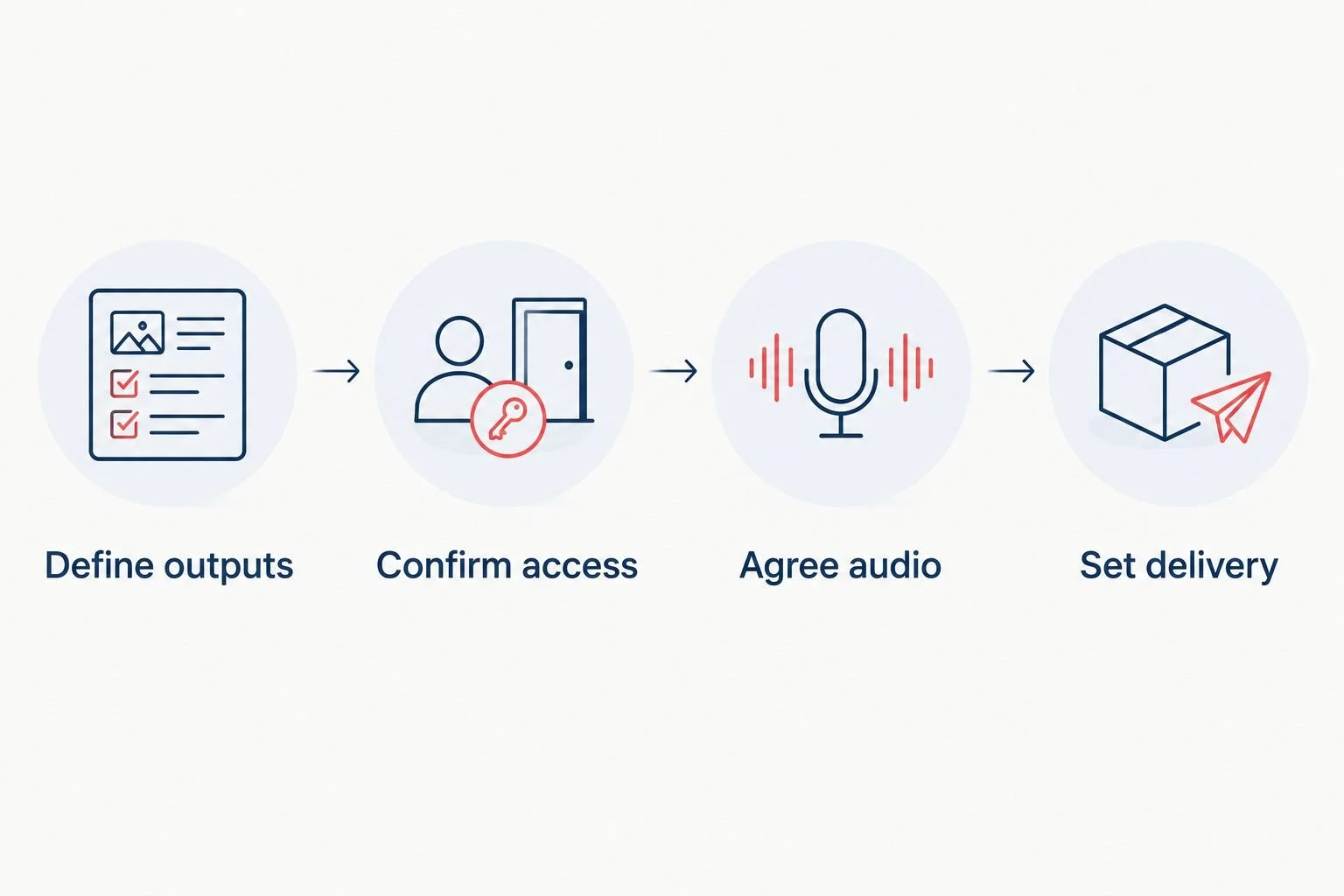
Agree on the finished work before deciding how to capture it.
A useful proposal answers each part of this brief. Beautiful references do not replace responsibility for permissions, source files, or deadlines.
Discuss your release video brief
Bring your release date, references, and deliverable list to a project inquiry.
How the options are ranked
This 2026 ranking prioritizes assignment fit, then access, audio, delivery, creative judgment, and rights clarity. It compares hiring structures rather than claiming a universal winner across named production companies.
Continuous touring coverage comes first because it most directly answers the touring part of the brief. Release-led production, individual shows, concurrent festival assignments, and archive editing each occupy a separate use case. None substitutes automatically for another.
Which music videographer should you choose?
Choose an embedded touring videographer if your central requirement is continuous coverage across the run. Choose a local operator if the job ends with one performance, and a festival crew if separate assignments happen at the same time.
If the performance footage supports a release rather than constituting the entire project, assess production alongside the wider creative brief. If you already have the footage, inspect it before commissioning another shoot.
Do not buy a larger production because it sounds more serious. Buy the scope that produces the work you will actually publish.
FAQ
What's the best videographer for a touring band in 2026?
An embedded touring videographer is the best hiring model when you need continuous coverage across multiple dates. A local concert videographer is a better fit when you only need one performance documented.
Is Davy a fit for music video production?
Davy offers video production alongside music marketing and creative services. Its confirmed music video credits include A Place to Bury Strangers, Bootblacks, Mold, and Crow Jane; discuss touring or festival requirements as a separate scope.
Should I hire a photographer or a videographer for festival content?
Hire according to the finished deliverables: still photographs require photography, while edited moving-image work requires video production. If you need both, assign both responsibilities explicitly rather than assuming one operator will cover everything.
Can one videographer cover an entire festival?
One videographer cannot cover simultaneous performances in separate locations. Prioritize a limited assignment or commission a crew with defined coverage responsibilities.
Do I need permission to film my own band's festival set?
Confirm filming permissions with the festival and relevant venue contacts before the performance. Artist participation does not establish unrestricted access to every shooting position or permission for every intended use.
What should I send when requesting a music videographer quote?
Send the dates, locations, finished deliverables, intended uses, audio requirements, references, and approval deadlines. Explain who handles access and whether you need shooting, editing, or both.
Can a music editor use footage from previous shows?
A music editor can work with existing footage when its quality and permissions support the intended edit. Review the original files and available audio before agreeing on deliverables.
One last thing
Ask each shortlisted candidate for a complete piece resembling your assignment, not another highlight reel. Then ask what the brief required and what the final handover contained.
That conversation tests whether the work matches your buying decision. A striking shot proves someone captured a moment. Your project needs someone who can finish the assignment.
