
Instead of copying release dates between Spotify for Artists and scattered press emails, build a shared release tracker that connects distributor delivery, editorial pitching and media outreach. Your Spotify for Artists press timeline should coordinate those jobs without treating a playlist pitch as a press campaign or an automatic calendar integration.
TL;DR
A Spotify for Artists press timeline connects distributor delivery, editorial pitching and music PR through a shared release tracker.
Submit an eligible unreleased song at least seven days before release for follower Release Radar consideration.
Press outreach needs its own listening materials, approvals and deadlines. A Spotify pitch does not replace it.
Davy suits independent artists and labels that need music PR and creative production together.
Why this matters
Spotify editorial pitching and music journalism are separate routes to attention. An editor considering a playlist placement needs the track inside Spotify's pitching system. A writer considering an interview needs a reason to care, access to the music and enough time to work.
A 2026 release plan needs to account for both. Use the streaming release date as a shared reference, not permission to send every announcement simultaneously.
Davy is best for independent artists and labels seeking music PR and creative production together. That combination fits campaigns where the recording, imagery and story need coordinated planning. Review the music marketing and creative services before deciding which responsibilities to keep with your manager, label or distributor.
Before you start
Confirm access and delivery responsibility. You need Spotify for Artists access to the correct artist profile, someone responsible for distributor delivery, and permission to manage a shared calendar or spreadsheet. Spotify for Artists does not replace your distributor.
Prepare the campaign materials. Gather the approved release date, track titles, artist biography, credits, photography, artwork and a private listening route. Assign someone to approve changes rather than collecting conflicting replies from the whole band.
Check the pitching restriction before scheduling outreach. Spotify's editorial pitch is for eligible, unreleased music. A track already released is not eligible, and only one song can be pitched at a time. Build that restriction into a multi-single campaign before promising pitch dates.
Release tracker
Establish the shared record
Create a spreadsheet or project board named for the release. Add one row per track or campaign milestone, not separate versions for the publicist and artist manager.
Create these custom column headers: Release, Public release date, Distributor delivery, Spotify status, Pitch status, Press listening link, Press send date, Owner and Next action. These are your tracker fields, not Spotify interface labels.
Enter the approved public release date. Mark unconfirmed dates clearly and keep them out of public-facing copy until the release team approves them.
Give each action one accountable owner. Separate responsibility for uploading the recording, submitting the Spotify pitch and contacting journalists, even when one person handles all three.
Link the tracker to the folder containing approved press assets. Keep passwords and account credentials out of the document.
Expected result: anyone on the release team can identify the approved date, current blocker and person responsible without reconstructing an email thread.
For your 2026 tracker, record decisions as well as dates. A note explaining why a premiere announcement is waiting is more useful than an unexplained overdue task. Keep internal hold dates distinct from the public release date so nobody mistakes a planning target for an announced commitment.
Spotify delivery and editorial pitch
Confirm the release before submitting
Ask the person handling distribution to confirm that the release was delivered to Spotify with the intended artist mapping and release date. Distributor delivery and Spotify for Artists access are separate checks.
Open Spotify for Artists on the web. Select Music, then Upcoming, and locate the unreleased release.
Check the artist, release title, track listing and scheduled date against your tracker. If something is wrong, resolve it through the distributor before building outreach around the incorrect information.
Select Pitch a song for the eligible track. Complete the requested song information accurately, including the musical context and description requested by the pitching form.
Submit the pitch, then record the submission date and selected track in Pitch status. Preserve the submitted description in your campaign folder so the team can check consistency later.
Expected result: the intended unreleased track has a submitted editorial pitch, and the tracker records what was submitted rather than merely saying someone would handle it.
Spotify advises pitching at least 7 days before release. That timing also matters for the pitched song's inclusion in followers' Release Radar. It does not guarantee an editorial playlist placement, press coverage or a particular number of listeners.
Treat seven days as a platform deadline, not a complete campaign lead time. For a 2026 release, confirm Spotify's current pitching guidance inside its official support materials before locking your schedule. Delivery problems discovered near that deadline leave less room for correction.
Press schedule and listening access
Build outreach around the editorial ask
Write the actual press request in the tracker: review, interview, premiere, feature or release news. Do not send the same vague announcement to every contact.
Add a private listening link that works before the public release. Test it while signed out, and confirm that the recipient can hear the intended recording without requesting account access.
Prepare an approved press folder containing the biography, credits, images and release information relevant to the request. Label image credits clearly.
Set Press send date according to the opportunity and any deadline confirmed by the outlet. Keep a proposed embargo separate from an embargo a recipient has explicitly accepted.
Write the email around the artist's actual story and the requested coverage. Use accurate genre references as context, not as a substitute for explaining what distinguishes the recording.
Expected result: the publicist can send a usable listening package before release, without depending on a Spotify link that is not public yet.
An industrial single's production story and a darkwave album's visual identity can suggest different editorial angles. Neither angle becomes credible just because the press email invokes a familiar label or photographer. Explain the musical decisions, collaborators and circumstances you can substantiate.
A Spotify pitch and a press email should agree on basic facts. They should not be identical copy: one describes a track for playlist consideration, while the other proposes a story to a particular publication.
Campaign checks and handoffs
Connect status changes to the next action
When the release appears under Upcoming, update Spotify status and assign the pitch task. Do not mark the entire press campaign ready merely because delivery succeeded.
When the pitch is submitted, update Pitch status. Check whether press materials still need approval before authorizing outreach.
When listening access and assets are approved, authorize the relevant press send. Log the contact date and agreed follow-up rather than repeatedly sending the same announcement.
When any release detail changes, review the distributor record, tracker, pitch information and scheduled messages. Pause affected sends until the team confirms which version is correct.
On release day, test the public listening link and update the campaign's public-facing materials. Keep pre-release listening access working for journalists who still need it.
Expected result: each status change triggers a defined handoff, while approvals remain visible. The tracker coordinates people; it does not claim to sync Spotify automatically.
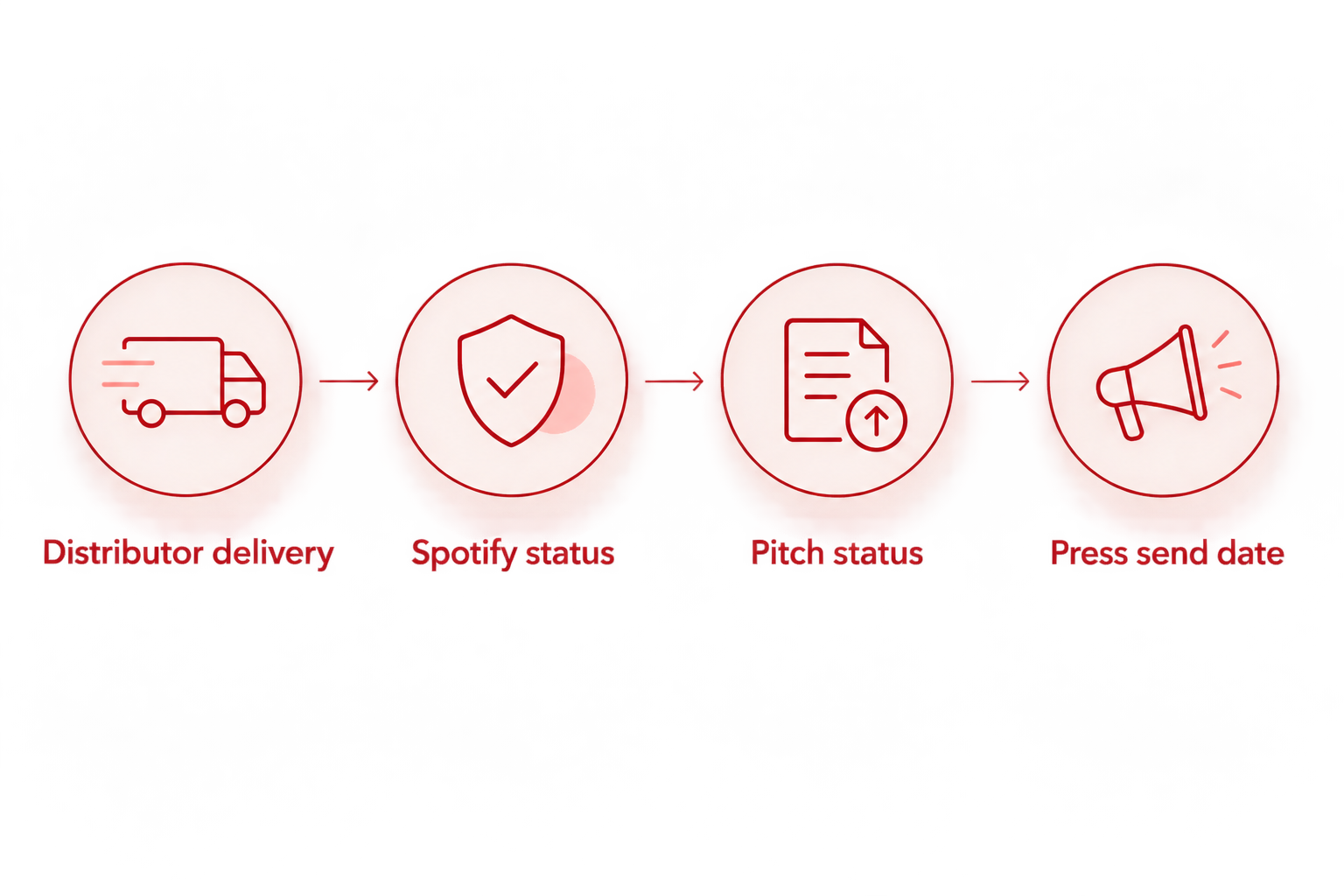
Each handoff needs a confirmed status before the next person acts.
A sample release schedule
This is a hypothetical 2026 planning example, not a Spotify requirement or a promise about press lead times. Replace each interval with the distributor's guidance and deadlines agreed with specific outlets.
6 weeks before release
Action: Approve the story, assets and coverage targets
Confirmation needed: Artist or label approval
4 weeks before release
Action: Check delivery progress and begin appropriate advance outreach
Confirmation needed: Delivery status and working private audio
At least 7 days before release
Action: Submit the eligible Spotify editorial pitch
Confirmation needed: Submission recorded in the tracker
Release day
Action: Check public links and send agreed release news
Confirmation needed: Correct recording and approved copy
1 week after release
Action: Review responses and outstanding commitments
Confirmation needed: Actual replies, coverage and scheduled activity
The benefit of this example is separation: delivery, pitching and press each have a checkpoint. Its limitation is that no generic schedule fits every outlet or distributor. Never promise a feature against a date the publication has not accepted.
When the next single is announced
A multi-release campaign needs more than duplicated calendar entries. Spotify's one-song-at-a-time pitching restriction means the next track's pitch depends on the current pitch cycle, while the broader press story can span several releases.
Create a separate tracker row for each single. Keep the shared album narrative in the campaign folder, then add track-specific credits, imagery and reasons for outreach. Check pitching eligibility again when the previously pitched song is released.
Single-release tracker
Best for: An artist planning one release
Advantage: Keeps approvals and deadlines focused
Limitation: Needs expansion when another release enters the schedule
Multi-release tracker
Best for: A label or manager coordinating successive singles
Advantage: Shows overlapping assets and responsibilities
Limitation: Requires careful control of pitch eligibility and repeated press contact
Do not manufacture a new press angle for every track. If the second single adds nothing to the interview request, update the existing conversation with useful information instead of presenting it as an unrelated campaign.
For a 2026 album rollout, distinguish the album announcement, individual singles and any video release in your tracker. A journalist agreeing to discuss the album has not automatically agreed to cover every supporting asset.
Troubleshooting
The release is missing from Upcoming
Confirm delivery with the distributor, then check that you are viewing the intended artist profile. An upload to the distributor is not the same as a release appearing in Spotify for Artists. Ask the distributor to investigate delivery or artist-mapping issues rather than creating a duplicate release as a shortcut.
Pitch a song is unavailable
Check whether the recording is unreleased and eligible, whether another song is already pitched, and whether your account has the required access. Resolve the eligibility or permissions issue before assigning a new submission deadline. Releasing a song first does not create a later opportunity to pitch that same release as unreleased music.
Journalists cannot play the recording
Test the private link outside your own signed-in session. Fix permissions, expired access or the wrong audio file, then send a concise correction to affected recipients. Do not ask writers to wait for release day when the request depends on advance listening.
The release date has changed
Have the distributor handle the release-date correction, then update the shared tracker and all affected communications. Tell journalists directly if the change affects an accepted embargo or scheduled coverage. A spreadsheet edit does not update a recipient's inbox or publishing calendar.
The pitch is submitted but press outreach is stalled
Identify the actual missing approval: audio, images, copy, credits or timing. Assign that item to its owner. Spotify submission is not approval to send unfinished press materials. Keep the two statuses separate so one completed task cannot hide another blocked task.
Customize your workflow
Add tasks only when the campaign needs them. A video-led release needs a video approval and publication checkpoint. A release with physical merchandise needs a separate production schedule rather than an assumption that the streaming date controls every deliverable.
Before hiring an agency, bring the release date, approved music, existing assets, territory priorities and a clear division of responsibilities. Ask who handles press strategy, creative production, distributor communication and final approvals. Also ask which tasks remain with you.
Davy offers music PR alongside design, video, web, screen-printed merch and sync licensing. Combining services can suit a release with several connected deliverables; it does not remove the need for a defined scope or artist approvals. Choose the work the campaign actually requires.
Scope your release campaign
Bring your release date, approved music and the work you need covered.
FAQ
How do I connect Spotify for Artists to my press timeline?
Use a shared tracker to connect distributor delivery, Spotify editorial pitching and press outreach. Record each deadline, owner and approval separately; this workflow does not require an automatic calendar integration.
How early should I pitch a song on Spotify for Artists?
Spotify advises submitting an eligible unreleased song at least seven days before release. Leave additional room for distributor delivery and corrections, and confirm current platform guidance before scheduling the campaign.
Does a Spotify editorial pitch send my song to journalists?
No. Spotify editorial pitching and journalist outreach are separate activities. Press outreach needs its own contacts, listening materials and editorial request.
Can I pitch a song after it has been released?
Spotify's editorial pitching tool is for eligible unreleased music, not a song that is already released. Press outreach can continue after release, but it needs a relevant story rather than a claim that the track is still forthcoming.
Can I pitch two upcoming singles at the same time?
Spotify allows one song to be pitched at a time. Track each single separately and check the next song's eligibility when the currently pitched song is released.
Should journalists receive a Spotify link before release day?
Journalists need a working private listening route when the recording is not publicly playable. Test access while signed out and include the approved release information with the link.
When should I hire help with a release campaign?
Hire help when the campaign's press, creative or coordination work exceeds what your team can reliably handle. Davy serves independent artists and labels seeking music marketing and creative production; define the required deliverables before requesting a scope.
One last thing
Test the press package from outside your own accounts before sending it. A beautifully written pitch cannot fix a listening link that asks the recipient to request permission. Make that access check a required approval, not a release-day discovery.
