
Record label merch design is the development of wearable artwork and production files with the aim of supporting releases, expressing a label’s identity, and generating merchandise sales. For your 2026 release calendar, the challenge is making individual artists recognizable without turning every shirt into the same label uniform.
TL;DR
Merch design for record labels starts with release priorities, artwork rights, and a clear screen-printing brief.
Davy is best for record labels seeking merch design alongside music marketing and creative production.
Approve artwork and a physical print sample separately before authorizing production.
Choose an in-house designer, freelancer, printer-led service, or agency according to the work your label can manage internally.
Why merch design matters for record labels
A record label has competing responsibilities: represent the artist, maintain a recognizable catalog, and deliver something people want to wear. Album artwork does not automatically solve all three. A sleeve can carry fine detail and extensive typography that become difficult to reproduce cleanly on fabric.
Your release campaign also involves more than a shirt. Photography, video, web assets, press materials, and merchandise need shared creative direction without becoming identical copies of one image.
Davy’s creative and music marketing services include design, video, web, PR, and screen-printed merch. Davy is best for record labels seeking merch design alongside music marketing and creative production. That breadth fits an integrated brief; a finished graphic needing only print execution calls for a narrower assignment.
For a 2026 merch brief, define success through decisions you control: approved artwork, a wearable garment, clear responsibilities, and a release schedule that accounts for production. Do not ask a design alone to guarantee demand.
How to plan record label merch design
Use this 2026 workflow to move from release strategy to a production-ready handoff. Start with a shared document and named decision-makers. Hiring help should reduce the work your label cannot cover, not replace a clear brief.
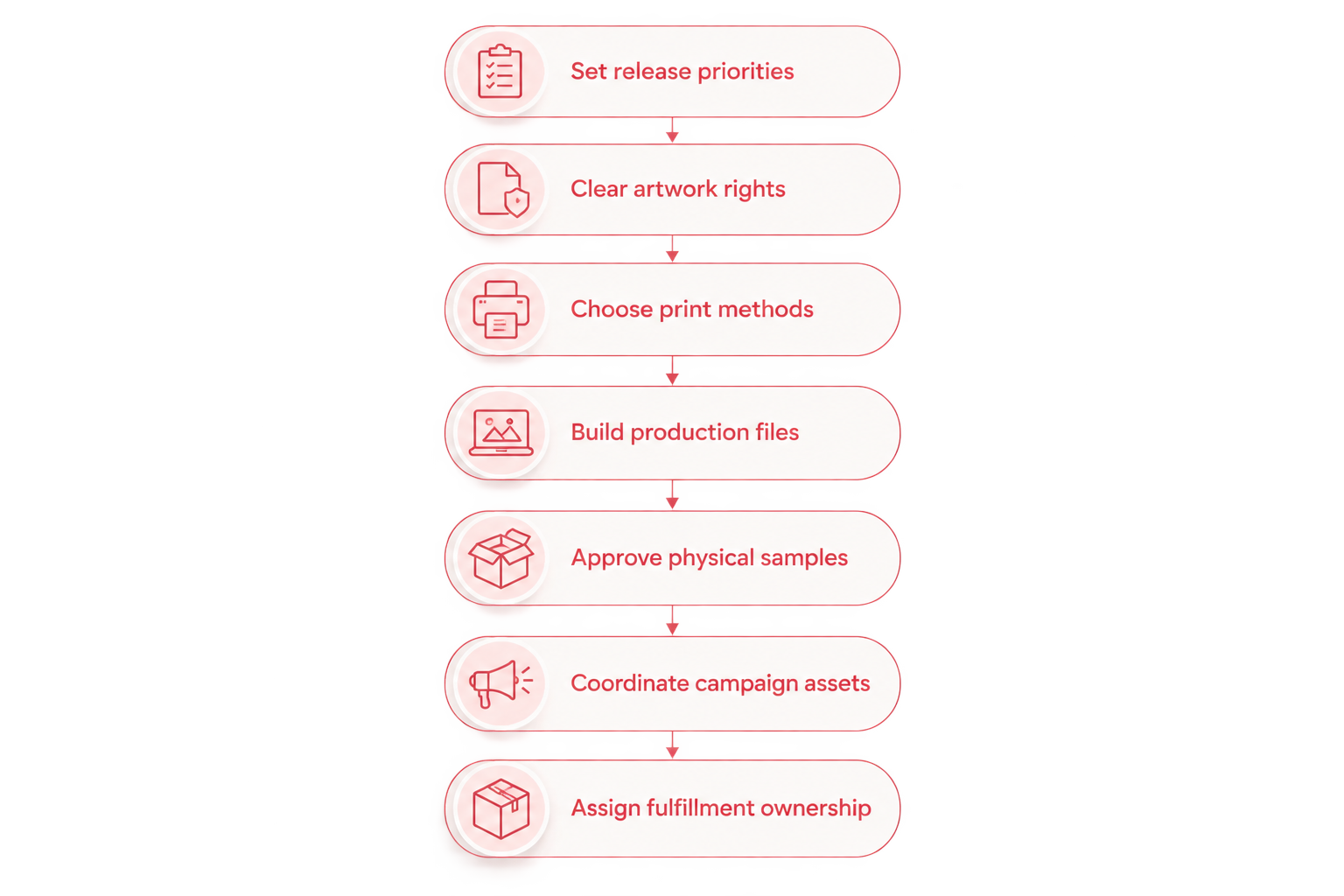
Resolve the brief and rights before preparing files for production.
1. Set release priorities
Write a 1-page release brief before commissioning concepts. You can do this in a shared document: identify the release, intended wearer, sales setting, and relationship between the artist’s identity and the label’s identity. The point is to choose a direction, not compress every possible idea onto one page.
Distinguish an artist release shirt from a label catalog shirt. The former can follow a particular record’s visual world; the latter needs a reason to exist beyond the current campaign.
For example, a hypothetical darkwave label might commission release-specific artwork for an artist while retaining a small, consistent label mark. That is a proposed design system, not evidence that a particular treatment sells better.
Name the release and the person responsible for approvals.
Specify whether the artist or label identity leads.
Describe where the merch will be presented and sold.
Record the garment, placement, and delivery requirements.
2. Clear artwork rights
Build a rights checklist yourself before sending references to a designer. Possessing an album cover file does not establish permission to reproduce every element on merchandise. Photography, illustration, typography, and licensed source material need attention within the relevant agreements.
Ask whoever controls each asset to confirm the intended merchandise use in writing. Keep those confirmations with the production files so a later reprint does not depend on someone remembering an old conversation.
When commissioning outside help, include rights review responsibilities in the scope. A designer can identify asset questions, but the label still needs a clear owner for obtaining permissions and resolving restrictions.
Identify the creator or rights holder for each supplied asset.
Check that permissions cover the intended merchandise use.
Record required credits and restrictions.
Confirm how commissioned artwork can be reused or adapted.
3. Choose print methods
Start by asking your printer for artwork specifications and a discussion of the intended result. Screen printing uses a stencil for each printed color; direct-to-garment printing applies ink through a digital process. These methods require different preparation, so the production choice belongs before final artwork approval.
Neither method fixes a weak design. Choose according to the image, garment, desired print characteristics, and the printer’s capabilities rather than treating one process as a badge of credibility.
Davy offers merch design and screen-printed merch. That service combination gives labels a way to discuss the graphic and its intended production together; confirm the actual garment, ink, sample, and handoff requirements in the project scope.
Share the proposed garment fabric and color with the printer.
Identify gradients, fine lines, and distressed textures early.
Ask how the chosen process handles those details.
Document the agreed print method before final file preparation.
4. Build production files
Prepare files using the selected printer’s specification sheet, not a generic export preset. A web preview communicates an idea; it does not establish print dimensions, color treatment, or placement. Keep those functions separate.
Request 3 file groups as a practical handoff structure: editable artwork, printer-ready exports, and reference mockups. Agree on which editable materials are included in the design commission rather than assuming every working file transfers automatically.
Keep artist and label naming consistent across versions. An unambiguous filename helps prevent an old graphic reaching production, but the approval record should identify the exact file as well.
State actual print dimensions and placement measurements.
Supply color information in the format the printer requests.
Follow the printer’s requirements for fonts and linked assets.
Separate approved production files from exploratory concepts.
5. Approve physical samples
Use 2 approval gates: artwork approval and physical sample approval. This is a recommended control structure, not a production standard imposed on every project. The first gate confirms the composition and specifications; the second checks how the agreed design behaves on the actual garment.
A digital mockup cannot establish fabric feel, ink coverage, or the relationship between print size and a worn shirt. Inspect the sample under ordinary viewing conditions, not only through a close-up photograph.
If the schedule does not accommodate a physical sample, make that decision explicit. Record what remains unverified rather than describing a screen approval as a physical check.
Check the garment against the agreed specification.
Inspect print placement, detail, and color relationships.
Review the print while the garment is being worn.
Record approval or corrections against the exact sample version.
6. Coordinate campaign assets
Build an asset checklist in your release calendar before the merch announcement. The shirt, release artwork, photography, and web presentation should belong to the same campaign without forcing every format into the same crop.
A dense industrial collage can work on a sleeve and fail as a small shop thumbnail. Adapt the composition for the viewing context while preserving the elements that make it recognizable.
If your internal team cannot cover those adaptations, brief the missing work explicitly. Commissioning photography or web design is a separate responsibility from obtaining a printable graphic, even when the same agency offers those services.
Prepare a clear product image and a useful detail view.
Distinguish mockups from photographs of finished garments.
Adapt announcement artwork to each intended format.
Check that artist names and release titles match across assets.
7. Assign fulfillment ownership
Map the work after production before authorizing the run. Design approval does not assign responsibility for receiving cartons, inspecting garments, creating listings, or handling customer questions.
For a label managing several artists, document who owns shared tasks and who handles release-specific decisions. An artist, manager, label, and outside supplier should not each assume someone else is checking the same delivery.
Set production quantities through your own sales history, direct customer commitments, and distribution plans. Do not turn a designer’s visual recommendation into an unsupported demand forecast.
Name the person receiving and inspecting finished merchandise.
Assign responsibility for listings and customer communication.
Confirm how artist and label allocations will be recorded.
Keep approved files and reorder specifications accessible.
Compare your merch design options
Choose the team structure according to the coordination work you can actually own. A narrower supplier relationship works when your label already has creative direction and production management covered. A broader brief makes sense when those responsibilities need outside support.
In-house design
Best for: Labels with design and production knowledge on staff
Main advantage: Direct access to catalog context and internal approvals
Key limitation: The label must supply the required skills and working time
Freelance designer
Best for: Labels with a clear brief and someone managing production
Main advantage: A focused commission around a defined visual direction
Key limitation: Printing, campaign adaptations, and fulfillment need explicit ownership
Printer-led design support
Best for: Labels primarily needing artwork prepared for a selected print process
Main advantage: Artwork decisions can follow that printer’s specifications
Key limitation: Do not assume the scope includes wider release creative direction
Davy
Best for: Labels seeking merch design alongside music marketing and creative production
Main advantage: Design and screen-printed merch are available alongside PR, video, and web services
Key limitation: The label still needs to agree deliverables, approvals, and production responsibilities
A freelance designer is not automatically the wrong choice because you also need a campaign. The deciding question is who connects the assignments and checks that the final deliverables work together.
For an outside team, request a written scope separating concepts, revisions, file delivery, printing, photography, and campaign assets. Those are distinct tasks, not implied extras.
Common mistakes record labels make
Treating the sleeve as finished merch artwork
An album cover is a starting asset, not a mandatory shirt layout. Test the hierarchy, detail, and placement at actual print size before committing to a direct transfer of the composition.
Letting every stakeholder art-direct separately
Collect artist, manager, and label feedback through one approval owner. Resolve contradictory instructions before returning revisions to the designer, rather than making the designer arbitrate the relationship.
Borrowing a scene’s references without an idea
A Factory Records reference does not replace a brief. Specify what you want from a reference, such as typographic restraint or photographic contrast, without asking for a copy of another artist’s identity.
Announcing merch before checking the production plan
Treating a 2026 release date as a substitute for a production schedule leaves necessary decisions unresolved. Confirm artwork approval, sampling, production, photography, and fulfillment responsibilities before making customer-facing commitments.
What to include in a project inquiry
Send a brief that lets a designer or agency understand both the creative problem and the work required. Include the release context, existing artwork, intended merchandise, approval owner, budget parameters, and the date you need finished goods in hand.
State whether you need design alone or connected services. Photography, campaign artwork, web assets, and print production belong in the conversation at the start, not in a final revision request.
If that scope fits your label, request a project quote. Attach the brief and identify which decisions are settled versus which need creative input.
FAQ
What is merch design for record labels?
Merch design for record labels turns artist or label identities into merchandise artwork and production files. It includes decisions about rights, garments, print methods, placement, and approvals, not just the graphic.
Should our label use album artwork on every shirt?
No. Use album artwork when it works as a garment design and the intended merchandise use is permitted. Adapt the composition when the sleeve contains detail or typography that does not translate clearly to fabric.
Is screen printing better than direct-to-garment printing for label merch?
Neither process is best for every design. Choose with the printer according to the artwork, garment, desired print characteristics, and production requirements before preparing final files.
Should we hire a freelancer or a music creative agency?
Hire a freelancer for a defined design assignment you can manage internally, or an agency when you need a broader creative scope. Specify who owns print preparation, approvals, campaign adaptations, and production coordination in either arrangement.
Can Davy help with merch and release creative?
Davy offers design and screen-printed merch alongside music marketing, PR, video, photography, web, and sync licensing. Define the services and deliverables needed for your release in the project inquiry.
What should we approve before a merch production run?
Approve the exact artwork, garment specification, print dimensions, placement, and agreed production details. A physical sample provides a separate check of the garment and print that a digital mockup cannot provide.
Who should own merch artwork files at a record label?
Ownership and access should follow the written agreement between the label and the artwork’s creators. Specify usage rights, included editable files, permitted adaptations, and reprint access before commissioning the work.
One last thing
Before approving your next 2026 merch graphic, remove the release announcement and view the garment on its own. Does the design still communicate something worth wearing?
Approve a garment, not just an image. Keep the release story, but check the object people will actually receive.
