
Record labels' social media marketing is the coordination of label and artist channels to turn attention into release-specific actions, such as listening, buying records, or joining a mailing list. This 2026 guide explains how to manage overlapping campaigns without flattening every artist into the label's house style.
TL;DR
Social media marketing for record labels works best when release planning comes before the content calendar.
Davy suits labels seeking music marketing and creative production from one agency.
Separate label discovery, artist storytelling, music PR, and paid promotion into clear responsibilities.
Measure release-specific actions, not a combined follower count across the roster.
Why social media marketing matters for record labels
A label has two jobs on social: give each release a reason to matter, and establish why listeners should trust the label's next recommendation. Those jobs overlap, but they are not interchangeable. An artist account speaks from inside the project; a label account connects the project to a wider catalog and point of view.
That distinction becomes operational when release schedules collide. Your designer needs an approved sleeve, your publicist needs a usable story, and your social editor needs permission to publish the footage. For the broader publicity decision, use this guide to indie record label PR firms for multi-release campaigns.
For your 2026 plan, build a system that answers three questions before anyone opens an editing app: what is being released, who needs to care, and what should that person do next? A content calendar cannot repair an undecided release campaign.
Build a release-led social media system
1. Assign a job to each account
Start with a shared document listing every label and artist account involved in the campaign. Write down what each account contributes, who controls access, and who approves posts. A spreadsheet is enough; buying another scheduling tool does not settle ownership.
Give the label account a curatorial role rather than treating it as a duplicate artist feed. Let artist channels carry the personal voice, rehearsal context, and explanations that require the artist's perspective. Agree on exceptions before the campaign starts, especially when an artist does not want to maintain an active personal presence.
Label discovery: Introduce the release through the catalog, scene, or curatorial connection.
Artist storytelling: Assign personal commentary to someone authorized to speak for the artist.
Audience action: Name the destination and action each account should support.
2. Define the release objective before choosing formats
Write a one-page campaign brief before building the posting schedule. Specify the release, audience, desired action, available assets, decision-maker, and restrictions. Separate the artist's ambitions from the work the label can actually fund and deliver.
Choose one primary action for each campaign phase. An announcement can introduce the project; a later post can direct listeners to the release. Asking every post to generate awareness, streams, merchandise sales, and email signups makes the creative brief harder to judge.
Keep three decisions separate: the audience you want, the message that gives them a reason to care, and the action you can track. These are planning requirements, not performance benchmarks.
Write a primary objective in plain language, such as introducing a new signing or supporting an album release.
Identify existing listeners separately from people encountering the artist for the first time.
Specify the destination, its owner, and the action that indicates progress.
3. Build an asset system around the music
Audit what already exists before commissioning more. Sleeve artwork, approved photographs, rehearsal footage, lyric sheets, and live recordings can serve different campaign roles, provided the relevant permissions are clear. Put approved files in shared folders with naming conventions that distinguish drafts from final exports.
Then identify the production gap. If the campaign needs an original visual concept rather than another crop of the cover, brief that work explicitly. Davy offers music marketing, PR, design, video, web, screen-printed merch, and sync licensing. Review the music marketing and creative services against your actual gaps, not a wish list of deliverables.
Davy is best for record labels seeking music marketing and creative production from one agency. A full-service brief still needs priorities: commissioning unrelated assets without a release objective creates more material to approve, not a clearer campaign.
Keep an asset register showing file location, usage permission, approval status, and intended channel.
Prepare alternate crops and caption context without changing the artist's visual language.
Commission missing production only after defining where the asset belongs in the campaign.
4. Sequence posts around release decisions
Build the calendar backward from confirmed release milestones. Use five working phases: Announcement, Context, Release, Follow-through, and Catalog. Treat them as an editable sequence, not a claim that every artist needs the same campaign length.
Announcement tells people what is coming. Context gives them a reason to care. Release makes the next action obvious. Follow-through develops the story after release day, while Catalog connects the record to the label's ongoing identity.
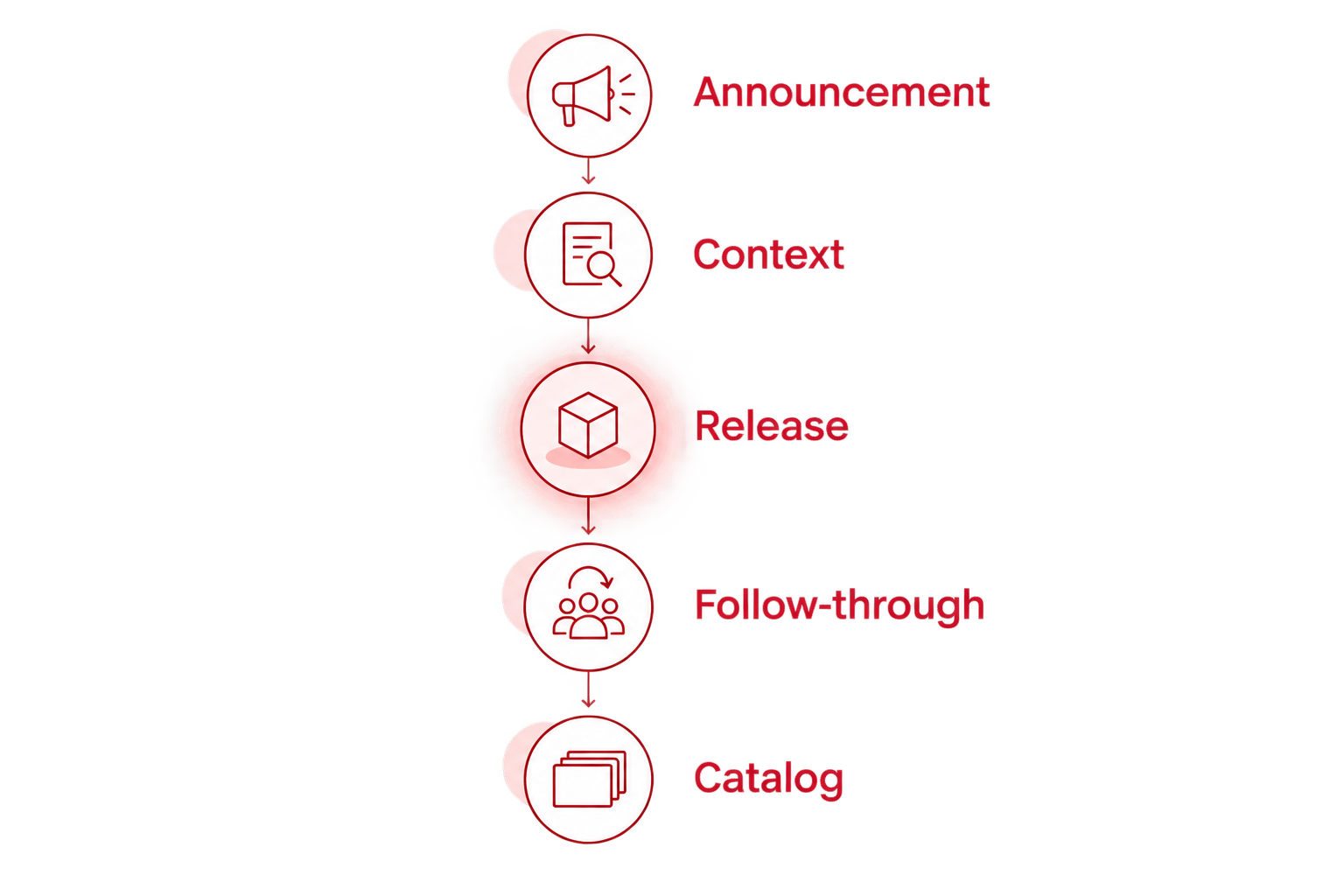
Keep the campaign active after release day with a defined follow-through phase.
For a hypothetical post-punk album, Context might be an artist explaining a recording decision, while Catalog might connect the release to another record on the label. Neither requires pretending the artist is a lifestyle creator. Keep your 2026 calendar tied to confirmed milestones rather than filling empty squares.
Attach each planned post to a phase and a clear audience action.
Mark dependencies, including artwork approval, video delivery, and public announcement permissions.
Reserve space for confirmed coverage, live footage, and useful audience questions.
5. Coordinate social, publicity, and paid promotion
Use a shared release brief to align the publicist, social editor, artist, and advertising operator. A public announcement should not accidentally disclose an exclusive before its agreed publication. Likewise, a paid campaign should not send people toward an unfinished destination.
Handle this manually with an approval sheet and a single campaign owner. Outside support becomes useful when the bottleneck is specialist execution or coordination across releases, not simply because the calendar looks busy. State which responsibilities remain with the label when you hire.
Treat paid promotion as a separate decision with its own objective, creative, destination, and reporting. Do not assume an organic post deserves advertising just because it received reactions. Check whether the message and destination support the release objective.
Record publication permissions and embargo instructions beside the relevant assets.
Identify who can approve advertising creative, spending changes, and campaign pauses.
Check destination links and tracking before distributing or promoting a post.
6. Measure actions without overstating attribution
Create a release-level reporting sheet before launch. Record the objective, publication date, destination, and available results for each campaign component. Use consistent tracking labels so an announcement post and a paid placement do not become indistinguishable in your reports.
Separate platform activity from business outcomes. Views describe exposure within the platform's measurement system; destination visits describe a different action. A store order or mailing-list signup belongs in the report only when you have a valid source for it.
For 2026 reporting, avoid adding unlike metrics into one impressive-looking total. An outbound click is not proof of a stream or a sale. Review results alongside the creative and release context before deciding what to repeat.
Track native attention metrics separately from outbound actions and confirmed conversions.
Label the source, reporting period, and attribution limits beside each result.
Record a specific next decision, such as revising the destination or testing another approved edit.
7. Choose support around the actual bottleneck
List the work your team can reliably own, then identify what keeps slipping. Missing footage calls for production. Unanswered press opportunities call for publicity capacity. A roster-wide approval problem calls for an accountable campaign lead, not more captions.
Ask prospective partners to describe scope, exclusions, approval responsibilities, reporting, and handover. Assess credits by the work performed: a music video demonstrates a video credit, not proof of a successful publicity campaign. Request examples relevant to the responsibility you are hiring for.
If you need coordinated outside support, prepare a project quote request with release dates, assets, decision-makers, and the work you want covered. A usable brief makes the hiring conversation more specific.
Name the bottleneck and the deliverables required to remove it.
Set an approval deadline, revision process, and escalation contact for each workstream.
Confirm who retains account access, source files, and reporting records after the engagement.
Compare social media support options for record labels
Choose the operating model before choosing a supplier. The relevant question is which responsibilities you need covered, not which option produces the longest deliverables list. Each model has a useful role and a clear limitation.
Label-managed workflow
Best for: Labels with internal capacity and a focused release schedule
Practical advantage: Direct control of voice, timing, and approvals
Key limitation: The label owns production, publishing, and reporting workload
Specialist freelancer
Best for: Labels with a defined gap, such as editing or social publishing
Practical advantage: A narrow brief can address a specific execution problem
Key limitation: Cross-discipline coordination needs a separately named owner
In-house social lead
Best for: Labels needing continuous roster-level oversight
Practical advantage: One internal owner can maintain account and approval continuity
Key limitation: Design, video, and publicity remain separate responsibilities unless assigned
Davy
Best for: Labels seeking music marketing and creative production together
Practical advantage: The agency offers marketing, PR, and multiple creative services
Key limitation: You still need an agreed scope and a label-side decision-maker
Do not choose a broader engagement to avoid making internal decisions. Artist positioning, permissions, release priorities, and final approvals still need an accountable owner at the label.
Common mistakes record labels make
Posting identical material across the roster
A shared production system should not produce a shared personality. Keep the workflow consistent, but write artist-specific context and respect the difference between a noise-rock performance clip and an intimate solo recording.
Making the label account a noticeboard
Release announcements alone do not explain your curatorial point of view. Connect records through actual musical, visual, or scene relationships rather than attaching the same genre tags to every signing.
Treating artists as an unlimited content department
An artist's recording, rehearsal, and touring commitments belong in the plan. Agree on what the artist can deliver before promising a recurring format that depends on constant new footage.
Ending the campaign on release day
A release remains part of your catalog after the announcement cycle. Plan follow-through material before launch, including approved performance footage, recording context, and connections to other label releases.
FAQ
What's the best social media strategy for a record label?
A release-led strategy gives each account, asset, and post a defined job. Separate the label's curatorial voice from the artist's personal voice, then measure actions tied to the release objective.
Should a record label manage every artist's social accounts?
Manage artist accounts only when responsibilities, access, voice, and approvals are explicitly agreed. Label promotion does not automatically require taking over an artist's personal channels.
Which social platforms should a record label use in 2026?
Prioritize platforms where you can identify relevant audience activity and publish suitable material consistently. Choose channels from your audience evidence and production capacity rather than opening an account everywhere.
How often should a record label post about a release?
Set posting frequency around release milestones and approved material, not a universal daily quota. Give each post a distinct purpose and avoid repeating the same announcement without new context.
Is music PR the same as social media marketing?
Music PR and social media marketing are different responsibilities. PR focuses on media relationships and editorial opportunities, while social media manages activity on label and artist channels; coordinate both around the same release brief.
When should a record label hire an agency?
Hire an agency when the work requires outside capacity or coordinated specialist services that your team cannot reliably cover. Define the production, publicity, publishing, and reporting responsibilities before selecting a partner.
What should a label include in a social campaign brief?
Include the release, audience, objective, dates, assets, permissions, decision-maker, and required services. State what the label and artist will supply so the proposed scope addresses the actual gap.
One last thing
Before commissioning another batch of clips, open the destination your campaign asks people to visit. Check the release information, playback or purchase path, and mobile experience yourself. A compelling post cannot complete an action that the destination makes difficult.
Then send the next collaborator the brief, not just a folder of assets. That document is where your label's taste becomes an executable release campaign.
